
The Bishop of Southwark spoke in the Kings Speech debate on the topic of global conflict on 15th November 2023, calling for better resources for the Foreign, Commonwealth & Development Office:
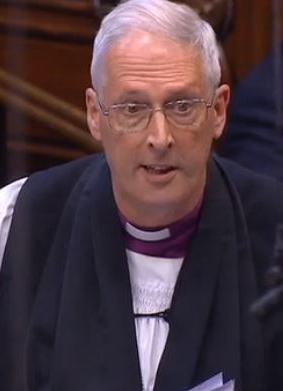
The Lord Bishop of Southwark: My Lords, the gracious Speech set out a number of the key challenges impinging on our security and His Majesty’s Government’s intentions in addressing them. I shall focus to some degree on the fragility of the international order at present.
I suspect that many of us have an underlying anxiety about the future in terms of the potential for conflict and our ability to either forestall or manage it should it arise. However, in the perspective of much of the world we already live in an era of endemic warfare. By one count, there are 110 international or internal armed conflicts under way as I speak. Only North America is free of any armed clash, and even there the United States is facing historic challenges to its democratic norms.
Conflict is, sadly, not new, and it is tempting to say that we must simply embark on the latest round of realpolitik until things settle down. But there is a worrying recent trend to our instability. The fragility of states maintaining themselves in the face of militarism, populism or, in some cases, organised crime, and the instability of the international order itself, have been marked by a failure to maintain common norms of behaviour and the rule of law. Our contemporary treaties and international structures rely on a common acceptance of their value and an inculcation of the sorts of habits and attitudes that naturally support them, especially at times of stress. It is easy to observe international humanitarian law when you have no incentive to do otherwise.
There is nothing that justifies the attacks on Israeli citizens on 7 October, let alone the taking of hostages and the evil nature of those atrocities. But does the difficulty of military operations against Hamas positions in Gaza City allow the Israel Defense Forces to set aside some aspects of international humanitarian law to manage that difficulty? Clearly, it does not. A ceasefire in Gaza is not only to be hoped for but needs to begin now, with extended pauses for humanitarian relief, medical care and supplies, which will alleviate the ever-increasing levels of innocent suffering. I echo the noble Lord, Lord Coaker, in condemning anti-Semitism and Islamophobia.
There are egregious examples around the world in conflicts in Sudan, Ethiopia and Syria, in the Russian invasion of Ukraine and in other places, where aggressors have not only acted with enormous brutality but, in some cases, managed to solicit sympathy from other states. This has been due to disinformation, self-interest and even venality. But it is also because those of us who argue for a rules-based system are seen as benefiting from a global trading system that treats many people unfairly.
We cannot isolate ourselves from this, because many of the communities around the world caught up in conflict are represented in significant numbers in this country. There is a task for us here to model the norms we promote internationally. This means that we should be scrupulous in our international dealings, including our support for the European Convention on Human Rights. We need to address deep-seated issues around climate change and development.
There is now an opportunity, in the light of the Supreme Court judgment on Rwanda today. As the most reverend Primate the Archbishop of Canterbury has said, the Church of England continues to call for the 1951 refugee convention to be built on, through nations around the world working effectively together, so it can meet the challenges we face today, commending a 10-year strategy for tackling the refugee crisis, human trafficking and people smuggling.
But we also need to respect our own institutions. We should promote dialogue with communities here and abroad. In advance of the state visit of the President of South Korea, His Majesty the King visited New Malden the day after delivering the gracious Speech, engaging with the largest Korean community in Europe. On the evening of the gracious Speech, I commissioned Bishop Moses Yoo of the Anglican Church in Korea to be an assistant bishop in the diocese of Southwark, in order to minister to the large Korean community in south London. He was presented to the King the following day.
The focus being given to “global Britain” in our external relations is mirrored in the increasingly global identity of many of the communities of this land, not least the great metropolis of London, and Southwark, where my diocese is located. In his recognition of this, His Majesty the King is setting an example for us all to emulate in our multicultural local contexts. The fruit of this endeavour will be in building social cohesion that reflects the nation we have become.
I ask for a greater effort, in a larger and better-resourced Foreign, Commonwealth and Development Office, to promote an unapologetic rules-based international order—one no longer on the back foot but gaining in strength.
Extracts from the speeches that followed:
The Earl of Dundee (Con): If there is a consensus on the desirability of peace and stability, no doubt all conflicts, not least those now forming part of the daily news, reflect a paradox: not so much that they are happening at all, yet more to the point, they do so alongside an increasing concordat that they should not even be allowed to begin, instead being prevented and eclipsed through the far greater muscular strength of a shared priority agenda, which in the first place and at all times is there to safeguard democracy, human rights and the rule of law. That point was also emphasised by the right reverend Prelate the Bishop of Southwark, the noble Lord, Lord Coaker, and my noble friends Lady Hodgson of Abinger and Lord Vaizey of Didcot.
Lord Ahmad of Wimbledon (Con, Foreign Office): I turn to some of the challenges. I pay tribute to the contributions of the noble Lords, Lord Collins and Lord Purvis, in their summing up and in particular to the noble Lord, Lord Coaker, for his customarily broad introduction. I agreed with much of what he said. It was clear from the noble Lord and from my noble friend Lord Minto’s introduction that there is much in foreign policy and defence where we stand united, rightly, in light of the challenges that we face around the world—as we have done on sanctions with Ukraine—because that is an important element of what defines our incredible United Kingdom.
A personal inspiration of mine has always been Mohandas Mahatma Gandhi-ji, who once said:
“Our ability to reach unity in diversity will be the beauty and the test of our civilisation”.
That applies to us in the United Kingdom as it does to many of the challenges we face. The noble Lord, Lord Coaker, and the right reverend Prelate the Bishop of Southwark talked about the diversity of our country but also, since those abhorrent acts of 7 October, the rising tide of anti-Semitism. The noble Lord, Lord Mann, spoke passionately about this. I listened to all speeches attentively, but I agreed with his passionate plea for all of us to come together and stand in the face of these horrors at home and abroad. We must also face the rising tide of anti-Muslim hatred.
 The Church of England in Parliament
You must be logged in to post a comment.