
On 10th January 2024, the Bishop of Norwich made a speech in support of the introduction of the Biodiversity Gain Site Register (Financial Penalties and Fees) Regulations, which institute a requirement for biodiversity net gain into grants for planning permission:
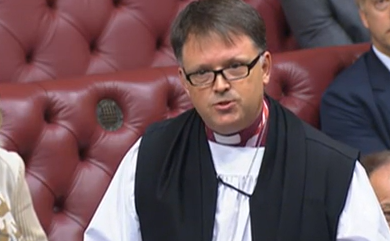
The Lord Bishop of Norwich: My Lords, I welcome the two statutory instruments before us and the Minister’s helpful introduction. I declare an interest as a Church Commissioner and a member of Peers for the Planet.
Having an accurate register of biodiversity gain is of key importance as we move ahead with the Government’s commitment to nature recovery. There is only one parcel of land and it is increasingly being competed for. We eat from it, grow on it, live on it, move across it, build infrastructure over it, make things on it, extract things from under it, drink water that flows over it, breathe the air above it, sequester carbon in it and generate energy on it. The list goes on and on.
But we share our land with rich flora and fauna—biodiversity that we have seen drastically decline in our own lifetimes. Making space for biodiversity to thrive in an integrated way is part of living more harmoniously with ourselves and with each other on the limited space of our island home but also on this single island planet home of ours, which we share with the whole of creation. Does the Minister agree that when biodiversity thrives, people thrive? To be out in nature, to see nature around us, to smell and touch, to hear and taste nature is good—good for our mental health, good for children’s learning, good for communities to live more contentedly together, good for financial returns and sustainability of business and good for rekindling in us a sense of joyous wonder.
I am interested that the ancient word “covenant” appears a number of times in the statutory instruments before your Lordships. The word reminds us that land is a gift but also of the danger that land can become a temptation, not least to exploit, and we forget what it has been and what it could be. “Covenant” reminds us that we are stewards and that land comes with responsibilities. There is a good biblical precedent in the 10% tithe that in these instruments is the target, though I praise those local authorities and developers that, as the noble Baroness mentioned, have increased that target, because I suspect that a collective greater ambition will be needed to reverse biodiversity decline.
What I would really like to see as a result of this secondary legislation is for all involved in land to begin to take a real pride in enhancing biodiversity, halting and reversing the decline in species abundance, reducing extinctions and restoring and creating wildlife-rich habitats. Does the Minister agree that this should become a badge of honour, something that every development strives for, enhancing developers’ brand and reputation and, more than that, doing it because it is the right thing for us all to do?
We must leave our natural world in a better state than we have inherited it and how we have allowed it to decline under our stewardship. I thank the Minister and all the officials involved in bringing these statutory instruments before your Lordships.
Extracts from the speeches that followed:
Baroness Bakewell of Hartington Mandeville (LD): I agree with the comments made by the noble Lord, Lord Deben, on the planning system. I also congratulate the right reverend Prelate the Bishop of Norwich on his thought-provoking contribution. I am reminded of the land use committee I sat on last year, which produced a report about land use across the whole country that the Government, due to a change of Secretary of State, were quite dismissive of.
These SIs are a step in the right direction. There was discussion in the other place on Monday about off-site biodiversity gain, with Minister Pow indicating that the requirement was for a 10% net gain for biodiversity from each eligible grant of planning application. That gain could be delivered through on-site habitat enhancement or creation where possible. Otherwise, it could be delivered through off-site enhancements, purchasing units from the market or, in the last resort, purchasing statutory credits sold by the Government, as the Minister indicated.
Baroness Hayman of Ullock (Lab): My Lords, I thank the Minister for introducing these two instruments, which we very much welcome as they are integral to rolling out the new biodiversity net gain framework and integrating it with the planning system. I intend to discuss them together but, sadly, not as poetically as the right reverend Prelate the Bishop of Norwich did in his comments.
When these regulations were debated in the other place, a number of concerns were raised about how the new framework would operate in practice; the noble Lord, Lord Deben, talked about this as well. These included concerns regarding local planning authorities. Some of the questions raised were not completely addressed, so I will come back to some of these; I also have a few other questions.
The noble Baroness, Lady Bakewell of Hardington Mandeville, talked about ecology officers. One thing that was raised by my colleague in the other place, Barry Gardiner MP, was a statistic that only a third of local authorities have an ecological officer. This was not addressed by the Minister in her response in the other place, so can the Minister confirm whether this is the case? If it is correct, how will the Government address the shortfall and support local authorities? If the Minister is unaware of it, he could write to me as it would be interesting to know whether that figure is correct.
Lord Benyon (Con, DEFRA): The right reverend Prelate the Bishop of Norwich speaks with great knowledge—I heard his outstanding maiden speech in this House. He is an ecologist, and I would say that his erstwhile career is now a growth industry, which answers some of the points he made. I do not know the exact number of local authorities that employ their own ecologists; I am very happy to seek that out and to write to noble Lords. It is a growth industry, because developers and local authorities are going to need them. There are a great many local authorities that use a contractual arrangement, and so do not employ them directly, but many still do.
The right reverend Prelate also made a very important point: biodiversity is not just about bugs, bees, animals and flowers; it is about humanity as well. The Dasgupta review—which I think is one of the great reports—was commissioned by the Treasury, and the first time anywhere in the world that a piece of work on biodiversity has been commissioned by a finance department. It makes very clear the economic importance of restoring biodiversity. As somebody once said: we are not free- holders; we are the tenants on this planet, with a full repairing lease. That was Margaret Thatcher. The question of stewardship which she raised is absolutely vital. It is an old-fashioned word with a very relevant meaning. If we want to hand on this planet and the environment in a better condition than we found them, we need to re-understand what stewardship really means.
 The Church of England in Parliament
You must be logged in to post a comment.