
The Bishop of Norwich spoke in a debate on closure of high street banks and the need for a national network of banking hubs on 25th January 2024, raising the impact of bank closures on those in rural areas and market towns:
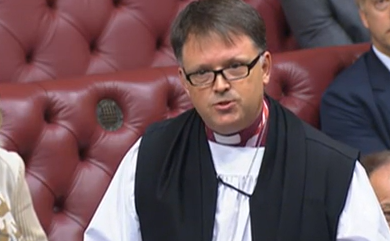
The Lord Bishop of Norwich: My Lords, I am grateful to the noble Baroness, Lady Tyler of Enfield, for this timely debate. I will speak particularly about rural areas and market towns.
The diocese I serve across Norfolk and Waveney is largely a rural one, but it is one where market towns play a key part in peoples’ lives. Historically places of transaction, they contribute to the warp and weft of community life, especially with their rural hinterland. It is no accident that, in Norfolk, they are fairly evenly spread out across the county, having developed so that livestock could be driven to them for sale and the bonds of extended familial friendship and trust strengthened.
From my internet searching, I estimate that we lost at least 12 bank branches in Norfolk last year. The market town of Wymondham saw the closure of NatWest, HSBC and Barclays within 12 months. The parish church’s treasurer now has a 26-mile round trip to bank the cash collection and cheques. Banks are vital for small rural businesses and charities that deal with cash. Yet, as we have heard, closures are accelerating, and this seems to be a pattern across the UK.
The sad reality is that the withdrawal of banks from market towns has disadvantaged sections of our community, especially those who want to speak to a human and not a robot, those for whom trust is a hard-won necessity, those with sensitive things to discuss and that group of people who are not savvy with the internet or have poor connectivity and so are digitally disfranchised. The negative impact on financial inclusion of closures needs to be borne in mind.
It is good that LINK, the cash machine network, and Cash Access UK have recognised the difficulty of accessing banks in rural communities and market towns and that the whole idea of banking hubs is coming to the fore. As we have heard, there are 31 of them: 21 in England, seven in Scotland, two in Wales and one in County Down in Northern Ireland, mentioned by the noble Lord, Lord Rogan. Their role is, sadly, lagging behind the rate of bank closures. The gaps are there, and I hear that it takes some time to establish a banking hub, so I very much warm to the suggestion from the noble Baroness, Lady Tyler, that the last branch in town should not close until a banking hub is ready to go, for many people are in great need of reasonable access to cash deposit and withdrawal services.
In the Norfolk rural district of Breckland, there have been eight bank closures since 2018, with a further two announced for the coming months. That is a drop of nearly 60% in the number of local banks. In the market town of Watton, no bank remains. The newly opened community banking hub is a welcome addition, following the closure of all the town’s banks in recent years, and its services are proving popular. It is open five days a week, with a counter service operated by the Post Office where customers of all major banks can carry out their regular cash transactions, but it also offers this banking hub, a community banker service where customers can talk to their own bank about more complicated issues. The community bankers work on rotation, with a different bank available on each day of the week. NatWest, HSBC and Barclays each take one day, so, in a sense, this is an invitation for other banks to take up the other two days. The local vicar, Dave Cossey, tells me that the only drawback he has discovered so far is that the banking hub will not accept partially full bags of cash. This is proving to be a challenge for small charities, and it would be great if that blockage could be removed.
In other places where banking is not in people’s DNA—especially, perhaps, in our economically poorest communities—credit unions bring much. Often run by volunteers, they can help people save cash and receive small, affordable loans. I have two questions for the Minister. What is the Government’s strategy for rolling out more banking hubs and how will government support be given to local authorities, to LINK and to Cash Access UK to enable this to happen? Secondly, I think credit unions have a great part to play. What plans do the Government have to aid their development, particularly in rural areas and our market towns?
Extracts from the speeches that followed:
Lord Hacking (Lab): I adopt everything that the noble Baroness, Lady Tyler, has said to us and everything that the noble Lord, Lord Rogan, and the right reverend Prelate the Bishop of Norwich have said. I therefore do not need travel over that ground again. I will just mention one thing. I am in the age group of those particularly affected by bank closures. I am in my mid-80s and therefore I have sympathy—although, luckily, I have been taught about internet banking and so know a few things about that.
I will go straight to an important example—the closure of the NatWest bank in Ryde on the Isle of Wight a few months ago. Ryde is a town of 100,000 or more and for the purposes of getting cash, you now have to walk all the way down the very steep high street to Sainsbury’s, which has a cash machine. However, it is not only people of my age who have difficulty and need personal banking. I will give a solid example. I have a son who is very badly disabled and who until recently was living in Peru. His only source of support is the financial support that the family can give him. My son-in-law is the treasurer of the trust to supply money. It is not easy to convey money in the banking system from here to Peru, and there were occasions when it was not coming through—well, that was the information we were given. I am very well within time; there will be plenty of time for the Minister to reply. Let me just finish this account, because it should be recorded. It was essential for my son-in-law to go personally to the NatWest bank in Ryde to sort out this problem. It would have been so difficult and cumbersome to do it online.
Baroness Vere of Norbiton (Con, Treasury): Of course, banking hubs can go more broadly than the services offered by the Post Office. Banking hubs are a very exciting development. They are quite a new development. They help businesses and people withdraw cash, make deposits, pay in cheques and check their balances, but they may also have a community banker who can help people with more complicated matters that require specialist knowledge or privacy or when somebody wants to have a face-to-face meeting with a banker. These hubs are deployed in response to a bank announcing a branch closure or a community making a cash access assessment request. Where LINK has assessed a community’s cash access needs and concluded that a banking hub is the most appropriate option, that is done as quickly as possible.
I note the comments by the noble Baroness, Lady Tyler, which were echoed by many others noble Lords, including the right reverend Prelate the Bishop of Norwich. I reassure her that to ensure that there is no gap in the provision of services, the industry has committed that when a hub is recommended, a branch will not be closed until a hub is open. I think that will be welcome news to the House today.
Cash Access UK, the provider of banking hubs, has opened more than 30 banking hubs so far and I expect this to rise to about 50 by Easter. I agree that the speed of the rollout has potentially been too slow, but this is a relatively new intervention and the processes are now in place. I echo the comments of the noble Lord, Lord Rogan, in welcoming the work of Cash Access UK. We support it and are in regular contact with it. I am pleased to report that it tells us that it expects the pace of delivery of banking hubs to continue to improve over this year.
 The Church of England in Parliament
You must be logged in to post a comment.