
On 25th January 2024, the Bishop of Norwich spoke in a debate on sustainable farming, welcoming the sustainable farming incentive scheme and calling for a new regulatory framework around nature protection:
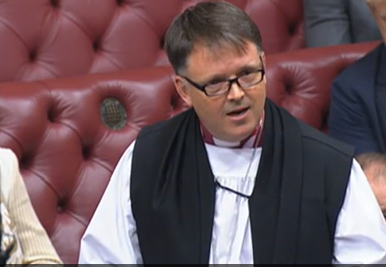
The Lord Bishop of Norwich: My Lords, it is a pleasure to follow a fellow tree planter, the noble Lord, Lord Robathan. I give a tree to every person I confirm as a sign of the care of God’s creation. I am grateful to the noble Earl, Lord Caithness, for securing this debate. I declare an interest as a member of Peers for the Planet and as a Church Commissioner.
Landowners and conservationists with whom I have spoken have broadly welcomed the changes to the sustainable farming incentive, not only the increased payment rates, which make uptake more attractive, but the new areas of action, the increased flexibility and the promise of a simpler, clearer and faster application service. Let us hope it does what is says on the new, streamlined tin. This better-rounded and more holistic agri-environmental scheme in England will undoubtedly see a greater uptake across all agricultural sectors. The tools are certainly in place to help deliver both sustainable food production and nature recovery.
In particular, I welcome the new emphasis on soil health. Being under our feet, we too often forget it, but soil is perhaps our greatest natural asset and the key to so much nature recovery. I am glad that the noble Baroness, Lady Bennett of Manor Castle, shares my enthusiasm for soil. Healthy soil supports a range of environmental, economic and societal benefits. These include food production, climate change mitigation and increased biodiversity. These vital soil functions are at risk from poor soil management or inappropriate land use, leading to soil degradation, soil compaction and soil erosion from wind and water. Ecological breakdown of our soils together with climate change are perhaps the primary threats to food security.
Of course, any change to a scheme, or the start of any new scheme, needs the test of unintended consequences, and I see three risks that I would be grateful if the Minister could address. First, I am conscious of the acknowledgment from the noble Earl, Lord Caithness, of the incredible commitment of farmers and the added stresses and challenges of new schemes. With the increased options that are now available through a single application process, will farmers be supported in the uptakes of those applications and given the right advice and support? Can the Minister say what advice and support will be given to applicants, particularly so that this public funding secures the most value and delivers effective environmental outcomes? We do not want to find, in future years, that we have been paying for suboptimal or even perverse outcomes for nature.
Secondly, it is critically important that farmers, once in ELMS, are taken on a journey of increasing ambition for nature. There is a risk that farmers remain on sustainable farming incentives, the lowest level of ELMS, and pick the low-ambition, free-choice, well-funded options that align with their existing farming actions. This will not deliver the widescale change in farming activity needed to restore declining wildlife populations. If we are to progress towards the targets in the Environment Act, we need a more joined-up nature landscape, with wildlife corridors, acknowledgement of the impact of edge effects and some clear understanding of which species we want to protect, recover or thrive. If we want to continue to hear the magnificent call of lapwings, curlews or corncrakes, clear strategies need to be developed across whole landscapes. Yet in all this, there is a risk that high-quality, high-yielding land will be taken out of food production in favour of higher payments for environmental goods. Can the Minister say how the correct balance can be struck that benefits these various competing areas, so that we can maximise both food security and nature recovery?
Finally, ELMS is just one side of the coin when it comes to nature and farming. Funding to encourage nature-positive farming needs to be underpinned by the right level of regulatory baselining to prohibit actions that cause the most damage to nature. However, the announcement by the Government said almost nothing about regulation, other than to review the relationship between Natural England, the Environment Agency and farmers and landowners. This is at a time when EU regulatory legislation protecting hedgerows, soils and watercourses came to an end on 31 December last year. This cross-compliance has now dropped out of UK law, leaving regulatory gaps in these areas. We urgently need a new regulatory framework, starting perhaps with the swift progression of the replacement hedgerow protection proposals that were consulted on last summer; they have yet to be replaced. My final ask of the Minister is for a firm commitment that protections for nature will, at the very least, be maintained this year at the same level as the old regulations.
Extracts from the speeches that followed:
Baroness Bakewell of Hartington Mandeville (LD): This is not about creating a chocolate box vision of a bygone era. Diversity of species benefits so much more than the simple flora and fauna of a field. We are now recognising the importance of multispecies pastures as reservoirs of beneficial predators. The technical term biological pest control, which is standard practice today in more than half of our horticulture production, is, at its heart, little more than the eradication of pest, disease or weed populations by a natural predator, whose population can be encouraged by a richer tapestry of habitats for food production and environment. I am afraid that I see little in the Secretary of State’s announcements in this area.
The NFU has always supported sustainable food production alongside environmental work, provided that domestic food production levels are at least maintained, but the impact of this updated SFI is not clear. For arable farmers, some of the best-paying options are where they take land out of production—the right reverend Prelate the Bishop of Norwich referred to this.
Baroness Hayman of Ullock (Lab): Although we are pleased to see that the changes are largely positive for nature, including the expanded set of actions, the average 10% uplift in payments, increased payment frequency and a commitment to double the number of agreements for more complex and targeted environmental land management, still more needs to be done. The changes will expand the contribution that farmed landscapes make to achieving our nature recovery targets in the Environment Act. However, as the right reverend Prelate the Bishop of Norwich and the noble Baroness, Lady Bennett, asked, how are we going to use this to dramatically increase our soil health? That is critical if we are to make real progress.
I should say that I thought it wonderful that the right reverend Prelate hands out trees at confirmations. That is fabulous. I shall talk to our church about doing the same.
It remains to be seen whether the incentives we now have will result in the right level of action at the required scale. Can incentives alone achieve this? If they cannot, there is a real risk that Defra could miss what are pretty ambitious goals.
(…)
Finally, I come to the important point made by the right reverend Prelate the Bishop of Norwich about farmers needing improved support and advice services. The transition from BPS to ELMS is significant and farmers need to be fully supported through this transition. The current advice service, the Farming Resilience Fund, is due to end next year. Can the Minister explain what will replace it?
Lord Douglas-Miller (Con, DEFRA): The second part of ELMS, Countryside Stewardship, pays for locally targeted actions relating to the creation of specific habitats and the management of some species. I reassure the right reverend Prelate the Bishop of Norwich: Countryside Stewardship schemes have helped to maintain and restore more than 10,000 kilometres of existing hedgerows and to plant an additional 4,000 kilometres across the country.
(…)
Turning to future plans, I hope to reassure my noble friend and others in the House that, as part of the rolling review process, we will continue to explore whether to include additional species management actions within our schemes. This will involve working closely with stakeholders and farmers to understand specific issues as they emerge. It will keep our offers, including payments, up to date and allow us to respond to farmer feedback and changing scientific evidence to maintain progress towards achieving our biodiversity goals.
The noble Baroness, Lady Hayman, the right reverend Prelate the Bishop of Norwich and the noble Baroness, Lady Bennett, raised questions about soil. I emphasise that healthy soil, abundant pollinators and clean water are the foundations of our food security; I am sure that they would agree with me on that. The SFI pays farmers to improve and conserve their soils and provide flower-rich habitats for pollinators and other beneficial invertebrates. These actions support the delivery of our environmental objectives; they also benefit food production, by reducing farmers’ reliance on costly artificial inputs.
 The Church of England in Parliament
You must be logged in to post a comment.