
On 29th January 2024, the Bishop of London spoke in a debate on the Safety of Rwanda (Asylum & Immigration) Bill, pointing out the inconsistency of the bill’s approach to international law, and the potential harm of disapplying parts of the human rights act to refugees and asylum seekers:
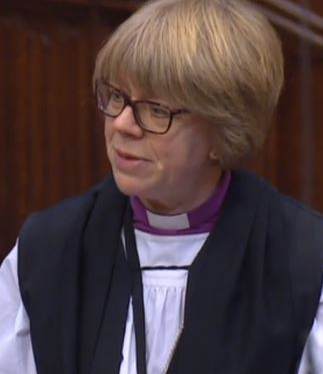
The Lord Bishop of London: My Lords, I share many concerns about the Bill that have been expressed by many other noble Lords, but I will focus on human rights. What underpins my contribution to the House is a fundamental belief that all people are made in the image of God. It is a belief that is the foundation not just of the Christian faith but of many other faiths and religions. People have an inherent immeasurable value and deserve dignity and respect. In the Bill, unfortunately, the value of people is consistently maligned. For example, the Bill decides who is and is not entitled to human rights. Has history not taught us the risk of that?
It is an odd situation that we find ourselves in when it feels necessary to state in your Lordships’ House that the Government should obey the law, yet the Minister has stated on the face of the Bill that he is unable to say that the measures within it are compatible with the European Convention on Human Rights. Clause 3 disapplies sections of our Human Rights Act and Clause 1(6) lists great swathes of international law that will be contravened to pass the Bill. As many noble Lords have said, it is illogical that the Government are disregarding international law while relying on Rwanda’s compliance with it to assure us it is safe. That is not a mark of global leadership.
Clause 5(2) states that compliance with interim measures made by the European Court of Human Rights will be decided by a Minister of the Crown. Disregarding these orders will cause legal uncertainty, with a profound impact on how we expect others to abide by international law. We have a respected place on the world stage, with very few injunctions in comparison to other European countries, because human rights legislation is so well embedded in our law. As a number of noble Lords have said, the Bill marks a change. We cannot afford to forfeit our place in the international community in the face of the significant global challenges that must urgently be navigated. Global conflict remains a serious issue, and we must not lose our focus or our leadership on it.
Passing the Bill will mean that other countries will be tentative in reaching forward to us on other international agreements. In addition, it is troubling that the vulnerable are not being protected in the Bill, with no exceptions made for victims of trafficking or children who either are in families or are suspected to be adults. The right reverend Prelates the Bishop of Chelmsford and the Bishop of Bristol are not able to be in their places today but hope to explore amendments to further protect these vulnerable groups, to which I hope the Government will give due consideration.
The Bill disapplies parts of the Human Rights Act with respect to asylum seekers, and the Government are doing the same in respect of certain prisoners in other legislation before this House. This is a slippery slope. Making a minority group unprotected from the actions of the Government undermines everyone’s collective access to justice.
If our courts find that this legislation is indeed incompatible with rights under the ECHR and issue a declaration pursuant to Section 4 of the Human Rights Act, will the Minister confirm that the Government will make a Statement to Parliament and bring forward regulations to remedy the incompatibility?
I underline that my overriding concern is that in this legislation we are deciding to whom human rights apply and to whom they do not. Again I say: has history not taught us the risk of that? I hope the Government will consider that question before proceeding any further. As the House has heard, we on these Benches will continue to engage with the Bill to develop better legislation that will recognise the value of each human being.
The House may not be surprised to hear that I also support the most reverend Primate in his call for a long-term strategy for immigration that is cross-government and worked out with our international partners.
Extracts from the speeches that followed:
Lord Murray of Blidworth (Con): In the brief time available to me, I shall focus on two matters that have been the subject of much misperception in your Lordships’ House. The first is the effect of the Section 19(1)(b) statement on the face of the Bill. As a person who has previously signed such a statement, I have carefully considered its significance. Contrary to a common misunderstanding among opponents of the Bill in your Lordships’ House and the other place, and as we have just heard from the right reverend Prelate the Bishop of London, the statement does not mean that the Minister is certifying that the measures in the Bill are incompatible with the human rights convention. Following a practice introduced under the last Labour Administration, a Minister will not make a Section 19(1)(a) statement of compatibility unless they are satisfied that, if there was a legal challenge to the new law or a decision taken under it, there is a greater than 50% probability that the court will find the measure to be compliant with the convention commitments of the United Kingdom. In all other circumstances, the Minister will issue a Section 19(l)(b) statement. That is what has happened here.
Therefore, the placing of a declaration of this kind on the front of the Bill cannot, and must not, be characterised as a statement that the Government believe that the measures in the Bill are incompatible with the UK’s convention commitments. The point is that in making such a declaration the Government do not concede any breach of the convention, and indeed there is every prospect that the Government will prevail in any litigation, as occurred in the 2013 Animal Defenders case, which upheld the compatibility of a provision in the Communications Act 2003 that had, when before Parliament, been accompanied by a Section 19(1)(b) statement.
Baroness Fairhead (CB): The Bar Council of England and Wales commented:
“There is an obvious difference between a country that is in fact safe, and one that is not safe but is deemed to be safe. The United Kingdom’s obligation under international law is to ensure that asylum seekers are only ever sent to countries that are actually safe”.
The Bill does not respect the rule of law, including the separation of powers, as clearly articulated by the noble Earl, Lord Kinnoull, and it breaches our obligations under international law. The great irony, as the right reverend Prelate the Bishop of London stated, is that the Bill is proposing that the UK breaches its international obligations but insists that Rwanda meet its own.
Baroness Lister of Burtersett (Lab): Today, I will focus on Clause 3’s disapplication of the interpretive and remedial provisions of the Human Rights Act, in part because of this clause’s contribution to the Bill’s incompatibility with our international obligations, as advised by the UNHCR, with implications for the Good Friday agreement, as the Northern Ireland Human Rights Commission points out in its very critical advice on the Bill, and because of what it means for human rights and for how asylum seekers are seen and treated. Here I echo some of the points made by the right reverend Prelates the Bishop of London and the Bishop of Durham.
A briefing paper from the chair of the Joint Committee on Human Rights warns of the significance of disapplication:
“Human rights are meant to offer a fundamental level of protection for every person on the basis of their humanity alone. As … noted in a previous report, if those protections are disapplied when they cause problems for a policy goal they lose the fundamental and universal quality that characterises them. This is arguably particularly the case when they are disapplied in respect of a particular group”.
While the Government are beginning to make a habit of disapplication to marginalised and unpopular groups, as has just been said, the briefing points out that the disapplication of Section 6, which places
“the obligation on public authorities to act compatibly with human rights, has never before been attempted and represents a significant inroad into human rights protections”.
These concerns are echoed in numerous briefings, including from the EHRC, the Law Society and Amnesty.
Let us stop and think what this breach of the universality of human rights means. In effect, it is saying that asylum seekers are to be treated as less than human—as, to quote the noble Lord, Lord Singh of Wimbledon,
“a lesser form of life”.—[Official Report, 4/12/23; col. 1276.]
Their humanity is not worthy of human rights protection.
Lord Sharpe of Epsom (Con, Home Office): The right reverend Prelate the Bishop of London and the noble Lord, Lord Blunkett, asked what support will be available for those who are particularly vulnerable. Rwandan officials will have due regard to the psychological and physical signs of vulnerability of all relocated persons at any stage of the application and integration process. Screening interviews to identify vulnerabilities will be conducted by protection officers in Rwanda who have received the relevant training and are equipped to handle competently safeguarding referrals. Interpreters will be available as required to ensure that relocated individuals can make their needs known. All interviews will be conducted with sensitivity for the individual’s well-being.
The Government of Rwanda have processes in place to safeguard relocated individuals with a range of vulnerabilities, including those concerning mental health, gender-based violence and addiction. All relocated individuals will receive appropriate protection and assistance according to their needs, including referral to specialist services, as appropriate, to protect their welfare.
Article 13 of the treaty makes specific provision that Rwanda will have regard to information provided about a relocated individual relating to any special needs that may arise as a result of their being a victim of modern slavery or human trafficking and shall take all necessary steps to ensure that these needs are accommodated.
(…)
The Bill allows decision-makers and the courts to consider claims that Rwanda is unsafe for a person due to their particular individual circumstances, as we have discussed. As the right reverend Prelate the Bishop of London noted, the Bill does not disapply Section 4 on declaration of incompatibility, as this is the only substantive remedy against the conclusive presumption that Rwanda is safe. Retaining DOIs allows the courts to respond to changing circumstances and for this question to be brought back for parliamentary consideration. Of course, the final say on the matter will remain with Parliament and the Government because Section 4(6) of the Human Rights Act makes it clear that a declaration cannot affect the operation or validity of domestic legislation.
 The Church of England in Parliament
You must be logged in to post a comment.