
On 12th February 2024, the House of Lords debated the Safety of Rwanda (Asylum and Immigration) Bill in committee. The Bishop of Southwark spoke in support of an amendment to the bill tabled by Baroness Chakrabarti which would ‘add the purpose of compliance with the rule of law to that of deterrence,’ pointing out the dissonance between the bill’s intention of replacing the Supreme Court’s judgement on the safety of Rwanda and the actual situation in the country for vulnerable asylum seekers sent there:
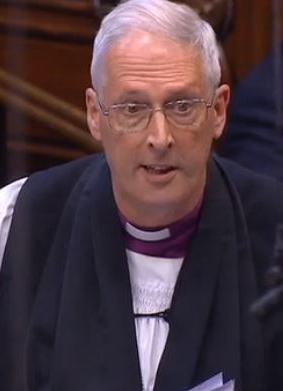
The Lord Bishop of Southwark: My Lords, I support Amendment 1, tabled by the noble Baroness, Lady Chakrabarti, the noble and learned Baroness, Lady Hale of Richmond, and the most reverend Primate the Archbishop of Canterbury, and Amendments 2, 5 and 34, tabled by the same noble Lords and the noble Viscount, Lord Hailsham. I also offer supportive comments on Amendment 7 to Clause 1, tabled by the noble Viscount, the noble Baroness, Lady Chakrabarti, and the right reverend Prelate the Bishop of Manchester. The most reverend Primate is present but cannot attend the entirety of this debate and the right reverend Prelate cannot be with us this afternoon.
It will be a very slight augmentation of the wisdom of this House to know that we on these Benches do not favour the outsourcing of asylum claims to other countries or territories—which is rather different from what the noble Lord, Lord Howard, was saying about the outsourcing of power. We recognise, however, that the courts have deemed this lawful in certain circumstances and that we have a Bill from the other place which is designed to deal with a particular designation that the Supreme Court deemed to fall outside our obligations under the law.
I accept that the recent treaty between His Majesty’s Government and the Republic of Rwanda makes legally binding, with additional enhancements, the 2022 memorandum of understanding between the two Governments—for example, the commitment under the new asylum procedure that no person relocated to Rwanda under the treaty will be sent to any country other than the UK, if the UK so requests. However, as the House knows, the International Agreements Committee of this House recommends not ratifying until further evidence is available.
None the less, there remain very significant concerns about the contents of the Bill, not least about using legislation to make a declaration of fact in order to correct a court that has heard evidence. It is clear that the Government have gone to a great deal of effort to provide evidence to persuade critics of the feasibility of removal to Rwanda as a safe and properly functioning process while at the same time trying to satisfy their policy aim, and critics of a different stamp, that the limited capacity of the scheme will be a deterrent to those who make long and dangerous journeys to cross the channel.
The purpose of these amendments is to match the Bill more closely to the requirements of the Supreme Court judgment, so that it is more just and less open to challenge. For the sake of the people whose lives will be affected by yet more upheaval, who as it stands will not even have the opportunity to have their claim heard in this country, we cannot afford to get this wrong. Courts and tribunals must be able to make a judgment about the safety of Rwanda based on a consideration of the facts. We are not primarily discussing the suitability of Rwanda; we are discussing its safety for people who, by definition, have highly complex lives and circumstances.
The treaty introduces safeguards and checks, as it should, but these are not yet in force. I share the view that more is needed. The United Nations High Commissioner for Refugees, an agency the Government have worked with in a highly effective way over many years, should provide that positive judgment of safety. Until then, the Government are taking an unreasonable risk by sending anyone to Rwanda.
These amendments offer practical steps which strike the kind of balance we are wise to pursue in this revising Chamber. They do not wreck the Bill, nor remove the objective of deterrence from it—and we can debate in due course the degree of inhibition that brings to the process. Rather, these amendments would provide an adequate mechanism for addressing concerns about the UK’s compliance with international law, and, appropriately, given the name of the Bill, the safety of Rwanda as a destination for the processing of asylum claims intended originally for the UK. These amendments are important for the preservation of judicial oversight and for the maintenance of the separation of powers, which is a fundamental component of our constitution. It is for Parliament to make laws and it is for the judiciary to judge cases, including the lawfulness of government decisions, and to make findings grounded on the basis of evidence.
Amendment 7 seeks to make it plain that the Bill replaces the Supreme Court’s finding of fact. A Bill cannot change the actual situation on the ground in another country; it can only mandate that evidence to the contrary is disregarded. We have a duty of care in international law towards asylum seekers who arrive in this country. Legislating that Rwanda is a safe country does not necessarily make it so for the potentially vulnerable people who might be sent there. However, the Bill’s primary purpose is to disregard the UK’s own Supreme Court’s finding that Rwanda is not a safe country for asylum seekers.
Let us be clear what we are doing. The Law Society has said, unequivocally, that it is inappropriate for the Government to undermine the judiciary in this way and that the Bill threatens the balance of powers in the United Kingdom. The amendment would put in the Bill that a judicial finding of fact is being replaced. I hope that we give these amendments a fair wind.
Extracts from the speeches that followed:
Lord Alton of Liverpool (CB): The right reverend Prelate the Bishop of Southwark got to the heart of this when he said that legislating that Rwanda is safe does not make it so. The noble and learned Lord, Lord Falconer of Thoroton, touched on that point. Just saying an apple is a pear does not make it such. Saying that a dog is a cat does not make it such. It may be your opinion, but it is not true—and that is surely what we have a duty to try to do in this place.
On process, procedure and governance, during our debates on the Illegal Migration Bill and the treaty, I complained that we had not been treated properly as a Select Committee in the way you would expect Select Committees to be treated. Suella Braverman, the then Home Secretary, declined to appear before the Select Committee. We did not see James Cleverly in the context of this Bill. However, we did see the Lord Chancellor, Alex Chalk, and I pay tribute to him for the way he delivered his evidence and took the questions we put to him. As the noble and learned Lord has just said, it is the duty of the Home Secretary of the day to explain the intentions of legislation. If there is anxiety about something as important as a compatibility statement, they should explain why they feel unable to give it.
Lord Green of Deddington (CB): My Lords, this has been a long debate and I shall therefore be extremely brief. The right reverend Prelate the Bishop of Southwark spoke powerfully, as have many extremely well-qualified lawyers, so I will not talk about the law. I found myself very much in agreement with the noble Lord, Lord Howard of Lympne. He put important points that I hope will be reflected later in our debates.
We also need to take account of what one might call the real world. I am glad to see that the Opposition Front Bench is being cautious at this point; perhaps that is one of the reasons. The reality is that the Government have lost control of our borders, and even the backlog of asylum seekers is enough to fill the largest stadium in the UK. I regret to say that there is deep public anger, but there is, and we have to take it into account—I am sure that the Commons will—when we take this forward. It is therefore for the Government to take action to bring all this under control and for us to give some advice as to how that could best be done. But let us not lose sight of the fact that this is a very difficult and widely resented situation, and we need to be careful ourselves.
Lord Coaker (Lab): We support the thrust of Amendments 3 and 7, as did many noble Lords, including the noble Lords, Lord Anderson, Lord Hannay and Lord Kerr, the noble and learned Lord, Lord Garnier, the right reverend Prelate the Bishop of Southwark and my noble friend Lady Chakrabarti—I will come back to her lead amendment in a moment—because they go to the heart of the Bill. Clause 1(2)(b) replaces a judicial finding of fact with Parliament simply declaring that Rwanda is safe, irrespective of the Supreme Court judgment. I will not go into the legal niceties we have heard, but it seems remarkable to me that Parliament should make a judgment that the court has got it wrong and just change it without reference to the court.
There is a missing word in that paragraph which gives great credibility to many of the contributions made this afternoon:
“this Act gives effect to the judgement of Parliament that the Republic of Rwanda is a safe country”.
As many noble Lords and the committees that have reported on this Bill have said, this paragraph says that Rwanda is safe now, not that it will become safe. The Supreme Court said that that is the point of difference between them. It has not said that the Government cannot act in this way—I would have thought they would be pleased and say, “Look, the Supreme Court says that what we’re doing conforms with international law”—but that they cannot say that Rwanda is safe now. The Government are saying: “Don’t worry about that; we’ll just pass a law saying that it is”. That is the point of conflict, as it flies in the face of the Supreme Court, the International Agreements Committee and many others.
Baroness Chakrabarti (Lab): I am also very grateful to the right reverend Prelate the Bishop of Southwark for speaking on behalf of his Benches. He reminded us of our duty of care to refugees. Like me, he and the Church are uncomfortable with offshoring at all. None the less, they are engaging with the process—not a wrecking process but a constitutional compromise.
 The Church of England in Parliament
You must be logged in to post a comment.