
The Bishop of Winchester spoke in a debate on the second reading of the Schools (Mental Health Professionals) Bill on 1st March 2024, pointing out the need for a consistent, universally applied policy to improve student mental health, and the need to address the causes of mental health issues at a root level:
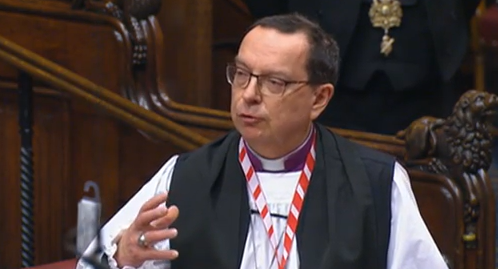
The Lord Bishop of Winchester: My Lords, I am grateful to the noble Baroness for bringing this Bill to us for its Second Reading. We indeed face a crisis in this area and need to be aware of the long-term consequences of not addressing it.
The Bill would pave the way for just the kinds of interventions that are sorely needed. The NSPCC and our own Library briefing state that more than 20% of children and young people are living with poor mental health. CAMHS referrals are provided for only the most severe presenting issues, while early intervention, though widely recognised to be key to good long-term outcomes, is now a thing of distant memory. The sobering fact is that children are taking their own lives while they wait to be seen, and that is deeply shameful.
Last summer, the Church of England published the document Our Hope for a Flourishing Schools System, which makes specific mention of mental health, it being the issue school leaders most often raise with us. It states:
“Children’s mental health and wellbeing is prioritised and resourced generously by a society that invests in the long-term future of its nation by placing children first in funding and political direction. The fulfilling of a child’s potential should never be hindered, blocked or prevented by the system in which they find themselves”.
However, those words are, sadly, far from being the current reality.
There is, of course, much good practice out there. In my own diocese, Abbotts Ann Primary School has a group of “gardening grannies”, who have helped the children plant and maintain their own veg patch. Milford uses its “beach school” activities to engage pupils with beach art and games, to help them feel better connected to the natural world. St Katherine’s in Bournemouth has “head, heart, hands” time every Friday, to promote mental, spiritual, emotional and physical health. St James’ school in Pokesdown has just rethought pupils’ mental and emotional health, with several designated rooms where children can receive extra support—in the sunshine room, the rainbow room and the harbour.
There are many other excellent examples I could cite, but, excellent as they are, they are not a substitute for policy consistently applied. Schools need specific training in children’s mental health and on its impact on pupils’ behaviour, their attendance and their ability to access learning. This should be for all staff, not just for one individual, as all staff have contact with pupils. Schools also need access to specialist expert support to support and manage children’s mental health in their own settings. This is critical, since access to CAMHS has become so limited over recent years. Schools should not have to find the funding for this from their own budgets.
The intersectionality of mental health with poverty, those involved with social care and other disadvantaged groups must also be considered, since pupils are much more likely to be excluded or refused schooling the more disadvantaged they are. I chair the ChurchWorks Commission, and it is no surprise that our three priorities are vulnerable children and families, tackling poverty, and mental health and well-being. This issue sits at the intersection of all three. According to the Church of England’s toolkit on UKME mental health, a disproportionately large number of people from a GMH background will come into contact with mental health professionals not through the NHS or education system but through the criminal justice system. School and government policy needs to recognise all of the above, and not negatively disadvantage pupils who struggle because of their mental health, leading to yet more severe issues and, ultimately, to disengagement from education.
More broadly, we must recognise that the quality of education matters much more than standards in education. I welcome the fresh approach of Ofsted to include mental health training for its inspectors, but it is tragic that it took the death of a dedicated head teacher to precipitate that. Quality must always trump standards, for without high quality you will not have high standards. Specifically, a narrow focus on attendance statistics might be positively counterproductive. Poor attendance needs addressing by prevention, via high-quality, value-rich education, rather than by simply penalising non-attenders, because poor mental health is the main reason that children—especially those with special needs and disabilities—give for failing to attend. So investing more broadly in mental health via holistic person-centred education would effectively address the Government’s narrower focus on attendance.
In closing, I will set this in an even broader context: we must look at causes. There are abundant reasons why young people today might suffer from poor mental health. The world in which they are growing up is an increasingly dark place. They live with the growing threat of climate change and against a background of the rise of aggressive, dominant and domineering global powers. Is it any wonder that they face the future with anxiety? We may feel that we have little agency in the face of such pressures, but we have much more than the children of whom we speak today. I feel this very much as a new grandparent. What kind of world will Josiah Arthur Zachary, just five weeks old, grow up in? What kind of world are we making for him? I hope and pray we will not let him down, nor so many others like him.
Extracts from the speeches that followed:
Lord Storey (LD): I look back on my 23 years as a head teacher, and mental health was not talked about in schools. Yes, there was bullying, and schools had bullying policies. Yes, there were behavioural problems, and schools had behavioural policies. Yes, there were children who perhaps behaved in odd ways, and did not turn up for school, et cetera. The right reverend Prelate the Bishop of Winchester and the noble Baroness, Lady Wyld, were absolutely right to say that you do not deal with non-attendance by penalising but by finding out the reason why pupils are absent—it might well be because of a mental health problem. The last thing that we want in the world is for those people not attending school to suddenly decide to be home educated so they will not be penalised.
(…)
I have two questions for the Minister, which may already have been raised. First, where does mental health figure in the training of teachers, if at all? I think the right reverend Prelate mentioned that. If it does not, why not? Secondly, we are talking about schools but there has been some mention of universities and higher education. I am conscious that universities and the higher education sector are either wholly autonomous or semi-autonomous, but how do we make sure that the necessary support and provision are there? Is it just left to those stand-alone institutions to provide it?
Lord Hunt of Kings Heath (Lab): The growing increase in the incidence of mental disorder suffered by so many young people is alarming, as the noble Baroness, Lady Berridge, rightly said. My great fear is that we are storing up so much trouble for the future that, unless we deal decisively with the issues now, we as a nation will face severe problems in the decades ahead. That is not confined to mental health: last month, the Academy of Medical Sciences released a very stark report highlighting wide-ranging evidence of declining health among children under five in the UK. More than a fifth of five year-old children are overweight or obese, one in four are affected by tooth decay and vaccination rates have plunged. Although we are focusing on mental health today, we must recognise that there is a much wider health dimension to the situation for many of our young people. As the right reverend Prelate suggested, this will have an impact on them for generations and on our economy, in terms of the number of people who will be fit to work in the future.
My noble friend Lord Watson correctly asked why that is happening and the noble Baroness, Lady Tyler, had a go at answering. She suggested that it was because of pressure in education and I agree with her. I will not mention SATs much today, but there are issues around the pressure that some children feel because of the insistence on the SATs process. There is also the impact of social media and the pandemic. The right reverend Prelate also mentioned concerns about climate change. I think he was thinking of malevolent, dominant global powers; we know what he means by that.
Baroness Tyler of Enfield (LD): I thank the noble Lord, Lord Jackson, for his insightful contribution and for raising the issue, which I had not thought of before, of children with Tourette’s, and how that is another example of children falling through the gaps in provision. The right reverend Prelate the Bishop of Winchester made a powerful and wide-ranging intervention; I was grateful to him for drawing the links with poverty and disadvantage.
 The Church of England in Parliament
You must be logged in to post a comment.