
The Bishop of Gloucester gave a speech on the topic of justice and prison reform during the Kings Speech Debate on 24th July 2024, calling for a new and joined up approach to criminal justice and rehabilitation:
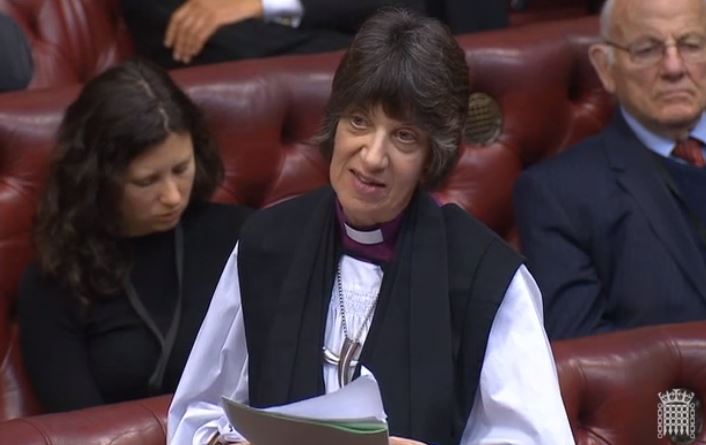
The Lord Bishop of Gloucester: My Lords, I congratulate the noble Lord, Lord Timpson, on his superb maiden speech, and I refer to my interest as stated in the register as Anglican bishop for prisons.
The gracious Speech began with the principles of
“security, fairness and opportunity for all”.
What does that mean for our criminal justice system? Much mention has been made of overcrowded prisons, an overflowing remand population and a void of rehabilitation leading to reoffending. In the past year I have convened cross-party, round-table discussions with key people in this and the other place, plus academics, those with lived experience and prison reformers. We are all agreed that we need a legislative definition of the purpose of imprisonment, and we need to improve the public’s understanding of sentencing. The concepts of punishment and vengeance are strong in the public narrative.
Beyond these doors, in the Prince’s Chamber, is the statue of Queen Victoria, positioned between the figures of Justice and Mercy. How would our criminal justice system be different if we allowed those two figures to properly dialogue? I recently visited the Netherlands, where there has been a huge reduction in the incarcerated population, not least through an imaginative rethink of sentencing, including different and appropriate care of those with mental health problems and addiction. Children are also dealt with differently, and I hope that in due course I will be able to share more of what I believe we could learn.
The narrative that our streets will be safer if we lock more people up and for longer is not supported by the evidence, and simply leads to doing more of the same thing. Just criticising the previous Government for not building more prisons is missing the point. A system that results in more imprisonment, continued repeat offending, more victims and no change in what is broken in lives and society is not only failing but is not cost effective. The government commitment to a
“justice system that puts victims first”
not only requires tackling reoffending with a fresh look at appropriate education, rehabilitation and purposeful training in prison and beyond the gate. It also requires whole-system change, with a public health approach focusing on what will make for stronger and transformed communities, including tackling root causes. I am sure the Minister is aware of the Better Justice Partnership and its work on whole-system change, and I hope he might commit to meet with it.
Over decades, the inequality of our society has contributed to the warehousing of the vulnerable. We need a whole-community approach, and the issue of relationship is key. We need to look at the big picture, including up stream. We need that long-overdue review of sentencing. We need courage to establish alternatives to the revolving prison door and the repeated pattern of fractured relationship, and this must include community-based alternatives as well as the presumption against short sentences, not least with their disproportionate impact on women.
We need to properly resource, train and value prison and probation staff. More needs to be done with them, and for them—it is the big picture. The ambition of security, fairness and opportunity for all needs a large, articulated vision for the society and world we wish to see. Even our debate on the gracious Speech is siloed across government departments. We need to do join-up. It would be wonderful if we could start from a person-centred way of doing things. How about saying, “For a child born today, how will all that we do enable their flourishing into adulthood?”
But back to reality. I applaud the acknowledgement of children of prisoners. They also often serve a hidden sentence, so identification is long overdue. I am sure the Minister will connect with the charities Children Heard and Seen and the Prison Advice and Care Trust, which bring much expertise. I also applaud the intention to expand the remit of the Victims’ Commissioner and the ambition to halve the violence against women and girls—but that too requires looking up stream.
Time is ticking. Even if people are not driven by mercy in dialogue with justice, perhaps finance will be the driver. Prison costs just over £50,000 per person per year, and the annual social and economic cost of reoffending is estimated at £18 billion. A different and more effective approach means not higher cost but a redistribution of funds. As a Lord spiritual motivated by my faith in Jesus Christ and my belief in every person created in the image of God, I am hopeful about the opportunities that we have to transform the system, holding fast to those principles of security, fairness and opportunity for all.
Extracts from the speeches that followed:
Baroness Burt of Solihull (LD): I repeat my welcome to the Minister. Just for a moment, I shall continue on the theme of prisoners. I belong to a small, doughty cross-party group determined to rectify the most terrible of injustices still being perpetrated on the suffering, lonely rump of 3,700 indeterminate-sentence prisoners. Can the Minister at least give some hope that he has not totally ruled out a resentencing exercise? It could be combined with some of the innovative alternatives mentioned by many noble Lords, including the right reverend Prelate the Bishop of Gloucester and the noble Lord, Lord Macdonald of River Glaven.
The noble Lord, Lord Blunkett, spoke about small local remand centres. Not a lot of people know this, but it was at one of those centres—which then rejoiced in the name of Pucklechurch remand centre—that I began my training as an assistant governor in the Prison Service. However, there is no time to go into that fascinating aspect of my career here.
Baroness Wheatcroft (CB): Dostoevsky wrote:
“The degree of civilization in a society can be judged by entering its prisons”.
How would the author of Crime and Punishment judge our society had he ventured inside the overcrowded institutions that, as the right reverend Prelate the Bishop of Gloucester put it, are warehousing our vulnerable, in appalling conditions in many cases? Half of prisoners are addicts, and more than half—57%—are largely illiterate. Some 31% of women prisoners and 24% of male prisoners were taken into care as children; that figure is only 2% for the population at large.
So these are people with deep-seated problems. They need help if they are to become useful members of society. Instead, they are locked up then turfed out—with nowhere to go, in many cases—with £82.39 in cash. Recent statistics from the Government showed that 17 prisons met the target for providing accommodation on the night of release; 98 did not. Performance against the target for ex-prisoners being in employment six weeks after release was little better. Is it any wonder that our recidivism rates are so high?
We have a Minister who understands the dire failings in our prison system. I trust that he will be able to bring about change—that is what the Government came to power promising—but I ask him to look in particular at whether people should be in prison in the first place. Others have made the point that our sentencing is completely wrong. It is absolutely having the wrong effect and it needs revisiting now.
Lord Marks of Henley-upon-Thames (LD): Turning—or returning—to prisons and the penal system, many noble Lords have made a strong case for a complete change of approach to prison and punishment, starting, of course, with the Minister, the noble Lord, Lord Timpson. The right reverend Prelate the Bishop of Gloucester eloquently made the point that reliance on imprisonment as a complete answer to criminality is not supported by the evidence, as the noble and learned Lord, Lord Burnett of Maldon, repeated.
Lord Hanson of Flint (Lab): Turning—or returning—to prisons and the penal system, many noble Lords have made a strong case for a complete change of approach to prison and punishment, starting, of course, with the Minister, the noble Lord, Lord Timpson. The right reverend Prelate the Bishop of Gloucester eloquently made the point that reliance on imprisonment as a complete answer to criminality is not supported by the evidence, as the noble and learned Lord, Lord Burnett of Maldon, repeated.
 The Church of England in Parliament
You must be logged in to post a comment.