
The Bishop of Norwich spoke in a debate on a report from the environment and climate change committee on 11th September 2024, emphasising the need to protect and safeguard the natural environment:
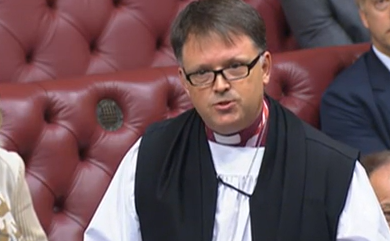
The Lord Bishop of Norwich: My Lords, I believe that restoring land and sea for nature is a crucial part of our response to the twin crises of climate change and biodiversity loss. It is a great privilege to follow four outstanding speakers, real heroes of the environment, particularly for the environment in this nation. It is indeed an extraordinary challenge that we face, but one that I hope we can rise to.
The report contains many excellent recommendations. I commend the noble Lords on the Select Committee who have taken evidence, distilled it and brought us a report containing so much clarity and wisdom. It is imperative that the regulation of habitat protection is retained and strengthened to make sure that protected land is truly being managed for nature. Alongside that, and ultimately far more effective, is for those who own and manage land or use the sea to have a great pride for the natural world in their stewardship and for society at large to value nature. I see the beginnings of a positive change in that regard, as more and more landowners, tenants and people who work the land and the sea recognise our negative impact on the environment and notice the silenced song of creation in so many places.
The importance of nature protection and restoration is also something that the Church of England recognises, as we increasingly strive to manage our land—churchyards, glebe land and the historic farming estates—effectively for nature. In 2023, the Church Commissioners—and I declare an interest as a Church Commissioner—partnered with Natural England to expand the wide Wybunbury Moss National Nature Reserve in Cheshire, leasing land to protect that delicate ecosystem of the moss, restoring its fields to a more natural state and improving access to nature for local residents.
In Hereford, the 100 acres of the Bartonsham Meadows have been leased to the Herefordshire Wildlife Trust, which plans to enhance the flora and restore the ancient hedgerows of that those meadows. We are working closely with our tenant farmers to provide regenerative agriculture to enhance soil health, plant hedgerows and woodlands and to make ponds. In the diocese of Norwich that I serve, the careful management of churchyards, with some areas left unmown until the autumn, has allowed much more nature to thrive at Hemblington, where oxeye daisies proliferate, and at Blakeney, where wild claries are now seen for the first time in abundance.
However, I wonder whether two areas of this report could have been stronger. First, there is the international dimension. Areas of the UK’s land and sea are important for migratory birds and marine mammals. These species do not recognise international borders, but different national commitments can have a profound impact on their populations and their conservation. We also have globally rare habitats, such as heather moorland and sphagnum blanket bog, and there are other outstanding examples of unique species and habitats in the UK’s overseas territories and Crown dependencies, although this report does not cover those places in detail. These internationally important species and habitats are protected by commitments, conventions and directives which UK Governments were instrumental in creating. We have led the way in nature conservation. Ramsar sites, the Berne convention and the EU birds and habitats directive—all of them have our fingerprints on them. So can the Minister say whether His Majesty’s Government will undertake to be absolutely committed to our international obligations for nature?
Secondly, there is only a passing mention in the report to the benefit of nature on human health, development and well-being. I am sure we have all experienced the benefits of spending time in nature, and I am struck that when I read the Gospels, I note how often Jesus withdraws to the natural environment of the Galilee to recharge and reconnect. Studies have shown that we thrive when out in nature, and there are many positive health benefits in terms of reducing stress and enhancing our mental well-being, as well as the enjoyment of physical exercise. In nature, children develop inquiring minds, learn to assess risk, and experience awe and wonder through taking a closer look at the flora and fauna. Yet all the evidence points to children being out in nature far less. However, when I visit schools in the diocese of Norwich, I am always struck by the passion of children for the environment. I would love it if every child could plant a tree in their formative years. There is nothing like getting your hands in the soil—“humus” and “humanity” sharing the same root.
When we pay attention to something, we are far more likely to treasure it. When we treasure something, we want to protect it. When we protect something, we want to see it thrive. Protecting land and sea for nature benefits everything and everyone. Will His Majesty’s Government undertake an assessment of the benefit of forest schools and similar nature-focused learning for child development, so that we can have a generation of children even more passionate about protecting our natural environment?
As I said, this is an extraordinary challenge, but one I believe we must meet, for our sake, for our children’s sake, and for the sake of the planet. When things are good for nature, they are generally good for humans, and generally good for business as well. The Book of Revelation speaks of the leaves of the trees being
“for the healing of the nations”.
To plant is to hope, to restore is to heal, to protect is to love, ultimately. We must do all that we can to protect species, habitats and landscapes, and I hope that His Majesty’s Government will not only take note of this report but act on it.
Extracts from the speeches that followed:
Baroness Rock (Con): The committee mentions the Farming in Protected Landscapes programme, which delivers improvements for nature in line with local priorities. However, that funding comes to an end in March 2025. Are this Government planning on extending the programme?
We must make sure that tenanted farms are included in achieving long-term nature conservation. That means we need longer tenancy agreements, as recommended in the Rock review. That is important, because length of tenure will allow a tenant farmer to make a more meaningful and effective environmental contribution. It was therefore extremely disappointing to note that tenant farmers are not mentioned at all in the report. That is a glaring omission, given their importance in managing, wholly or partly, 64% of total farmable and in England, including protected sites. Many of their landlords are institutions such as the National Trust, the Crown Estate, the Duchy of Cornwall and, as the right reverend Prelate mentioned, the Church Commissioners. I am extremely grateful to him for bringing up the importance of the Church Commissioners’ tenant farmers, many of whom I have met.
Most landowners have clear environmental goals, but those will not be delivered without those vital tenant farmers who actually manage the land. I therefore ask the Minister to confirm the Prime Minister’s commitment to quickly implement a fair deal for tenant farmers, building on the work of the Rock review.
Lord Gascoigne (Con): On the second area which I wish to discuss, the report and then Government talked about data and citizen science, ensuring that the public have better understanding of sites. I think that we can go much further and really focus on what more we can do for young people, in echoing what I thought was a beautiful speech from the right reverend Prelate the Bishop of Norwich.
I shall give a personal reflection. I am lucky to be the father of two very young daughters. Sophia is three and Helena is seven months. Out on walks with the dog or in the garden, my eldest often fills my pockets with snail shells, feathers, leaves and acorns; to her, these are the most precious things at that time. She does not think twice about putting her bare hands in the soil or jumping around in muddy puddles. We are lucky enough to have a reasonably sized back garden where Sophia and I have planted plants since the day she could walk, made ponds from old washing-up tubs and sown flower seeds and grass in areas and let them go wild—and we probably now have more bird feeders than there are in London Zoo. She and I often sit to watch the birds in the garden, sniff flowers, see dragonflies zoom around, enjoy the bats at night and watch the cameras to see the foxes and hedgehogs—and we both have, just in the last few days, seen not just frogs but our first toad.
Yes, of course I would like to take credit for that— I love it; my dad did the same for me, and it did stick eventually—but why is it that, when we grow a little bit, we lose interest in the outdoors? A few years ago, a study showed that there is a sharp dip in people’s connection with nature from the age of 11 onwards, with a slow recovery around the age of 30; the average age for nature-connectedness was 61. What can we do to maintain that fascination and longing throughout young people’s lives?
Lord Lucas (Con): My Lords, I was a member of the committee that produced this report, under the superb chairmanship of the noble Baroness, Lady Parminter, which made it a most enjoyable experience. I welcome the Government’s commitment to 30 by 30. I suggest that the best way of getting there, because it will not be easy, is to involve the public on a large scale. Conservation should be everywhere, not over there. It should not be something which is done in reserves that you never visit and in places managed by other people; it should be in green spaces in towns and cities. We want people to develop a close connection with nature, at scale. It is good both for nature and for people. Access to nature is a key policy, as the right reverend Prelate the Bishop of Norwich said, and it should be a very strong government objective to move in that direction.
The concept of OECMs—other effective area-based conservation measures—provides a route for doing that. They are defined as:
“A geographically defined area other than a Protected Area, which is governed and managed in ways that achieve positive and sustained long-term outcomes for the in-situ conservation of biodiversity, with associated ecosystem functions and services and where applicable, cultural, spiritual, socio-economic, and other locally relevant values”.
Baroness Hayman of Ullock (Lab, DEFRA): Finally, the right reverend Prelate the Bishop of Norwich talked about forest schools. My granddaughter has just finished three years at a forest school. She has thrived and grown and it has been the most wonderful experience for her, so I have huge admiration for the work that they do.
Once again, I thank the noble Baroness, Lady Parminter, for securing today’s debate and her committee for all its work. It is a huge piece of work and can greatly inform the Government as we actively consider the recommendations it sets out. I look forward to working constructively with everybody in this Room as we go forward and will write if I have missed anyone’s question.
 The Church of England in Parliament
You must be logged in to post a comment.