
On 18th October 2024, the Bishop of Sheffield spoke at the second reading of the Education (Values of British Citizenship) Bill, a private members bill tabled by Lord Harries of Pentregarth, supporting the bill and welcoming provision to improve provision for education on religion and the environment:
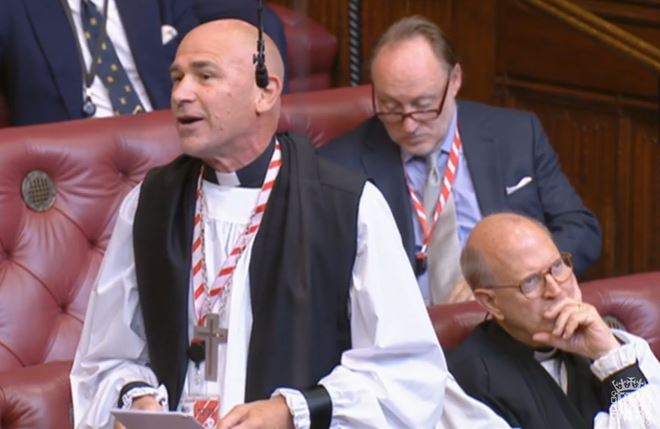
The Lord Bishop of Sheffield: My Lords, I too congratulate the noble and right reverend Lord, Lord Harries, on bringing forward this Private Member’s Bill, and indeed on the many years of thinking and hard work which have brought the Bill to this point. I welcome the Bill, support its aims and heartily welcome the five specific headings, which together give some definition of what is meant by “British values” in an educational context.
Especially in an educational context, it will be vital to foster a culture in which these headline categories are inhabited in a meaningful way. This kind of culture is capable of being fostered as much in the teaching of maths and science as through the teaching of citizenship, PSHE or RE, but these latter subjects provide an opportunity for values to be addressed directly and explicitly. I shall say something further about RE in particular, but the list of values identified in the Bill includes respect for the environment, and I would also like to say something about the potential for a natural history GSCE.
I will address RE first. The statutory inspection process for Anglican and Methodist schools and their teaching of RE means that church schools can confidently guarantee a high-quality, diverse religious education that supports children to develop the skills and knowledge they need to grow into global citizens and to navigate the nuances of a secular, multi-religious society. However, both citizenship and RE subjects have fallen foul of the English baccalaureate system. Since its introduction in 2017, uptake of RE at GCSE has fallen sharply and social studies uptake has consistently remained below 10%. It is my sincere hope that, through the Bill and through the current government curriculum and assessment review, timetables and curriculum frameworks will be structured to prioritise and value the crucial learning currently taking place under the banners of citizenship and religious education.
Secondly, on the proposed natural history GCSE, the Bill provides an extraordinary opportunity to embed respect for the environment into British values through the education system. Wisely applied, this could ensure that young people are taught about climate and nature issues consistently and systematically, rather than as part of discrete subject areas such as geography and science. The right reverend Prelate the Bishop of Norwich, lead Bishop for the environment, assures me that the natural history GCSE has gone through the required iterations and is ready, but the launch of this new GCSE has been delayed without explanation. I would be grateful for some clarification from the Minister as to what problem, if any, there is in launching this new pathway.
I support the Bill and hope that it will give renewed purpose to the teaching in our schools of RE and citizenship on the one hand, and natural history on the other, while also recognising that the five headline areas identified in the Bill will only ever be headings unless we foster the culture in which they can truly be inhabited and lived out.
Extracts from the speeches that followed:
Baroness Bennet of Manor Castle (GP): Given the time limit, I will focus on Clause 1(5), which concerns the required inclusion in educational directions of respect for the environment. This follows from the contribution of the right reverend Prelate the Bishop of Sheffield; I repeat his question for the Minister on where the new GCSE in natural history is.
We have inherited a disastrous set of values and attitudes towards the environment, with thinking that goes back a long way and which we have adopted into our intellectual tradition. It includes the great chain of being, which is the concept that human beings are some kind of pinnacle of life, and the idea that the whole complexity of life on earth—the living system that James Lovelock identified as Gaia, which has evolved over billions of years—is there for us as a species, under our control and for our exploitation.
The 21st century has exposed that for the dangerous fallacy it is, with the climate emergency, the nature crisis and the poisoning of our planet with novel entities; six of the nine planetary boundaries have been exceeded. We know that there are other intellectual traditions and other ways of looking at the world, which are attracting attention from our scientists and researchers. For example, I note that, across many African religions, there is the concept of ukama, which states that animals are part of a community with humans; it emphasises mutual dependence, a sense of unity and, at least sometimes, a moral imperative of respect.
Baroness Smith of Malvern (Lab, DfE): My noble friend Lady Blower rightly talked about the significance of schools in tackling racial and religious discrimination. It is absolutely right that, as part of a broad and balanced curriculum, there are opportunities to discuss racism and other forms of discrimination. Those include citizenship education, which teaches about religious diversity, and mutual respect and understanding; relationships education, which teaches about the impact of prejudice and the importance of respect and individual worth, as many noble Lords have mentioned; and religious education, which the right reverend Prelate the Bishop of Sheffield also rightly challenged us on, which teaches about religious tolerance. Once again, the Education Against Hate website provides important teaching resources to help schools discuss those sensitive topics. The department is also committed to tackling all forms of prejudice, including Islamophobia, and other forms of racism. Earlier this month, my right honourable friend the Education Secretary announced that the Government are resuming the procurement of £7 million-worth of funding to tackle anti-Semitism in schools, colleges and universities.
The right reverend Prelate the Bishop of Sheffield also asked what the DfE is doing about rolling out the GCSE in natural history. The natural history GCSE was a commitment made by the previous Government. We will want to set out our policy priorities for the curriculum in due course—I will come to the curriculum and assessment review in a moment—but that does not mean we do not believe, as was rightly emphasised by the noble Baroness, Lady Bennett, and the noble Lord, Lord Bourne, that respect for the environment is a very important part of what we need our schools to be able to develop.
 The Church of England in Parliament
You must be logged in to post a comment.