
On 5th December 2024, the Archbishop of Canterbury made his valedictory speech in the House of Lords during a debate on housing:
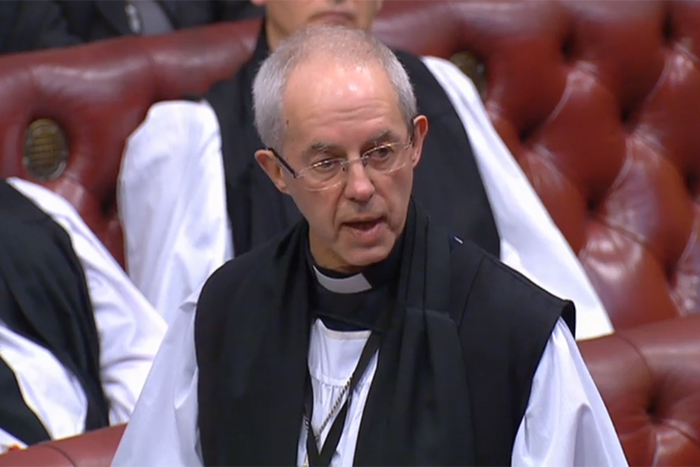
The Lord Archbishop of Canterbury: My Lords, it is often said and it is a cliché to say it—but hey, I am the Archbishop still—that if you want to make God laugh, make plans. On that basis, next year, I will be causing God more hilarity than anyone else for many years, because the plans for next year were very detailed and extensive. If you pity anyone, pity my poor diary secretary, who has seen weeks and months of work disappear in a puff of a resignation announcement.
The reality, which I wish to start with—then pay some thanks, and then talk about housing—is that there comes a time, if you are technically leading a particular institution or area of responsibility when the shame of what has gone wrong, whether one is personally responsible or not, must require a head to roll. There is only, in this case, one head that rolls well enough. I hope not literally: one of my predecessors in 1381, Simon of Sudbury, had his head cut off and the revolting peasants at the time then played football with it at the Tower of London. I do not know who won, but it certainly was not Simon of Sudbury.
The reality is that the safeguarding and care of children and vulnerable adults in the Church of England today is, thanks to tens of thousands of people across the Church, particularly in parishes, by parish safeguarding officers, a completely different picture from the past. However, when I look back at the last 50 or 60 years, not only through the eyes of the Makin report, however one takes one’s view of personal responsibility, it is clear that I had to stand down, and it is for that reason that I do so.
Next, I want to say thank you to so many people in the House. In these 12 years, I cannot think of a single moment when I have come in here and the hair on the back of my neck has not stood up at the privilege of being allowed to sit on these Benches. It has been an extraordinary period, and I have listened to so many debates of great wisdom, so many amendments to Bills that have improved them, so much hard work.
I have also found that, despite the fact that I still cannot find my way round this building, the staff here are endlessly patient as I look panic-struck when I suddenly find I am standing on a green carpet, not a red one, and have guided me to the right place. I am hugely grateful, and I am very grateful to noble Lords who have been kind enough to send supportive and encouraging notes over the last few weeks. It has been a great privilege and strength to have that.
Housing, as has been said, is one of the key areas of life in any society. When I look back historically—I will not develop the whole history—whenever this nation has taken a huge step forward since the end of the Napoleonic Wars, three things have played a part: housing, education and health. Where they have changed, they have laid a new basis for a healthy society, not just physically but in every way, and I believe that is what we are called to do now.
There has been much reference to the two reports that the Church of England has issued, and I am in the same place, as much of what I was going to say has been said. So, I will not say it again and will say something slightly different—but very briefly. The Coming Home report that the noble Lord, Lord Young, referred to so kindly, sets out five words beginning with “s” which it decided to recommend as the moral centre of good housing. They are: that housing should be safe, and we have heard and know about the need for that through Grenfell, mould, and the need to improve the safety of housing; that housing should be secure, so that people know they can bring up families; that housing should be stable, as people should not constantly be forced to move without choice—it is utterly disruptive; and that housing should be sustainable and zero carbon. We cannot afford to build tens of thousands of houses which increase the problems of climate change.
But I want to add two things. First of all, housing must be affordable, particularly social housing. Social housing is one of the areas which is very inelastic in terms of supply and demand. We need clear criteria for what “affordable” means. One of them should not be in proportion to the average cost in the area, which is the present test: 80% of average cost. I can assure noble Lords that, as we come to the end of our time where we are living at the moment and start looking for a house to buy, 80% of average market cost puts us a very long way away from where we would like to be—and that serves us right, in some ways. Affordable housing needs to be related to income, not to average cost. It needs to be measured against real living wage in a particular area if it is going to be genuinely affordable.
Secondly, it is no use building houses unless you build communities. Housing without community sets us up perfectly for the social problems of the future, so, when we build houses, we have to create the open spaces. And I forgot one “s”, which is satisfying. It has to be a place where children can play, where families get to know each other and where—obviously, I would say this—there is a church, or at least a community centre that acts as a church, where people are brought together. Community facilities in most of our new developments are nugatory, nil, useless; we have to do better.
My last comment: the Church Commissioners for England hold about 5,000 to 6,000 acres of strategic land, out of the 100,000 acres of the Church Commissioners’ total landholdings and another 100,000 acres in the hands of dioceses, parishes, trusts and so on. I know that they are now working on plans for working with government and local authorities, using the mapping tool developed in the Coming Home report, to see the best places to get together with others and have economically helpful areas with good returns. Look at what the Duchy of Cornwall has done with that: you can look down a street and you cannot distinguish which is social housing and which is non-subsidised housing. That also is part of the way in which we treat people with respect.
I look forward to hearing from the Minister. I hope that the Government will undertake to work right across the sector of landholders, so there will be good mixed development that brings people together and sets us up for a better future—and that, as part of that, it is done in the deliberate building of communities before we talk about individual houses.
My Lords, I am hugely grateful to have been here. You remain in my prayers and in my deep affection and profound respect for the huge contribution made by this House to our nation, which it usually does not recognise. I am hugely grateful to the noble Baroness, Lady Taylor, for allowing this debate to happen.
Extracts from the speeches that followed:
Lord Griffiths of Bury Port (Lab): My Lords, it is a real privilege to have the opportunity to follow the most reverend Primate. We first met in Durham cathedral. It was a great civic occasion, where I was the appointed preacher and he was the recently arrived—merely, at that time—right reverend Prelate. I preached at him and he blessed me, and it has been like that ever since.
A month or two later, in May 2012, the most reverend Primate made his maiden speech in this House. On that occasion, he was still the Bishop of Durham and he toured the heights of his experience, drawing massively on his secular as well as his religious experiences. He has played a large part in the banking and financial sector themes that we have pursued in this House and in Parliament generally. Indeed, he is a towering figure in many other ways. After all, he officiated at the funeral of Her late Majesty Queen Elizabeth and crowned the brand-new King and Queen in his turn.
He has been a great campaigner for women’s consecration to the episcopacy and to see that happen. We cannot divorce him from the achievement of that great step, which has greatly enriched this House. Another of his great themes is on investment that crosses between morality and ethics, on the one hand, and finance performance, on the other.
In a sense, I could pursue a tour d’horizon of the great themes that he has taken some part in, but it would not really get to where I want to be. In his maiden speech, as well as proclaiming the virtues and qualities of the north-east—we remember that Newcastle drew last evening with Manchester City; a very good thing—he also championed the issue of loan sharks and people with payday loans at extortionate rates of interest. They were gone within two or three years of him striking that note. From then until now—choosing to speak on housing and homelessness in his valedictory address—that for me is the theme that runs right through this particular Primate’s life and witness, like the word “Blackpool” through a stick of seaside rock.
Somewhere along the way, he has espoused the marginalised, the oppressed, the poor people of the land, and internationally too. He has travelled to every province of the Anglican Communion. We can only honour him for his stamina as far as that is concerned; stamina to get there, but holding it together is an entirely different challenge. Somewhere on that parabola he quoted a line from Nelson Mandela which is the hallmark for his particular ministry—that overcoming poverty is a matter of justice, not charity. That is a pretty high bar to set. I honour him for his work.
Baroness Thornhill (LD): My Lords, I declare my interest as yet another vice-president of the Local Government Association. I begin by acknowledging the very personal valedictory speech of the most reverend Primate the Archbishop of Canterbury. His wise but often challenging contributions will be missed.
As ever, it has been a stimulating, knowledgeable and important debate, but I confess that it has left me feeling a bit depressed. Noble Lords’ excellent contributions have shown that, yes, there is a consensus that we have a housing crisis—no surprise there—and, yes, there are lots of reasons why it has come to pass: noble Lords have cantered knowledgeably around the course, covering almost all of them. We also seem to agree that this is not new: it has been brewing for decades and the many and various attempts to build more homes have been, by and large, unsuccessful—hence my depression. But I am looking forward to the Minister’s response and I hope she can lift my gloom, because this is one area where we all want to see change, and radical change at that. It is a sign of the quality of the debate today that noble Lords have given the Minister many suggested solutions that give us hope.
The Earl of Effingham (Con): My Lords, I thank the noble Baroness, Lady Warwick, for her success in the ballot to obtain this debate. It is also an honour and a privilege to be closing after the valedictory speech of the most reverend Primate the Archbishop of Canterbury. The fact that he chose this debate to be his last tells us a great deal about his values and his care for those in need. I believe I speak for these Benches and the whole House when I say that we wish him well for the future.
Home is where the heart is. A home is something we all need, and we should have grave concerns that we are a nation where not everyone has their own home. Homelessness should have no place in this country, and we must do everything we can to help those in need. But homelessness is a complex issue with a wide range of underlying causes and contributing factors. There is no one silver bullet. The causes and contributing factors are numerous, including affordability and population growth pressure, but there are also more personal and tangential causes of homelessness, including mental health crisis, domestic abuse and relationship breakdown. It is therefore crucial that any policy proposed to tackle homelessness targets its multiple root causes if it is to have any chance of success.
Baroness Taylor of Stevenage (Lab, DHCLG): It has been a great privilege to listen and respond to a debate in which the most reverend Primate the Archbishop of Canterbury gave his valedictory speech. He was present at one of the most terrifying experiences I have had since I joined this House. He has been a great champion of housing, as many noble Lords have said, and introduced the Homes for All report, which had a good launch in your Lordships’ House. I thought I was just going to attend, but I arrived to find my noble friend Lady Warwick asking me whether I would speak. As I walked into the room, he was already speaking and I had to quickly gather my thoughts together and make a speech there and then.
The most reverend Primate has done such fantastic work. His deep and thorough knowledge of the banking system from his earlier career enabled him to speak out powerfully in 2013 against payday lending, which was a great passion of mine as well. He launched a campaign in favour of credit unions as an alternative. The annual Archbishop’s debate, under his watchful eye, has seen him raise the following areas: banking standards, soft power, reconciliation, education, British values, housing, freedom of speech, migration and families. His book Reimagining Britain, published in 2018, set out his thoughts on areas for specific social change and reform, including social care, housing and families—issues on which he and the most reverend Primate the Archbishop of York founded policy commissions.
The most reverend Primate also has extensive knowledge of overseas issues through his travel around different countries and has made informed contributions in debates on foreign policy, including on Sudan, Afghanistan and Israel and Gaza.
Of course, in the 12 years that the most reverend Primate has been the Archbishop of Canterbury, he has offered spiritual counsel to six Prime Ministers and overseen many significant royal events, presiding at the Coronation of His Majesty King Charles III and delivering the sermon at the funeral of the late Queen Elizabeth II. He has also baptised Prince George, Princess Charlotte and Prince Louis, and married Prince Harry and Meghan at Windsor in 2018.
During his great speech on housing this afternoon, the most reverend Primate spoke about affordability, which I will come to later. He also spoke about community and building places for people, a topic that is very close to my heart in terms of planning. I thank him for the way that he has steered the Church Commissioners, if it is possible to steer them—he says no; I thought that was probably the case—because I believe there are extraordinary opportunities now regarding Church land. The Government welcome the opportunity to have that dialogue with the Church Commissioners.
There is no doubt in my mind that in my parish, as elsewhere in the Church, safeguarding is infinitely better than it was before his time as Archbishop. While we understand his very honourable reasons for resignation, I know that this House and the Church will miss him greatly. I can do no better than to quote his own words back to him:
“People of loving service are rare in any walk of life. Leaders of loving service are still rarer. But in all cases those who serve will be loved and remembered when those who cling to power and privileges are long forgotten”.
I thank him.
Baroness Warwick of Undercliffe (Lab): My Lords, I thank the Minister for that very comprehensive and indeed very encouraging response. I will not attempt to summarise the debate—indeed, my noble friend did it rather splendidly. But I do not think the Government can be in any doubt that there is support on all sides of this House for speedy action, as well as for a long-term strategy. I simply join in the tribute that she made to the most reverend Primate the Archbishop of Canterbury for the work he has done, and I think that was reflected in all the comments made around the House.
 The Church of England in Parliament
You must be logged in to post a comment.