
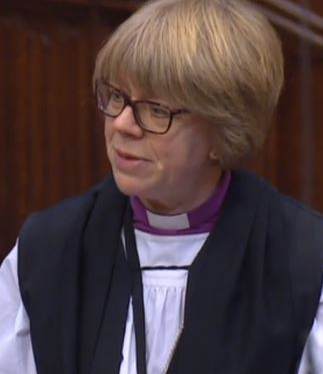
The Bishop of London spoke in a debate on UK policy on the war in Ukraine on 17th March 2025, advocating for a just and lasting peace in Ukraine, and for investment in preventative diplomacy, conflict resolution, and peacebuilding by the UK:
The Lord Bishop of London: My Lords, it is a privilege to follow the noble Lord, Lord Purvis.
As he points out, peace is not only the absence of war but the presence of justice and of the conditions for human flourishing. Therefore, what we need is a just and lasting peace. This peace must address the causes of the war and provide for Ukraine’s security, sovereignty and freedom. We must recognise that this peace needs to be negotiated by all parties and cannot be dictated by the US. We must recognise that any ceasefire will need to be maintained through a combination of mechanisms, such as troops on the ground and trained mediators who can deal with the contentious and central issues, such as access to resources and the repatriation of civilians.
While there has been talk in recent days about the uplift in the defence budget, investment in new military platforms is also needed. We must also ensure that proportionate funds are spent on preventive diplomacy, conflict resolution tools and development. We need to see a step change in Britain’s investment in active peacebuilding and conflict resolution capabilities. Active peacebuilding will not on all occasions prevent a descent into conflict, but its focus on prevention and mitigation represents value for money for the taxpayer, given the extraordinary costs that war now involves.
Can the Minister say what consideration has been given along these lines and towards active peacebuilding, including development?
Extracts from the speeches that followed:
Baroness Sugg (Con): My Lords, I will focus on humanitarian aid policy, an essential component of our assistance to the people of Ukraine, but I would like first to commend the speech of my noble friend Lady Helic, with every word of which I agree. I am also grateful for the speech from the right reverend Prelate the Bishop of London, and I agree with her on support for active peacebuilding, conflict prevention and development. We are, of course, seeing development cuts across the US and, indeed, Europe; I fully support the increase in defence spending, but I fear that these development cuts will cost us from a national security perspective in the long term.
The UNFPA has highlighted that around 640,000 women and girls in Ukraine will be impacted by the USAID cuts to gender-based violence prevention and response services, including psychosocial support, economic-empowerment initiatives and life-saving information services. I appreciate that the Government will not comment on other countries’ decisions, but here in the UK we are providing at least £120 million in humanitarian assistance through to the end of this financial year, bringing the total humanitarian contribution to £477 million for Ukraine and the region since the start of the full-scale invasion—as an aside, I do not see how we can say that this is not a full-scale invasion; we should not shy away from saying that it is. This humanitarian support is very welcome. However, given the UK cut to ODA from 0.5% to 0.3%, is the Minister able to confirm that this assistance to Ukraine will continue as planned? Also, given the pressure on UK aid, will the current level be continued in future years?
Baroness Smith of Newnham (LD): But, like my noble friend Lord Purvis of Tweed, from these Benches I have to reiterate our support for His Majesty’s Government’s stance on, and absolute unwavering support for, Ukraine. There may have been a change of Government in the United States, but we do not need to criticise or denigrate the President of the United States to say that, whatever his views about Ukraine, our position is unchanged and must be unchanged.
Donald Trump says he wants peace; who should not want peace? In a world of injustice, there have been conflicts—during the Cold War and beyond—almost every single day since the end of World War II. So peace is something to which we aspire. But that peace should not be about appeasement. As the right reverend Prelate the Bishop of London pointed out, it should be about justice. As my noble friend Lord Purvis pointed out, the aggressors should not also be the victors.
It is essential that the United Kingdom—with our NATO partners, to the extent possible—stands with Ukraine. We must keep trying to persuade our friend in the White House, who is still our ally, that it is vital that we support Ukraine now but negotiations with Vladimir Putin are not the way forward.
Lord Coaker (Lab, MoD): Again, I thank the noble Lord, Lord Purvis, for his support for the unity of purpose across this Chamber, and I think that is a really significant and important point that will be noted by those who read our debates and listen to our discussions. The point he made is that, as I have reiterated, the negotiation must involve Ukraine, and we are seeking to enhance our relationship with Europe in order to move forward with respect to that. I hope that, over the next few months, we will see that develop.
I agree with the right reverend Prelate the Bishop of London about the importance of the sovereignty of Ukraine, and of course we support any efforts to bring about the peace that we all want to see.
 The Church of England in Parliament
You must be logged in to post a comment.