
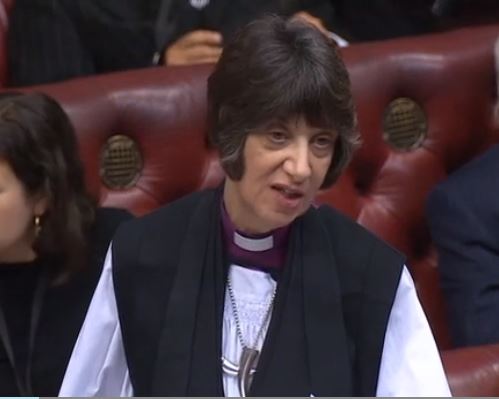
On 7th May 2025, the Bishop of Gloucester spoke at the second reading of the Sentencing Guidelines (Pre-sentence Reports) Bill, advocating for a long term approach to sentencing that takes into account families and communities:
The Lord Bishop of Gloucester: My Lords, I declare my interest as Anglican Bishop for prisons. I am grateful to be speaking in this Second Reading debate. I too greatly look forward to the maiden speech of the noble Baroness, Lady Nichols. Having said that, I do not believe this is a debate we should be having at all. I do not believe this rather theatrical legislation is necessary.
In a world of sufficient resources, as has already been said, there would be comprehensive pre-sentence reports for everyone, to which careful attention would be paid in court. If we have to prioritise PSRs, then it makes sense to prioritise those we know are especially vulnerable, or where there is evidence of disproportionate outcomes from the justice system. Will the Minister comment on why he thinks there was such shock at this apparent two-tier justice with regard to ethnicity but not the other cohorts in the guidance, such as young adults and pregnant women? Do the Government believe the issues raised in the landmark report by the current Foreign Secretary almost eight years ago are now a thing of the past? Is there no role for judges in mitigating the issues raised in that report?
The use of the Sentencing Council guidelines apparently to feed a culture war is distressing. The allegation of two-tier sentencing based around race, religion, belief or cultural background is damaging to public understanding. This is already shaped heavily by media headlines and the shocking and extreme cases of violent crimes, which are not the norm. Public understanding of why and how criminal sentences are handed down is severely lacking, as evidenced by the Justice Select Committee in 2023 and a recent Prison Reform Trust report detailing a citizen jury exercise. My own experience of talking to teenagers in schools is that more information about sentencing results in more considered responses and a greater sense of engagement with what we are trying to achieve, which surely goes beyond mere punishment.
At the heart of the Christian gospel is a God who holds together both justice and mercy. We need a big long-term vision. Surely long-term vision must be about transforming lives and communities, and that includes victims as well as offenders, recognising that many offenders are also victims.
If we are committed to the transformation of society, we need to take account of the impact of sentencing on families and the wider community. I am not saying that people who commit crimes should not receive punishment, but I am saying that sentencing should be much more than this and give the best possible outcomes for society.
In a recent judicial critique focused on sentence inflation, four former Lords Chief Justice, including the noble and learned Lord, Lord Thomas, highlighted that people in prison are individuals, not statistics, and that the
“consequences of imprisonment on people’s lives—in prison and upon return to the community—need to be considered in the whole”.
They go on to say:
“Evidence suggests that what happens during and after a sentence, including rehabilitative interventions and resettlement support, is more important than sentence length”.
If we are to treat people in the justice system as individuals, that surely includes taking into account people’s circumstances, such as whether a woman is pregnant, and their characteristics, such as neurodiversity. I echo what was said about characteristics. We cannot pretend that circumstances and characteristics do not matter. Wise sentencing is threatened by this am-dram politics, and the Bill risks taking us backwards, not forwards. I firmly believe that we need less political control over sentencing, not more.
I urge the noble Lord to revisit the House of Commons Justice Committee’s 2023 recommendation of the establishment of an independent advisory body on sentencing. I would propose an additional step: a commitment from the Treasury, set out to Parliament, where Ministers propose to expand or lengthen custodial sentences against recommendations from the advisory board, thus resetting the relationship between politics and justice, including the public purse.
There is more I could say—much more—but I will end by engaging with the Government’s own rationale for this legislation. The Justice Secretary says that inequality in society is a matter for policy and not for the judiciary. How, then, will the Government create an equal society over their term of office so that these guidelines become redundant?
Extracts from the speeches that followed:
Lord Marks of Henley-upon-Thames (LD): I agree with the noble Baroness, Lady Nichols, that we should be making thorough pre-sentence reports available for all offenders where the options are custody or a community sentence, to enable the court to have the fullest material about individual circumstances of offenders when sentencing. Where I part company with the Government and the noble Baroness, Lady Nichols, is that it neither logical nor defensible to say, “Well if we can’t afford reports for all those at risk of prison, we will forbid the judges to prioritise the most vulnerable groups in the interests of an artificial equality”. Yet that is what this Bill proposes. I agree with the right reverend Prelate the Bishop of Gloucester that it is plain wrong to forbid prioritising pre-sentence reports in the face of a lack of resources.
That is not to uphold equality before the law in the face of a misguided guideline. It is to prevent the Sentencing Council performing its function in the most helpful way possible by addressing the inequality of outcomes that bedevils the system as it operates at present. It is all very well for the Minister to say that the causes of unequal outcomes are presently unknown, but there is a mass of evidence to the contrary.
(…)
In addition, the Bill is incoherent in its drafting—what the Constitution Committee politely calls “legislative uncertainty”. I do not wish to go into detail because the points made throughout the House by my noble friend Lady Hamwee, the noble and learned Lords, Lord Thomas of Cwmgiedd and Lord Hope, the right reverend Prelate the Bishop of Gloucester, and the noble Lords, Lord Bach and Lord Verdirame, on personal characteristics are surely right. Are not pregnancy, being transgender and sexual orientation all personal characteristics? They are also circumstances that a sentencing court might want to take into account, as well as ethnicity, particularly where those characteristics give rise to persecution, abuse and psychological and mental health issues. Those are just the kind of factors that might be considered and explained in PSRs. Why should sentencing guidelines not indicate that some of these characteristics are important and make a PSR more valuable to judges?
Lord Timpson (Lab): A number of noble Lords, including the noble and learned Lord, Lord Phillips, the noble Baroness, Lady Hamwee, the right reverend Prelate the Bishop of Gloucester and the noble Lord, Lord Bach, have asked why this Bill is necessary and whether it was possible to resolve the matter with the Sentencing Council without primary legislation. In response, I would explain that we first exhausted all other options prior to introducing this legislation. The imposition guideline was due to come into effect on 1 April this year. Ahead of this, the Lord Chancellor used her existing power to ask the Sentencing Council to reconsider. Unfortunately, the Sentencing Council declined to revise the draft guideline. It was right, at that point, to act quickly to introduce the legislation.
As a result, the Sentencing Council decided to put the guideline on pause while Parliament rightly has its say, and we are grateful to it for doing so. By acting quickly, we prevented a guideline coming into effect which risked differential treatment before the law. This legislation has been necessary to achieve that and to clarify this Government’s commitment to equality before the law.
Noble Lords, including the noble Lord, Lord Beith, have questioned the scheduling of this Bill. I reassure noble Lords that the dates for Committee and Report have been agreed in the usual channels in the usual way.
The noble Lord, Lord Jackson of Peterborough, the right reverend Prelate the Bishop of Gloucester, the noble Baroness, Lady Fox, and my noble friend Lady Mattinson have spoken about the importance of trust and consistency in the justice system. As the speed with which we introduced the Bill demonstrates, this Government are definitive in their stance with regard to equality before the law. The issues that have been raised with regard to disproportionality in our justice system are the domain of government, politics and Parliament. This Bill serves to reassert our ability to determine this country’s policy on the issue of equality of treatment before the law.
 The Church of England in Parliament
You must be logged in to post a comment.