
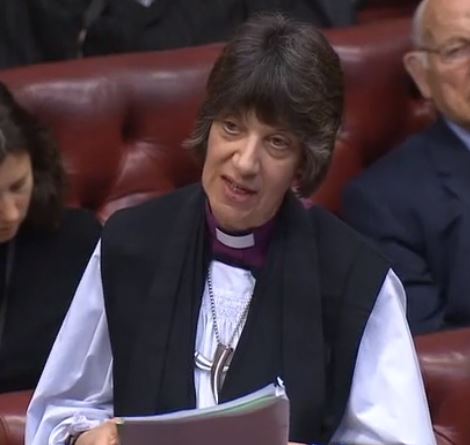
On 4th June 2025, the Bishop of Gloucester tabled her amendment to the Sentencing Guidelines (Pre-sentence Reports) Bill, which would “seek to ensure that existing sentencing guidelines relating to the mitigating factor of “pregnancy, childbirth and postnatal care” can continue to provide directions for courts to obtain pre-sentence reports for offenders who are pregnant or are primary carers of young children.”
The Lord Bishop of Gloucester: My Lords, like other noble Lords, I have already registered my feelings about the Bill at Second Reading and in Committee. Now that we have had the publication of the Independent Sentencing Review and the Government’s response, I reiterate the point that, like others, I simply do not believe that we need this legislation. It seems that the left hand is not aware of the right hand on the evidence around sentencing.
I agree with what has been said already. Amendment 8, in my name, seeks something very specific: to ensure that existing sentencing guidelines relating to the mitigating factor of pregnancy, childbirth and postnatal care can continue to provide directions for courts to obtain pre-sentence reports for offenders who are pregnant or primary carers of young children. Without this amendment, the Sentencing Guidelines (Pre-sentence Reports) Bill directly contradicts the Government’s stated policy intent to reduce the imprisonment of pregnant women and mothers of young children.
On 22 May, in her response to the Independent Sentencing Review, the Lord Chancellor explicitly stated the Government’s intent to reduce the imprisonment of pregnant women and mothers of young children. She said:
“I am particularly keen to ensure that pregnant women and mothers of young children are not anywhere near our female prison estate in future”.—[Official Report, Commons, 22/5/25; col. 1204.]
Indeed, the Independent Sentencing Review
“recognises the harm caused by imprisoning pregnant women and believes pregnant women and new mothers should be diverted and supported in the community, unless in exceptional circumstances. Custody must only be a last resort”.
How, then, are we to achieve this, when the Bill makes unlawful the existing Sentencing Council’s mitigating factor—pregnancy, childbirth and postnatal care—which came into force on 1 April 2024 and directs courts to obtain PSRs for pregnant and postnatal offenders? I am very grateful to the Minister for writing after Committee, but he confirmed—extraordinarily—that the Bill will render such direction about obtaining PSRs across existing sentencing guidelines unlawful. I query his assumption that, without direction, sentencers might request a PSR. This is a backward step. Simply put, without a pre-sentence report, alternatives to custody cannot be considered by a sentencing court. Without a mandatory direction to obtain a PSR, there is no way to ensure that women are diverted from custody. Without this amendment, the Bill directly contradicts the Government’s stated policy intent. I recognise the very difficult position that the Minister has been put in, but I am simply looking for the Government to have the grace to admit this contradiction and to accept this amendment. It does not have to be seen as a humiliating backing-down, but, rather, a humble response to listening.
I will not delay the House further. I will listen to the Minister’s response in due course, but I am minded, at this point, to divide the House. However, I might need some careful direction, should other amendments be passed, as to where that leaves my Amendment 8.
Lord Sandhurst (Con): As for the amendment of the right reverend Prelate the Bishop of Gloucester, we see merit in the view expressed by the Constitution Committee. We note that, in Grand Committee, the Minister sought to clarify the matter, stating that the Bill
“does not affect Court of Appeal case law that has covered the types of cases where pre-sentence reports are necessary or desirable, including examples around pregnant women and women who have recently given birth, young defendants and vulnerable defendants”.—[Official Report, 19/5/25; col. GC 24.]
The Minister went on to make other observations. We agree with those but we think that, again, in the light of what has been said today in particular, it would be helpful if the Government gave further thought to this when the Bill leaves this House.
Lord Timpson (Lab, MoJ): Amendment 8, tabled by the right reverend Prelate the Bishop of Gloucester, seeks to ensure sentencing guidelines can continue to advise sentencers to seek pre-sentence reports in cases involving offenders who are pregnant or who are primary carers of young children. I should like to start by thanking the right reverend Prelate for raising this point. I have long been an advocate for better support for pregnant women in prison and for those women who are primary carers of young children, ever since I first sat outside HMP Styal with my mother, taking foster children to see their mums on visits. I know all too well that so many of the foster children who I lived with had mothers in prison who were often victims of considerable trauma and abuse, and they were often vulnerable, addicted and mentally ill. Many found imprisonment had life-changing impacts, for not only them but their children.
Around two-thirds of female offenders sentenced to custody receive short sentences and around the same number are victims of domestic abuse. I proudly chair the Women’s Justice Board, which was set up last year with the aim of closing a women’s prison and addressing the specific needs of this cohort. The sentencing review’s recommendations on short, deferred and suspended sentences will reduce the number of women in prison. This is an important step towards that objective.
However, in the context of this specific Bill, following the Committee debate, I have further considered whether it would be appropriate to add an exclusion. Amendment 8 would allow the Sentencing Council to retain existing wording across relevant guidelines that suggests sentencers request pre-sentence reports for pregnant and post-natal offenders. We remain satisfied that the Bill’s current approach is the right one. It ensures sentencing guidelines do not risk preferential access to pre-sentence reports based on offenders’ personal characteristics. In doing so, it prevents the Sentencing Council making policy on who should get a pre-sentence report.
To be absolutely clear, this does not mean we think pregnant or post-natal women should not be receiving pre-sentence reports. We fully support the ability of sentencers to make their own judgment on whether to order a pre-sentence report, based on their consideration of the unique circumstances of individual cases. That is why nothing in the Bill stops courts requesting pre-sentence reports in any case where they ordinarily would do so. This includes appropriate cases involving pregnant or post-natal women, as well as other individuals who may be vulnerable for a number of reasons.
The key distinction here is that we cannot support any suggestion within sentencing guidelines that access to pre-sentence reports should be based on offenders’ personal characteristics. It is for this reason that we have been clear throughout the Bill’s passage that it does not affect the existing obligation on courts, under section 30 of the Sentencing Code, to obtain a pre-sentence report, unless considered unnecessary.
The Lord Bishop of Gloucester:
8: Clause 1, page 1, line 13, at end insert—
“but do not include pregnancy or maternity.”Member’s explanatory statement
This amendment seeks to ensure that existing sentencing guidelines relating to the mitigating factor of “pregnancy, childbirth and postnatal care” can continue to provide directions for courts to obtain pre-sentence reports for offenders who are pregnant or are primary carers of young children.
I am minded not to move this, given what we have seen already, but I did just want to say to the Minister that there has been real confusion here, and I am really disappointed that this is undermining something that is already in existence. The Minister said the pre-sentencing guidelines are saying one thing, and the Bill is saying another. I am very disappointed, but I am not going to move this amendment.
Amendment 8 not moved.
 The Church of England in Parliament
You must be logged in to post a comment.