
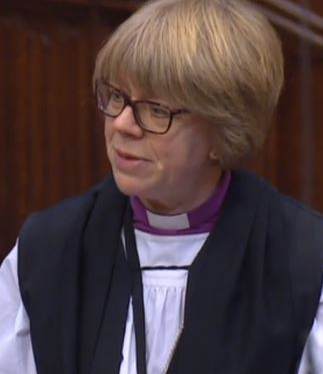
The Bishop of London spoke at the second reading of the Terminally Ill Adults (End of Life) Bill, opposing the bill and outlining the need for fully funded palliative and social care services in the UK:
The Lord Bishop of London: My Lords, as the noble Lord, Lord Kamall, has already pointed out, we in this Chamber share the same goal: for people to die with dignity and compassion. They are critical concerns for those who, like me, believe that the Bill is deeply flawed. Noble Lords will know that I am a former government Chief Nursing Officer, and I chaired the UK Commission on Bereavement. As a nurse, a priest, a daughter and a granddaughter, I have had the privilege to be with many people as they die. Most people die well although, as we have heard and will continue to hear, that is not always the case. I have known people to experience some of the most valuable days of their life as it comes to an end, including those with terminal illnesses.
As the noble Baroness, Lady May, has just pointed out, to change the law is to change society. Any law that introduces choice for a few is not limited in its effect to only those few. If passed, the Bill will signal that we are a society that believes that some lives are not worth living. The Bill would become our state-endorsed position, and our NHS would be active in its delivery. It is the role of the House to scrutinise, but there are no amendments to the Bill that could safeguard us completely from its negative effects.
I am concerned for those who will face internal and subtle pressure to end their lives in the absence of adequate palliative and social care or to avoid being a burden to their families. I understand the fear of many that they may be offered free assisted death before they are offered the care and equipment that they may live. I am concerned that we are still in the dark about how the Bill will be integrated into a struggling health and social care system, as the Delegated Powers Committee report has shown. I am concerned that the Bill is unequal to the task of preventing avoidable deaths due to the existing problems of discrimination, inequality and abuse. I am deeply concerned that so many in Parliament are not heeding the voices of professional and representative bodies that are raising the alarm. Above all, the Bill fails in its central claim that it delivers choice. A meaningful choice would see the measures in the Bill set alongside equally available, fully funded palliative and social care services. Without that being offered, this choice is an illusion.
It may not be the will of the House to take the decision on the principle of the Bill today, but I firmly hope that we will do so at Third Reading. If it is necessary, I will table the amendment myself, so the House is given the same opportunity as the other place to decide. Until then, I have no doubt that the scrutiny given to the Bill in the coming stages will make plainer its inadequacies.
As we have heard, much of the debate is about fear: fear of pain, illness, dependency, loss of control and being somehow unrecognisable to yourself and to others. The challenge, however, is that life is not something to be managed or limited when it becomes difficult. Life is often more than we can ever understand it to be. I believe in a God whose very being is life and, in that gift, we can discover meaning, dignity and innate worth, even if we are dying. To speak of God is to speak of the one who never is indifferent to human fragility, but who holds it and tends it. That is why I believe that there is always hope—hope that what looks like an ending is not the last word and hope that, with proper care, support and research, dignity and compassion are still possible. It is this firm belief that compels me to resist the Bill.
Extracts from the speeches that followed:
Baroness Hodge of Barking (Lab): My Lords, while I respect the views of the right reverend Prelate the Bishop of London, I speak in support of the Bill, in support of the principle of assisting people to die with dignity and in firm support of the legislation before us.
In my view, we are presented with a straightforward choice. Are we prepared to allow people in this country who are facing certain and imminent death to choose how they die? I want that choice for myself. I would have wanted that choice for those close to me whom I have seen die in terrible agony. I want it for the 650 terminally ill individuals who take their own lives each year; for the thousands of the terminally ill who attempt suicide each year; and for the roughly 50 who travel, often alone, to Dignitas each year; and for the many who die in pain each day, even with the very best of palliative care. I ask each and every noble Lord to reflect on whether, whatever they want for themselves, they are prepared to deny others the choice of how they wish to die. Who are we to deny others their right to choose? Denying choice represents a fundamental attack on the freedom and right of individuals to control their lives at that terrible time when they are dying.
There are those who argue that they are not opposing the principle of assisted dying, they just want yet more time for yet more consideration of yet more changes. I must say to noble Lords that I had 30 years in the House of Commons and I have never seen such scrutiny, such openness to considering amendments and such attention to detail as I saw when watching the Bill make its way through the House of Commons. We are deeply indebted to my honourable friend the Member for Spen Valley for the collaborative and collegiate way in which she steered her Bill through the Commons.
Baroness Hayman (CB): I had a wry smile when the noble Lord, Lord Campbell-Savours, said we should not rush into this. It has been 21 years; I am getting near retirement, and I would like to see some progress made. We have to recognise that other jurisdictions have made progress and that there have been advances in palliative care, which I of course support. But I have to say to the noble Lord, Lord McColl, that, however advanced palliative care is, it does not help everybody. I am still haunted by the last conversation I had last year with someone very close to me who was dying in a London teaching hospital that had cared for him for many years, with wonderful palliative care. The last thing he said to me was, “Every night I go to sleep, I pray that I won’t wake up”.
On our visit to Oregon, one of the things that struck me most, which was new to me, was learning how many people asked for a prescription for the drugs to end their life but did not use them. It was around 40% and has been a pretty constant figure, I think, which has been replicated in other jurisdictions.
The right reverend Prelate the Bishop of London rightly said that if we change the law, it will affect more people than the 1% who have an assisted death; but that is a good thing. It would give tremendous comfort and courage to many people with terminal diseases to know that, if the worst comes to the worst, if palliative care cannot help them, there is an option they could choose to take. That would be a good and compassionate thing not just for the 1% but for many more of us.
Baroness Prentis of Banbury (Con): My second point is that death within the law can be—and indeed usually is, as the right reverend Prelate the Bishop of London said—very good. My parents’ deaths are examples of this. My mother’s six years ago and my father’s 12 days ago were assisted by excellent palliative care. Drugs were able to help my parents to breathe and ensure that their pain could be managed at the last. These were good deaths. But my concern is that doctors need to be empowered to be frank and honest and to provide holistic care for the person they are caring for. One of the best things we did for dad was to go round his body disconnecting some of the bleeping machines and syringes that were in him and ask, “Why do you need that? What’s that for? You know that he’s dying. Let’s take it away”.
Those on my side of this debate must be honest as well. There is a small group of illnesses for which a peaceful death is not a likely outcome. We need to focus our efforts collectively on these—on managing them and on managing the law to support them being better deaths.
My third concern is that the ill are very vulnerable. I have recently been diagnosed with aggressive cancer and my treatment starts this week. My prognosis is excellent. I have every advantage. I have a strong faith, a loving family, an interesting workplace, good colleagues, a supportive community, enough money, underlying good health—and indeed excellent treatment, I should say. But there have been some very low moments in the past few weeks, when I have realised the burden I am to my family, who are currently arguing about who should take next week off to look after me. I also have concerns about watching them watch me suffer, as well of course as my own fear, frankly, of pain and loss of control.
I watched that final debate in the Commons, and what struck me was that woman after woman and ethnic minority after ethnic minority, and disabled people, stood up and said, “This Bill is not good enough for my vulnerable community”.
Lord Purvis of Tweed (LD): My Lords, the right reverend Prelate the Bishop of London said this morning that to change the law is to change society. The reality is that society has already changed, and it wants us to change the law. When the House of Commons passed the Bill, the Daily Express newspaper hailed the success of its campaign. Some 21 years ago, when I lodged my Bill in the Scottish Parliament, the entire front page of the Sunday Express—coincidentally on 12 September—shouted:
“MSP in bid to change law to kill patients”.
The death threats I received as a consequence seemed rather ironic to me. So some people have changed their minds over the years, even in the Church, as up to 2017, it denied someone a Christian burial if they died by suicide.
However, the Bill does not concern people who choose to end their life; it concerns those whose life is ending and the choices that they are denied to make that ending better. The arguments I heard in opposition then asserted that palliative care was either the answer or part of the answer, but I think we all know that, even with comprehensive and universal palliative care, there would be times where someone would prefer not to die through sedated starvation. You can prescribe morphine, but not personal dignity. A common argument I heard then was just to allow doctors to quietly ease the passing of people—do not interfere. I do not want an approach to the permanent turning of a blind eye to potential coercion and denial of transparency and protections.
Twenty-one years ago, police and prosecutors rigorously investigated and prosecuted those loved ones for travelling abroad because this enforced the law on assistance. I argued then it was unjust. Now, as we just heard a few moments ago, this is considered unheard of. I have not heard any calls today to return to the approach taken before then, nor have I heard any argument to return to the approach where a patient did not have the right to an advanced directive, to reject a doctor’s insistence on resuscitation or to refuse food and hydration. In their own right, all these changes are accepted by opponents of the Bill, but they provide for an inconsistent, unfair, confusing and, too often, inhumane legal framework.
 The Church of England in Parliament
You must be logged in to post a comment.