
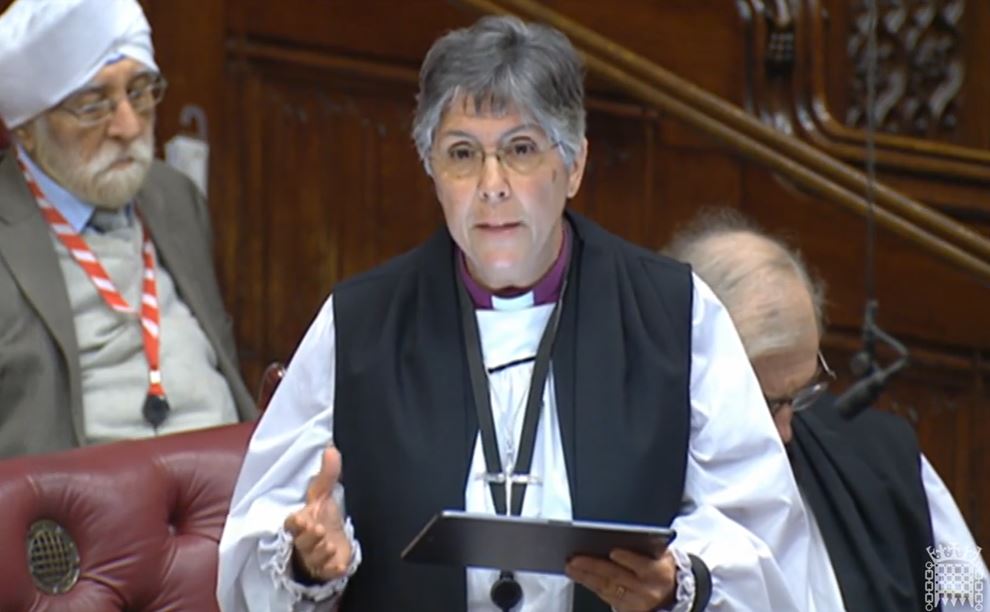
The Bishop of Chelmsford spoke in favour of two amendments to the Children’s Wellbeing and Schools Bill on 16th September 2025, first on introducing a duty on schools to record incidences of racism or interfaith bullying, and secondly on the commissioning of a report on improving educational attainment for children with a parent in prison:
The Lord Bishop of Chelmsford: My Lords, I speak in support of Amendment 464 knowing that, had my right reverend friend the Bishop of Lincoln been in his place, he would very much have wanted to contribute to the debate. If passed, this amendment would introduce a duty on schools to record and report any incidents of racism or faith-based bullying on school premises.
It would also help diocesan boards of education in collating and monitoring such cases and better assisting those church schools which might benefit from support.
In preparing for this speech, I spoke to our own director of education in Chelmsford diocese, whose team oversees 139 church schools. She told me that this proposed amendment had the potential to help the board of education strengthen anti-bullying and inclusive practices in partnership with schools.
Every child deserves to feel safe at school, yet we know that racist and faith-based bullying is a significant driver behind school exclusions. A report published last year by The Difference and the IPPR revealed that black Caribbean children are 1.5 times more likely to find themselves permanently excluded from schools than the national population. Irish Traveller children are three times more likely, and Romani, or Gypsy, and Roma children are four times more likely.
Last November, the Traveller Movement published its Fought not Taught report, which traced examples of coercive exclusions from school settings. The organisation defines “institutionally coerced exclusion” as a situation in which a school setting, either through action or inaction, becomes a toxic environment with
“conditions that make it untenable or unsafe”
for a child to remain enrolled. To name one example, the Traveller Movement’s research has revealed that, tragically,
“67% of young Gypsies and Travellers in London had experienced bullying from teachers that they felt was directly linked to their ethnicity”.
In relation to that, my right reverend friend the Bishop of Lincoln will host the launch of the Traveller Movement’s follow-up publication on Thursday 23 October in your Lordships’ House.
Tell MAMA, or Measuring Anti-Muslim Attacks, is an independent and confidential support service to record incidents of Islamophobia in the UK. Between 2023 and 2024, there was a 43% increase in the number of reported hate crimes targeting Muslims. Some 10% of these incidents occurred in a place of education. To make matters worse, parents often feel that their concerns are ignored due to a lack of formal mechanisms for accountability. Maintaining a clear record of incidents is the first step towards building trust and fostering more collaborative partnerships between parents, schools and local authorities.
However, this amendment would take one step further. For the collective safety and well-being of all pupils, educational environments must be prepared to take concrete action to address and, crucially, to prevent racism. By requiring schools to record actions taken in response when incidents occur, we could ensure that actively anti-racist practice in our schools is the expectation, not the exception.
In 2021, the Archbishops’ Anti-Racism Taskforce published From Lament to Action, which set out recommendations to eradicate racism in the Church of England. Education surfaced as a priority area for action, with commitments to ensure racial justice featuring as a core element of curriculum, staff training and school assemblies. There is, of course, much more work to be done, but this amendment would enable us to make long overdue progress.
The Lord Bishop of Chelmsford: My Lords, sadly, my noble friend the right reverend Prelate the Bishop of Gloucester is unable to be here to speak to Amendment 482 in her name.
This amendment, which I support and has already been touched on by a couple of noble Lords in our debate on the previous group, would compel the Secretary of State to
“commission a report on the educational attainment of school age children with a parent who is in prison”,
and to
“make recommendations for how the educational attainment of those children can be improved”.
I will not presuppose what the recommendations of this report would be. However, through its work in supporting more than 1,450 children with a parent in prison, the charity Children Heard and Seen has shown that, through simple, targeted and tailored emotional support, you can drastically change outcomes for children with a parent in prison.
Having a parent in prison is among the most significant adverse childhood experiences, severely impacting children’s mental health and well-being. Children with an imprisoned parent are 25% more likely to suffer from mental health issues, including depression, anxiety, insomnia and eating disorders. Negative school experiences such as bullying, persistent truancy and academic underachievement are also common among this group. It is estimated that there are almost 200,000 children with a parent in prison in England and Wales, yet we still do not know who or where these children are. This means that they are not being brought to the attention of schools.
Due to the lack of awareness of the issue of parental imprisonment throughout schools, support for children with a parent in prison varies hugely from school to school. There is no uniform approach and many children are left without the appropriate support that they need. Amendment 482 would be a strong step in the right direction in increasing awareness and understanding of the harms within schools of parental imprisonment, ensuring that pupils and students who are affected by parental imprisonment are supported through an inclusive and non-judgmental approach. Children with a parent in prison should be given the same chance in life as any other child. The amendment would help enable them to mitigate the impacts of their parents’ imprisonment, overcoming educational barriers and allowing them to fulfil their academic potential.
 The Church of England in Parliament
You must be logged in to post a comment.