
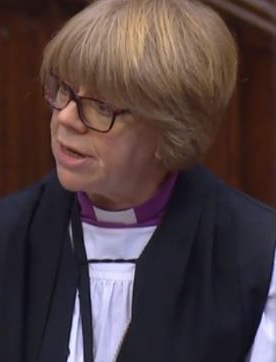
During a debate on the Border Security, Asylum and Immigration Bill on 11th November 2025, the Bishop of London spoke in opposition to two amendments aimed at potentially restricting claims of asylum for reasons of freedom of religion and modern slavery, pointing out the lack of evidence of any abuse of the baptism process by asylum seekers and the need to protect the safety of those under threat from religious discrimination:
The Lord Bishop of London: My Lords, I resist Amendment 79D. This amendment and Amendment 79E in the next group are both motivated by reports that asylum seekers are choosing to convert to Christianity upon arrival in the UK in order to support their claim for asylum on the grounds of religious persecution. Amendment 79E is of deep concern. I will address this in the next group.
Regarding Amendment 79D, I have no objection in principle to this data being collected, apart from the fact that both it and Amendment 79E are motivated by a desire to make an issue of something that is not an issue.
This is not the first time that this House has examined the question of faith-based asylum claims. Under the previous Government, the right reverend Prelate the Bishop of Chelmsford gave evidence on this very topic to the Home Affairs Select Committee in the other place, as noble Lords have heard. Noble Lords will recall that the right reverend Prelate the Bishop of Sheffield referenced the right reverend Prelate the Bishop of Chelmsford’s contributions in a recent supplementary question when addressing claims of the use of Anglican churches as
“a conveyor belt for an industry of asylum baptism”.—[Official Report, 13/10/25; col. 4.]
Noble Lords will be aware that not only did the Committee find no evidence of any abuse of the asylum system through forced conversions but there was no subsequent publication, report or summary regarding this claim. From our previous discussions with the Home Office on this issue, we do not believe that the data spoken of in Amendment 79D can easily be extracted. It seems to me that there are many more problems to be solved in our asylum system before addressing this data point.
The Lord Bishop of London: My Lords, as noble Lords may imagine, I have deep concerns about Amendment 79E. The World Watch List 2025, produced by Open Doors, found that more than 380 million Christians worldwide were subject to high levels of persecution and discrimination for their faith last year, and just under 4,500 were killed for faith-related reasons. Data on the persecution of Christians makes it clear that people are willing to, and indeed do, die for their Christian faith today. We should tread extremely carefully when legislating on such profound matters.
What is more, conversion to the Christian faith is, for most, not like flicking a switch. It is a process that may take years. It is for many Christians not possible to point to a day or hour when they committed their lives to Jesus Christ. John Wesley called it “being strangely warmed”. A public declaration of faith is an important moment in that process, but if that declaration may cost you your life or the lives of those you love, you may think very carefully about when and where you make it. What better evidence in many ways of fear of religious persecution in a country of origin than that a person might wait until they are in the UK to publicly declare their faith? Amendment 79E does not recognise this context. It is also deeply problematic in its denial of the freedom of religion of people living in this country. I need hardly remind noble Lords of the horrors that promoted the creation of the 1951 refugee convention and the 1948 Universal Declaration of Human Rights.
As I said on the previous group in relation to Amendment 79D, under the previous Government, the Home Affairs Select Committee looked at the question of fake religious conversions to support asylum claims. The right reverend Prelate the Bishop of Chelmsford gave evidence to the committee. Not only did the Home Office fail to produce evidence of any abuse of the asylum system through fake conversions, but there was no subsequent publication, report or summary of the committee’s findings, which speaks for itself.
I imagine that there are some asylum seekers who might well believe that converting to Christianity will help their asylum claim. One can hardly be surprised about that, when some politicians keep implying that that is the case. Clergy are not naive. We train them to discern as best they can, through teaching, discussion, reflection, observation and prayer, whether a person, whoever they are, is ready for a public confession of faith through baptism. As the noble Baroness, Lady Maclean, said, no one can see into the heart of another person: that remains between God and that person alone. It is not the job of clergy to assess asylum claims. The Home Office has stated that evidence from clergy or church members in an asylum case does not determine the outcome of a claim.
In January, the Church of England published a guidance document for clergy, Supporting Asylum Seekers; I understand that the Baptist Union of Great Britain, the Methodist Church and the United Reformed Church have also published similar materials. I am proud that the church into which I am called to serve welcomes, indeed embraces, any and all who express a genuine, considered and informed decision to follow Jesus Christ. Churches ought not to feel anxious about supporting and baptising asylum seekers if, to their best knowledge, the clergy are confident there is sincere desire for conversion and a commitment to Jesus Christ and discipleship.
We live in a world in which people regularly die for their Christian faith, and where many hide their Christian faith for fear of persecution. Thus it remains just as important now as it ever has been to offer protection, sanctuary and peace to all those who exercise their right to freedom of belief on our shores. Amendment 79E presents a concerning threat to this.


You must be logged in to post a comment.