
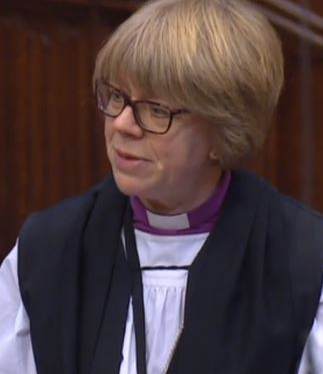
The Bishop of London spoke during a committee debate on the Terminally Ill Adults (End of Life) Bill on 21st November 2025, supporting amendments aimed at introducing further safeguards and monitoring into the bill:
The Lord Bishop of London: My Lords, I will speak particularly in support of Amendments 181, 45 to 49, 58 and 222. It is a privilege to follow the noble Baroness, Lady Hollins, and the noble Lord, Lord Griffiths, whom I thank for sharing their personal stories. They are a reminder to us that this debate touches some of the deepest things within us, and not only should we be kind to each other but we ought also to be kind to ourselves.
I declare my interests as set out in the register, and particularly that I am vice-president of Exeter Hospice Care, chair of the UK Commission on Bereavement, and patron of AtaLoss. Your Lordships will know that, however many amendments there are to this Bill, I do not feel it will ever be safe. But I want to speak on this group because I believe that these amendments are at the heart of the issue of motivation. I remain concerned about the fact that there is currently no real, deep investigation of the motivation for assisted dying.
Amendment 181 is critical for us in monitoring. Even if there were no further restriction on what the motivation is for assisted dying, just knowing and recording it is extremely important because it can give us understanding of why people choose assisted dying, especially if we are serious about properly funding the care and support for people who are dying.
If we are recording the reason why people choose assisted dying, this means that we can highlight reasons why people choose it that do not fall within the aim of this Bill. For example, there is currently no mechanism in the Bill to stop someone receiving an assisted death if they are in pain because they cannot access palliative care. I hope that all of us would believe that, if somebody in that stage of their life wants to live, they should have access to the palliative and social care support that they need.
Professor Katherine Sleeman, the Association for Palliative Medicine and the Royal College of Psychiatrists highlighted the importance of identifying and addressing unmet need. We have already heard about the pressure on our palliative care service. We know that only 30% of hospices are funded by the Government. We have begun to hear about the beds that are closing and the redundancy programmes that are in place. We also know that if hospices are only 30% funded through government funding, 70% comes through voluntary giving. That is unequal across the country, and therefore palliative care services in hospices in areas that are more deprived are likely not to be as good as those in areas where there is higher socioeconomic activity. It is important for us to begin to identify whether there are reasons for people accessing assisted dying that are not within the aim of this Bill. Therefore, asking this question of a person in the preliminary discussion is the bare minimum of what is needed here.
Amendments 45, 46, 47, 48, 49 and 58 all strike at what many other noble Lords have spoken about today: that pressure, coercion, influence, encouragement, whatever word is most legally appropriate, is subtle and complex. When asked about the meaning of pressure during the Select Committee, the Royal College of Psychiatrists cited
“expectation or the worry of letting someone down”.
In a sense, for me, that gets to the heart of why it is so important that we define these feelings and decide what we think about them. We have also heard not only how hard it is to define the term we want to use but how hard it is to spot it. We heard examples of how we are not spotting coercion already today.
We have also heard how hard it is to train. Certainly, one of my concerns in the discussion of the Bill so far has been that often our focus is on medical staff, but actually people spend much more time with support assistants, with nurses, with occupational therapists and a whole range of people, not just medical staff. Often, if somebody wants to talk about dying, it is not with the doctor but with the person who has spent more time with them, and that is a whole array of people. Therefore, training is much broader than I think we often see it.
It is also true that I suspect most of us at times feel obliged to, or a responsibility for, our family. There will be some point in our life, whether through illness or otherwise, when we have felt a burden to others. The reality is that our decisions do not live within a vacuum; they are shaped by the many currents of our life, which are different at different stages. I believe that the Bill’s supporters have decided that the policy intent is that, even if somebody chooses assisted death to save their family the cost of care, that is okay as long as it is their decision and free from coercion. Amendments 47, 48, 49 and 58 demonstrate why this is not okay. They get to the heart of how subtle coercion is. It is not just personal. As we have already heard, it can be society-wide. Discrimination in healthcare provision and failure to resource palliative care or adult social care adequately are examples of this. Indeed, describing indignity as the loss of physical function, or of incontinence, or the reliance on care, is another societal example of this. We need to remind ourselves that each person is of immeasurable value which cannot be diminished by illness, disability or care costs.
I turn finally to Amendment 222, in the name of the noble Baroness, Lady Hollins. Though we have been rightly focusing on the person at the centre of making a choice about their death, as we have heard, death affects so many more people than the person who has died. The National Bereavement Alliance has said that the needs of family members, including children, both before and after death, must be considered and met. We know that people who are bereaved unexpectedly are more likely to experience complex and prolonged grief, which is associated with worse physical and mental health, including suicidal ideation. The bereavement sector forum convened by AtaLoss highlighted the risk that the kind of grief associated with assisted death is very similar. It warned that the impact of failing to address it with the right support will bring costs not just on acute services and social care but on individual people.
That complex grief is also well documented in Canada. The Bill has encouraged helpful conversation about death and dying, but we must make sure that the Bill is clear on guidance and support for many families and friends who are involved with somebody who has requested assisted dying. The work of the UK Bereavement Commission highlighted that people still do not have access today to the bereavement support that they need, and there remains a lack of understanding of the cultural and faith considerations that many communities require for death. I hope that Amendment 222 will be an opportunity for us to be proactive about making sure that family, friends and loved ones can access the bereavement support they require.
Extracts from the speeches that followed:
Baroness Hayter of Kentish Town (Lab): My Lords, this has been something of an unbalanced debate, so I hope it might be possible to hear from someone who supports the Bill. I was particularly anxious to come before the noble Lord, Lord Polak—for whom I have a lot of respect; we agree on many other issues—to respond very soon after the right reverend Prelate the Bishop of London. She was very honest when she said that she did not support the Bill, and I think she said that it was unamendable. Here we are, however, discussing amendments.
The noble Lord, Lord Carlile, spoke earlier about whether we should discuss a form of wording on which we could all agree. The question then would be: if we can agree a form of wording, would he then support the Bill? My feeling is that these amendments are not about making the Bill acceptable so that those putting them forward could then support it but are a way of trying to stop our discussion and proper scrutiny, because they do not want the Bill to go ahead.
(…) The amendments to this Bill are about coercion or pressure. As stated by the noble Lord, Lord Pannick, the situation at the moment is that people can go to Dignitas without even proving to a doctor that they are dying, and without any check as to whether there is coercion or pressure, or whether someone is going to inherit their house. They can go, and that is the way they end their life, and they feel it is not worth living any longer. On the definition of coercion, are we really content with continuing the status quo where there is absolutely no check—from a psychiatrist, a social worker, a lawyer, or anyone else—on whether they have been coerced? That is the alternative: allowing the status quo to continue with no checks whatever.
We have to ask, therefore, whether these discussions about definition are really about that, or whether they are about trying to stop the Bill. Perhaps we could discuss whether those who want the wording changed would then support the Bill. If they would, let us get down to discussing that, but if they are never going to, they are wasting the time of those who want it to go through.
Baroness Rafferty (Lab): I thank the noble Baroness so much. I speak as a nurse and a former president of the Royal College of Nursing. I thank the right reverend Prelate the Bishop of London for referring to the broader family of health practitioners who are impacted by the Bill.
I also note the comments made by the noble Baroness, Lady Berridge, about training. I wonder whether the noble Baroness is aware of the current intercollegiate guidance on safeguarding, which covers many of the types of abuse touched upon in our current debate. Secondly, does she agree that many of the scenarios that have been presented and portrayed in this debate could provide very helpful material for the training that would be provided were the Bill to be passed?
Baroness Lawlor (Con): My Lords, I support the amendments in this group. I am a research director at Politeia, a think tank that has commissioned a great deal of work from lawyers and academics, including on this subject, but I speak in my own capacity as a historian. I associate myself with the remarks of the noble Lord, Lord Griffiths of Burry Port, and the right reverend Prelate, who reminded us that we are part of a whole society and not just one person against another.
I support these amendments because they aim to tighten this Private Member’s Bill and prevent it being unsafe by prohibiting inducement to assisted suicide by those who, for whatever reason—we have heard about the reasons—seek to induce, encourage, advise or influence another to take his or her own life. My Amendment 57A would prohibit someone from planting the idea in the person’s head and getting them to consider suicide as an acceptable or even necessary course of action, so inducing them to choose an assisted suicide, which he or she might not otherwise have considered as an option. Given that the planting of such an idea could be done in a number of ways, directly or indirectly, under the Bill as it stands, and given the gravity and irrevocability of the decision to end your own life, the safeguard is needed.
 The Church of England in Parliament
You must be logged in to post a comment.