
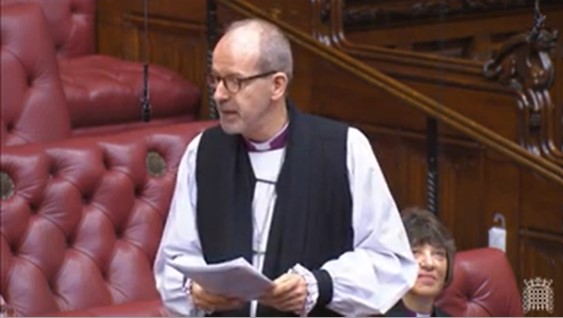
The Bishop of Hereford spoke during a committee debate on the Terminally Ill Adults (End of Life) Bill on 30th January 2026, pointing out a distinction between AI tools and artificial intelligence generally in regards to an amendment proposed by Baroness Coffey, which would stipulate that “(4) Artificial intelligence must not be used to carry out any functions in any section or schedule of this Act.”
The Lord Bishop of Hereford: I thank the noble Baroness, Lady Coffey, for raising a very important issue in this amendment. However, I am concerned that, as it stands, as the noble Baroness said, this amendment is too blunt an instrument. It is important that we distinguish between AI tools and the more dangerous artificial general intelligence, or superintelligence. The use of AI in medical diagnostics in patient care is already commonplace. AI tools are currently used to read scans and X-rays and will frequently perform as well as, if not better than, clinicians. To exclude the use of AI altogether might deprive patients who are considering assisted dying of valuable diagnostic assistance and care at a very vulnerable time.
However, it would not be acceptable for a general-purpose artificial intelligence, still to be developed, to be part of the decision-making process. We debated the importance of face-to-face diagnostics on the last group of amendments. Were this Bill to pass, it wouldbe vital that decisions about assisted dying required the combination of intelligence, wisdom, and love—as defined by Thomas Aquinas as
“to will the good of the other”.
These are distinctive and uniquely human qualities. However sophisticated AI becomes, it can never replace human interaction and judgment—and it should not do so.
I hope the sponsors of this amendment might consider a redrafting that takes account of these fundamental differences, retaining access to helpful diagnostic tools while excluding a general-purpose superintelligent AI, still to be developed, from a decision-making process that properly resides in human agency.
 The Church of England in Parliament
You must be logged in to post a comment.