
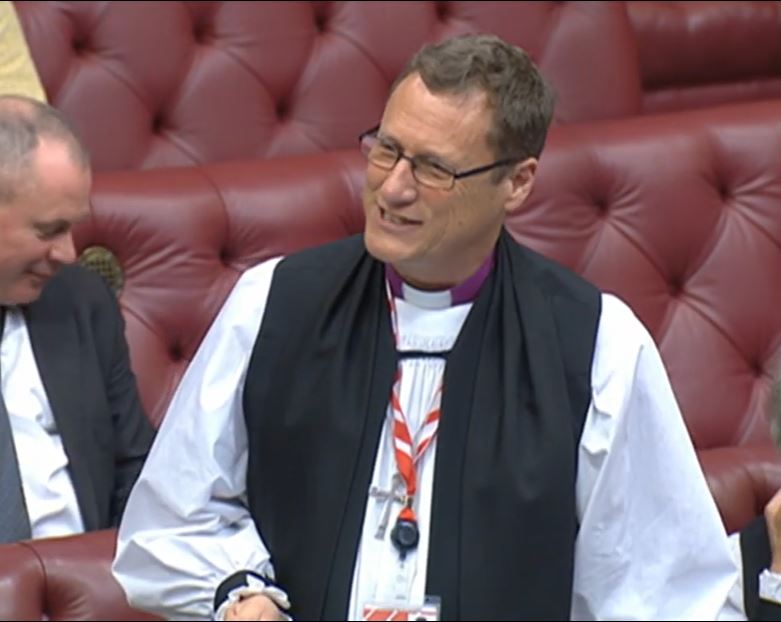
The Bishop of Leicester spoke at the second reading of the Universal Credit (Removal of Two Child Limit) Bill on 12th March 2026, welcoming the bill and criticising the impact of the two child limit on poverty and the associated sense of shame those engaging with the welfare system are made to feel:
The Lord Bishop of Leicester: My Lords, I warmly welcome the introduction of the Bill and the opportunity today to comment on it. I congratulate the noble Baroness, Lady Teather, on her truly excellent maiden speech, and I look forward to the maiden contributions of the noble Baroness, Lady Antrobus, and the noble Lord, Lord Walker, as well as of other noble Lords.
I count myself very fortunate to have never experienced true poverty myself, but I have spent much of my working life living in communities where poverty was very real—both the absolute poverty of one of the poorest nations in Africa, where I worked for several years, and the relative poverty of inner-city Sheffield, where I was vicar for a decade before becoming Bishop of Leicester.
I have seen first-hand, therefore, that poverty is not just about material resources but also has a much wider psychosocial impact. Amartya Sen argued that poverty should be understood not as low income but as capability deprivation: the lack of real freedom or opportunities to live a life one has reason to value. Martha Nussbaum expanded Sen’s framework by proposing a list of central human capabilities—such as life, bodily health, imagination, emotion, affiliation, play, and control over one’s environment—which all societies should secure for every citizen as a matter of justice.
Added to this is what some have called the poverty-shame nexus: the mutually reinforcing relationship between material hardship and the emotional experience of shame. People in poverty can experience shame through various mechanisms: social stigma, being judged as lazy, undeserving, or morally inferior; institutional interactions—for example, public services that treat people disrespectfully; or cultural norms that define success and worth in material terms. Research has found that people internalise stigmatising narratives about poverty and, as a result, have lower self-esteem and self-worth, and avoid social interaction with others.
Universal credit and its system of sanctions arguably institutionalise the poverty-shame nexus. Although I accept that its introduction in 2013 brought a necessary simplification to welfare payments, I nevertheless believe that the system of sanctions in particular has an implicit moralising message. Claimants must continually prove that they deserve support because they are both “poor enough” and “trying hard enough”. I have spoken with people who describe the feeling of being “presumed guilty until you are innocent”, on the assumption that every person looking for help might be “cheating the system”.
It is my belief that the two-child limit to universal credit has only added to the poverty-shame nexus. The assumption would appear to be that if you are on universal credit and have more than two children you are somehow not being responsible. Yet I have three wonderful children—I am sure that many other noble Lords also have more than two children—and I confess that I did not make a financial calculation ahead of deciding to have a third child. I wonder how many of us did. Surely, then, we have a duty to lift the sense of shame from others, not reinforce it.
Bishops on this Bench have consistently opposed the two-child limit right from its introduction. Indeed, as has already been mentioned, the former Bishop of Durham introduced a Private Member’s Bill seeking to abolish the limit in 2022. For us, this is part of a much wider calling to combat poverty in all its forms, addressing its causes and wider effects. I know that noble Lords on all sides of this House share that concern. Our differences are more to do with how, rather than whether, it is done. Yet I dare to hope that, once this policy is changed, we can work together to find other areas whereby those who are caught in poverty are enabled to contribute their gifts and skills to wider society.
Extracts from the speeches that followed:
Viscount Younger of Leckie (Con): I thank all other noble Lords who contributed to this debate and set out their views with such conviction on what is—in my view and in our view on this side—a deeply mistaken policy. I say that as someone who is proud of the compassion that defines this country.
The British people are generous, fair-minded and instinctively willing to help those in genuine need. That spirit of neighbourliness and of looking out for one another is something we should always cherish and protect. The noble Baroness, Lady Teather, is right: handling language and collaboration and getting these matters right are important factors in communities, where matters can be extremely sensitive.
However, compassion must also be balanced with fairness, as my noble friend Lady Jenkin alluded to. I am afraid that this policy tips that balance too far the other way. It asks those who work hard, pay their taxes and support the system to shoulder ever-greater burdens while expanding reliance on the state in a way that risks undermining the very foundations that sustain it.
It would be easy for me to say that raising the cap would be the right thing to do, and I was very pleased to note that the right reverend Prelate the Bishop of Leicester and, indeed, my noble friend Lord Redwood acknowledge that we all want to reduce child poverty—I personally want to, we all want to, but how we do it continues to divide opinion; that much I think we can agree on.
Baroness Sherlock (Lab, DWP): The Bill is supported by over 60 organisations, representing anti-poverty charities, which is perhaps not surprising, but also children’s doctors, teachers and health visitors—the people who know only too well the damaging effects of poverty and see its consequences every day. I remain very grateful for the work of the campaigning organisations, those professionals who support our children and all those who pushed for this change, including the Bishops’ Bench. I share the remembrance of the former right reverend Prelate the Bishop of Durham, who pushed for this in his time in this House.
The Bill is an investment to deliver a better future for children and for our country. Many noble Lords, including the noble Baroness, Lady Teather, and the right reverend Prelate the Bishop of Leicester, have set out the devastating impact that poverty has on children. Many, including my noble friend Lord Babudu, have pointed out that poverty is not evenly distributed.
Poverty imposes really significant costs on individuals and the country. Let me start with the Official Opposition, because they have set out clearly why they oppose this. It is my experience, in many years in and around politics, that, if you want to defend the indefensible, the first thing you do is set up some clearly false dichotomies. What have we listened to today? “It is children versus defence”. Of course it is not. If I were going to play politics, I would point out that, if the Conservatives felt that passionately about it when they were in government, maybe they should not have cut £12 billion from defence spending in their first term alone; maybe they should not have cut spending from the 2.5% the last Labour Government left, pushing us to raise it to 2.6% by next year; maybe they should have slashed child poverty. They were not choosing between the two things: they attacked both of them. Now, we could have that kind of conversation, or we could have a different kind of conversation. Let us take a step back and look at what actually happens with the policies.
 The Church of England in Parliament
You must be logged in to post a comment.