
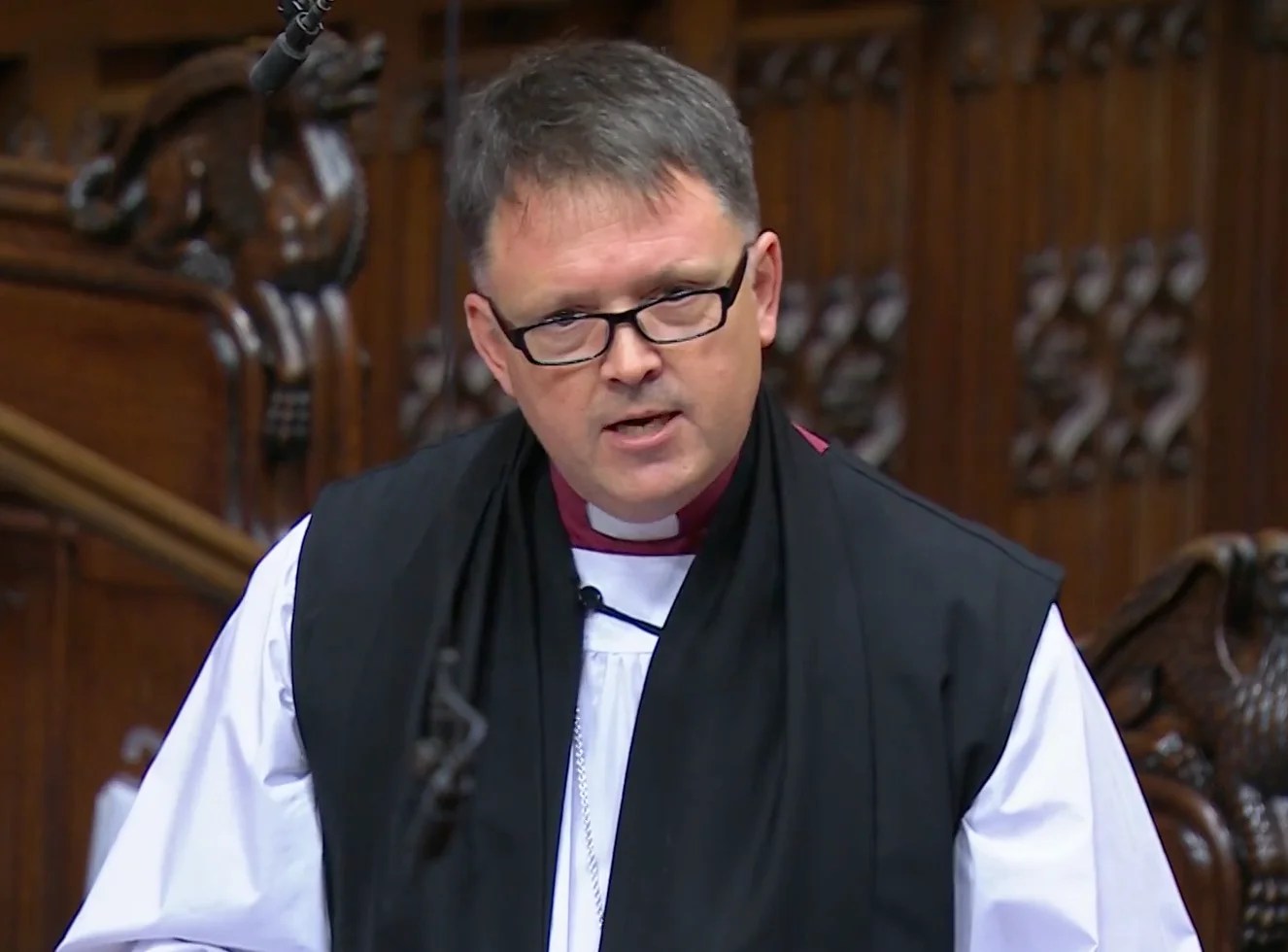
The Bishop of Norwich spoke at the second reading of the Armed Forces Bill on 6th July 2026, detailing the importance of the armed forces covenant to supporting communities and the military:
The Lord Bishop of Norwich: I thank the Minister and his officials for their work on this Bill. It is a privilege to follow the noble and gallant Lord, Lord Craig, and I look forward to hearing further contributions from noble and gallant Lords with their wealth of experience. When I read in Hansard the record of the Second Reading debate on this Bill’s predecessor five years ago, I could not help but notice that the noble Lord, Lord Coaker, and the noble Baroness, Lady Goldie, will simply be swapping places when they come to sum up this debate. In my remarks, I will focus on three areas: first, the Armed Forces covenant; secondly, the whole-society approach to civil preparedness; and thirdly, some niche comments related to the service police powers.
“Covenant” is an ancient word with deep resonances in Judaism, Islam and Christianity. It is about gifts offered and received, about commitments made and honoured, lived in mutual reciprocity. When we ask much of our Armed Forces—and, God forbid, we might need to ask more of them and their families in the years to come—pledging a commitment to what they can expect in return for all that they give and, for veterans, have given, is the mark of a grateful society.
“Gratitude” is perhaps an old-fashioned word these days, but when we lose it, recruitment drops, morale drops and retention drops. At its heart, the Armed Forces covenant seeks to embed gratitude—not special favours or a jingoistic patriotism, but a simple commitment to understanding, fairness and opportunity. That is why I am pleased that His Majesty’s Government are proposing in the Bill to enshrine the Armed Forces covenant fully in law, by extending it to central, devolved and local authorities, and expanding the issues to which these and certain public bodies must have due regard.
So much flows from that: mutual responsibility, protecting the vulnerable, providing hospitality and integration, and including appropriate housing at a good standard. Although the focus is rightly on family housing, I hope the new proposed defence housing service will also ensure that single persons’ accommodation is of a standard that can create a sense of home. I hope consideration will also be given to fitting housing with good insulation and solar panels, so reducing energy costs and contributing to His Majesty’s Government’s net-zero commitments.
The Armed Forces covenant was signed on behalf of the Church of England by the then Archbishops of Canterbury and York in February 2015. Since then, a number of English dioceses have also signed, working in partnership with local veterans, reservists and military bases. I confess that the diocese of Norwich needs to catch up, though I value my own engagement with RAF Marham, with the Queen’s Dragoon Guards at Swanton Morley, and those who serve at the STANTA. At the latter, I have witnessed the valuable work being done by the British Army, in collaboration with forces of other nations, in training Ukrainian conscripts to fight for the freedom of their country against Putin’s tyranny.
I believe that churches and Church schools have a particular role to play in supporting the 124,000 children of military families, who are likely to have to move school more often than others and to have parents away on deployment, sometimes for long periods with limited contact.
It strikes me that the conversations around signing the covenant, the engagement that involves with His Majesty’s forces, and the prompt that this gives to think more through the eyes of service personnel and veterans, is of as much importance as the ceremony of signing. Through good conversations, understanding is fostered, and the gift of concern and care can be extended.
I imagine that I am not the only father of a soldier who has stood at the central memorial at the National Memorial Arboretum in Staffordshire and run his hand over those panels of carved names on Portland stone, only to reach our contemporary era, where the stone becomes smooth: smooth stone awaiting chiselling—the names of those who will be prepared to pay the ultimate sacrifice in defence of our nation in whatever will unfold in the years to come.
There are other people, each also treasured by God, who carry or will carry the scars of conflict and war in body, mind and soul long into the future, often impacting those around them. Among those who support and care for them are our Armed Forces chaplains—men and women, both regulars and reservists, whose calling is to serve alongside, being with and being there at both joyous and tragic moments, offering hope, peace and prayerful presence, and being the bearers of spiritual, moral and pastoral support. The Armed Forces covenant is, in a sense, a continuation of that pastoral care shared by us all in wider society.
My second point is about whole society preparedness. The recently published Global Peace Index 2026 found that
“the world has continued its longstanding trajectory of deteriorating peacefulness … There are now more active state-based conflicts than at any point since the end of the Second World War, while the number of countries involved in external conflict has nearly doubled since 2008”.
Given the troubling and dangerous times we live in, the Church of England’s General Synod has been considering how we might be called to be the Church in a time of war. Last July, we heard from the Lutheran Archbishop of Tallinn, Urmas Viilma, about how their preparedness is significantly advanced. This does not sit easily with the Jesus that I encounter in the gospels proclaiming peace-making and that most difficult of commands about love of neighbour and love of enemy.
I note that Bishop George Bell in November 1939, faced with a terrible impending European war, said:
“It is the function of the Church at all costs to remain the Church”.
The Church’s task is therefore to work and pray for peace, and to shape and form peacemakers, peacebuilders and peacekeepers. I would argue that, while not scaremongering, we need also to prepare for the threats we face. The Church and other faith groups would play a key role in supporting communities in the event of a major conflict. Resilience, community solidarity and hope are all key Christian virtues that people have valued in previous wars and would be much needed in any future conflict. As St Paul’s letter to the infant church in Rome put it:
“Hate what is evil, hold fast to what is good”.
Will the Minister outline what preparations are in place and what resources are being made available to meet the strategic defence review’s goal of a “whole-of-society approach” to the review’s implementation, including
“widening participation in national resilience”?
My final point, and I declare a familial connection with the Royal Military Police, is a concern that under the Armed Forces Bill, service police will not be able to authorise pre-charge custody for Schedule 1 offences—that is, for battery, even when there is a domestic context. This is because the legislation is drafted for all serious offences to be in scope, which does not include Schedule 1 offences and does not articulate the context of domestic abuse offences. The issue of commanding officers dealing with domestic abuse offences was brought up by the Centre for Military Justice in its evidence in response to the Armed Forces Bill. It recommended an amendment to the relevant schedules to prevent commanding officers dealing with any domestic abuse matter at summary hearing. Although the Royal Military Police has a strong policy position that, where there is a domestic abuse context to offences, the commanding officer could investigate, it is very clear that such cases should always be referred to the relevant policing authority so that it can consider investigating. This is not articulated in legislation. Will the Minister commit to look at that please?
More broadly, I raise the issue that the additional requirements of meeting the threshold of a serious offence will add additional bureaucracy for service police during the arrest of suspects. This could be reduced by giving complete authority to authorise pre-charge custody to the provost marshals. The definition of a serious offence is noted as being similar to, but different from, the definition of a serious service offence in Part 1 of the Armed Forces (Powers of Stop and Search, Search, Seizure and Retention) Order 2009. The added complexity of this definition will inevitably slow down the processing of suspects in arrest and risk incorrect authorisations of pre-charge custody. Giving the provost marshals authority to authorise pre-charge custody in all offences would reduce these risks and give the service police greater parity with its civilian counterparts, who can authorise custody in such cases.
I have been made aware that service police currently have no specific legal protection against impersonation, either by civilians or by persons subject to service law. As the service police as forces are not constituted under the Police Act 1996, the offence of impersonating a police officer and the linked offences in Section 90 of the Police Act do not create an offence of impersonating a service police officer; nor are service police currently protected by the enhanced sentencing powers of the Assaults on Emergency Workers (Offences) Act 2018. Service police officers are regularly assaulted on duty yet are not given the same respect and protections afforded to civilian police officers and other emergency workers.
Will the Minister commit to looking at these anomalies around impersonating and assaulting service police so that there can be parity with their civilian counterparts, with a view to potentially introducing a government amendment to bring clarity to these current anomalies? I look forward to engaging with the Bill as it progresses through your Lordships’ House.


You must be logged in to post a comment.