
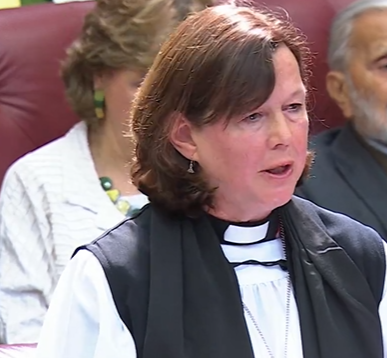
The Bishop of Peterborough spoke in a debate on the effects on AI, screen usage, and social media on children on 22nd October 2026, raising the challenges faced by AI for church schools:
The Lord Bishop of Peterborough: My Lords, it is a privilege to speak on a subject so critical to the flourishing of young people. I welcome this debate. I too wish to focus primarily on the role that emerging technologies might play in our schools and how we, as the shepherds of those who attend them, can ensure that such technologies are integrated safely, usefully and with humanity in mind. At its heart, a school is a place of preparation, and a good school system must equip young people to confront the challenges of life. But I ask your Lordships to consider whether we have given enough thought not just to preparing young people but to preparing and resourcing those we charge with educating them.
To give one example, there is a Church of England primary school in Peterborough diocese with just 99 pupils on its roll. It is not uncommon for a Church of England school to be even smaller than this. The governance challenge presented to such schools by the emergence of AI is enormous. How do we ensure its use is safe? How do we integrate it in a way that guarantees the security of children’s personal data? These are great philosophical questions, as well as governance ones. As a nation, we bear a responsibility to build a consensus that aids our schools with practical advice and support in navigating this new aspect of our world. We owe it to our educators not to expect them to conjure specialist knowledge on AI integration from thin air but to equip them so that they can prepare our children for lives where they can use these technologies safely.
The philosophical question of what it means to be fully human is one that the Church has been seeking to guide on for as long as it has existed. In our Church schools, we place the concept of human flourishing at the heart of what we do. We have a vision of a school as a place where pupils bloom into the human being they will become for the rest of their lives. These technologies have the potential to enhance our human relationships, experience and intellect, but, as we have heard, they also have the potential to replace, displace or diminish the humanity in our daily lives. Which of these paths we take is ultimately a very human choice. Whether AI and technology used by or in the service of children enhances or diminishes a human purpose is, to us, the central and critical question of our time.
At the National Society for Education, we are already exploring both the challenges and the opportunities of AI in Church schools. First and foremost, this is by working with schools and the diocese to understand their needs. Nothing can replace that first-hand experience from those who know their students so well, and I encourage the Government to look at similar consultation as they set their own policy. We have a solemn responsibility to prepare the next generation for a future where the widespread use of AI is their reality. As a nation, we must properly equip our educators to do so.
Lord Brooke of Alverthorpe (Lab): The essential principle is that AI should support human relationships, not replace them. Could we develop appropriately safeguarded AI companions to help children struggling with obesity, loneliness, poor self-esteem or difficulties in forming relationships? Rather than encouraging more screen dependency, could we help them develop healthier lives and stronger relationships with other people? Such applications would of course require independent evaluation and appropriate professional support.
I give another example. This House sent a Select Committee to Blackpool when it was undertaking a review of obesity, diet and how we could affect changes. In the north-west, we found particularly heavy growth of obesity among children. We have been weighing and measuring children since 2008, yet they get bigger and heavier. We found in Blackpool that the social services people were saying, “We do the measuring and weighing, but we do not do any follow-through to assist them because we don’t have the resources”. Is this not an area where potentially we could explore the use of an AI companion with children to give them guidance about food, calories and so on? These are areas worth looking at.
The other area that is developing—we wait with interest to see the report that is coming on employment—is how we start to prepare, if possible, for the different style of working that will be needed in the future and the extent to which we can use AI. AI is going to destroy many jobs that we have known, and what we have called “growth” may have to be redefined in the future, with a shift from the material and more towards—here I look to our Bishops’ Bench—the caring professions and towards teaching people about the importance of service as opposed to producing goods. This is an are where we do things better than AI or indeed any technology could do. We should look to the strengths in humanity and start increasingly to try to pass on the message to children and to train them and find all the tools we can, including AI, to make certain that we are effecting this very important shift that will replace many of the traditional approaches to employment.
Lord Clement-Jones (LD): On many occasions, I have asked whether this technology will be our servant or master. Today, that question has a rather sharper edge: is this technology serving childhood, or are our children being shaped to serve a business model built on attention? Are we being invaded in our domestic lives, as the noble Lord, Lord Rees, said; or, as the right reverend Prelate the Bishop of Peterborough said, is it serving their humanity?
The debate is no longer about whether to act; it is about whether what we do is well-designed, grounded in evidence and able to keep pace with AI. At its heart is one principle: safety by design. The question is not only which children we keep off which platforms but whether the products themselves are built with children’s well-being in mind.
The Earl of Effingham (Con): This outcome should not be a surprise to noble Lords. While no consensus has been reached regarding edtech’s benefits and only 7% of companies have conducted controlled trials, schools have been left with the responsibility of weighing the costs and benefits of procurement in line with their longer-term strategies. The right reverend Prelate the Bishop of Peterborough argued that we owe it to our educators. The noble Baroness, Lady Murphy, rightly challenged the Minister on the very same subject. Schools are left to navigate an uncontrolled experiment while edtech companies have little oversight of their actions.
These are big tech companies. The noble Lord, Lord Alton, flagged that some of them have larger market capitalisations than the entire GDP of many national economies. The noble Lord, Lord McFall, reminded us that AI, bizarrely, is less regulated than milk or washing machines. As a minimum, the industry must have some kind of centralised oversight. Will the Minister commit to such regulatory scrutiny, in line with the request of the noble Lord, Lord Tarassenko, to be measured in months, not years?
There is, rightfully, much interest around the benefits that new technologies can bring to learning and working. We are not suggesting that technology cannot be used to improve schooling, or children’s lives in general, but simply that it must be rigorously tested before it is rolled out and then overseen when it is.
Baroness Lloyd of Effra (Lab, DBT/DSIT): A number of noble Lords, including the right reverend Prelate the Bishop of Peterborough and the noble Lord, Lord Hampton, have stressed the critical role of teachers. The DfE has published practical AI support materials for teachers covering opportunities and risks of AI, which was updated in May 2026, and is developing a new digital and data skills pathway for the education workforce, setting expectations for skills needed to use tech, data and AI safely. The Department for Education’s policy paper Generative Artificial Intelligence (AI) in Education sets out our approach to the opportunities and risks of generative AI in education and provides advice on using AI safely, effectively and responsibly. These guardrails are incredibly important for the correct adoption of AI technology in our classrooms.


You must be logged in to post a comment.