Bishop of Gloucester asks about proposed review of personal independence payments

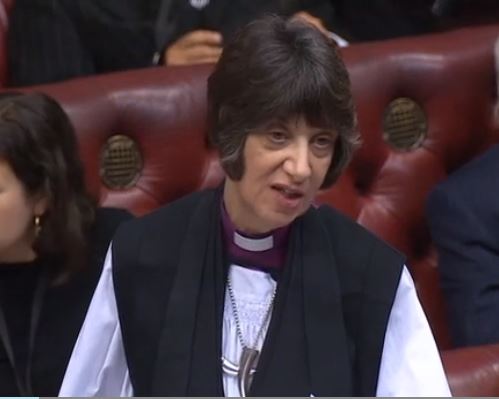
The Bishop of Gloucester asked a question on how the government’s proposed review of personal independence payments (PIP) would affect those with severe lifelong disabilities on 23rd April 2024:

The Lord Bishop of Gloucester: My Lords, yesterday I visited National Star, an FE college that serves young people with severe lifelong disabilities. Many of them are being subjected again and again to reassessment throughout their lives. That is not only traumatising but a complete waste of time and resources. What will the Government do to take this into consideration so that people with severe lifelong disabilities are not subjected to reassessment again and again, unless, of course, that disability is generative?

Continue reading “Bishop of Gloucester asks about proposed review of personal independence payments”

Bishop of Oxford asks about use of data in education

The Bishop of Oxford received the following written answers on 23rd April 2024:

The Lord Bishop of Oxford asked His Majesty’s Government whether they give third parties access to national pupil data or learner records, and whether they charge a fee for any such access.

Baroness Barran (Con, DfE): The department will only share pupil, or learner, level data with others where it is lawful, secure and ethical to do so. Where these conditions are met and data is shared, the department do not charge any fee.

Continue reading “Bishop of Oxford asks about use of data in education”

Bishop of Derby speaks in debate on help for parents and families considering separation

The Bishop of Derby spoke in a debate on support for parents considering separation on 22nd April 2024, referencing the work of the Archbishops’ Commission on Families and Households and the need for open communication with children in cases of family separation:

The Lord Bishop of Derby: My Lords, I am grateful to the noble Lord, Lord Farmer, for bringing this debate on this important matter. As I hope noble Lords will know, the Archbishops’ Commission on Families and Households—with which I know the noble Lord was engaged—looked at this subject closely. It is out of this commission that I want to speak this evening. During the commission’s work, the Divorce, Dissolution and Separation Act became law. Opportunities could be taken through that legislation to ensure that couples separating and considering separating—and their children—are made aware of all the support that could be available to them. Surely this is an area in which pastoral concern must feature heavily, both in our policy-making and in our application of legislation and guidance.

As the Family Justice Review found more than a decade ago, too many families whose relationships disintegrate end up in the court system. While the creation of a single unitary family court was a step in the right direction, there is still much work to do, not least in reducing delays in the family courts. As we have heard, the removal of legal aid for separating couples, except where there are allegations of domestic abuse or where a child is at risk, means that couples may not receive the advice and support they need. The continued availability of family mediation vouchers is welcome but is not necessarily a substitute for the vital legal aid that could be in place.

Continue reading “Bishop of Derby speaks in debate on help for parents and families considering separation”

Votes: Safety of Rwanda (Asylum and Immigration) Bill

On 22nd April 2024, the House of Lords debated Commons Reasons and Amendments to the Safety of Rwanda (Asylum and Immigration) Bill, and votes were held on further amendments, in which bishops took part:

Continue reading “Votes: Safety of Rwanda (Asylum and Immigration) Bill”

Leasehold and Freehold Reform Bill: Bishop of Derby opposes clause affecting estate areas

During a debate on the Leasehold and Freehold Reform Bill on 22nd April 2024, the Bishop of Derby, on behalf of the Bishop of Manchester, spoke in opposition to clause 28 standing part of the bill, as it would have adverse affects on great estate areas such as the Hyde Park Estate:

The Lord Bishop of Derby: My Lords, I will speak in support of my right reverend friend the Bishop of Manchester, who is unable to be in his place today and who has asked me to speak to his opposition that Clause 28 stand part of the Bill. This is linked to a similar stand-part debate, in the name of my right reverend friend, relating to Clause 47, to be debated later in Committee.

I declare my interest as a beneficiary, as is my diocese, of the Church Commissioners. I thank the Minister for her engagement with the charities affected by the legislation so far: the Church Commissioners, John Lyon’s Charity, Portal Trust, Campden Charities, Merchant Taylors’ Boone’s Charity, Dulwich Estate and the London Diocesan Fund. I hope she will continue to engage with my right reverend friend to find an amicable solution.

Continue reading “Leasehold and Freehold Reform Bill: Bishop of Derby opposes clause affecting estate areas”

Bishop of Newcastle emphasises importance of caution and public endorsement in approaching development of AI weapons systems

The Bishop of Newcastle spoke in a debate on report from the Artificial Intelligence in Weapon Systems Committee, highlighting the need for AI systems to be viewed with caution, and the importance of public confidence in future developments:

The Lord Bishop of Newcastle: My Lords, I am grateful to the noble Lord, Lord Lisvane, for his opening summary of this important report and to the noble Lord, Lord Stevens, for his remarks just delivered, reminding us of the maritime context of this debate as well. I also thank those involved in the creation of the report. Perhaps this alone is worth noting: AI did not produce this report; human beings did.

My friend the right reverend Prelate the former Bishop of Coventry was a member of the committee producing the report and he will be delighted that it is receiving the attention it deserves. He is present today, and I hope he does not mind me speaking on his behalf in this regard.

Continue reading “Bishop of Newcastle emphasises importance of caution and public endorsement in approaching development of AI weapons systems”

Bishop of Newcastle speaks on debate on horticultural sector

The Bishop of Newcastle spoke in a debate on a report from the Horticulture Sector Committee on 19th April 2024, with a focus on the welfare of seasonal workers and the benefits of promoting connections with nature:

The Lord Bishop of Newcastle: My Lords, I thank the members of the Horticultural Sector Committee for their work in producing a thorough report highlighting the challenges that this undervalued sector experiences. I also thank the noble Lord, Lord Redesdale, for his excellent summary when opening this debate. It is an honour to follow the noble Earl, Lord Caithness.

My understanding of this sector has been greatly helped by conversations with horticultural business owner Matt Naylor in south Lincolnshire, whom I met at the Oxford Farming Conference a few years ago. Listening to Matt has brought home to me the immense obstacles that the horticultural sector has faced in recent years. As other noble Lords have indicated, the sector is not in isolation from the totality of the farming and agricultural sector. To ensure food security for the future, of which horticultural activity is an integral part, we need joined-up, long-term thinking. I share the disappointment of noble Lords in this debate that the Government scrapped their plans last year to publish a horticultural strategy for England.

I want to focus my remarks on two issues. The reality of the seasonal work that the sector requires is not suited to most UK residents, resulting in a reliance on migrant seasonal workers. Without them, the industry could not function. However, their working arrangements often place them in positions of vulnerability. As evidence to the committee revealed, their protection under UK employment law is frequently not upheld. Seasonal workers often face abuse and poor pay and working conditions. I agree with the remarks made by the noble Baroness, Lady Bennett, on this matter.

Continue reading “Bishop of Newcastle speaks on debate on horticultural sector”

Bishop of St Albans asks about possible surge in cases of prostate cancer

The Bishop of St Albans received the following written answer on 19th April 2024:

The Lord Bishop of St Albans asked His Majesty’s Government:

  • further to recent research conducted by the Lancet Commission, what steps they plan to take to address the projected surge in prostate cancer cases.
  • what plans they have to expand public awareness campaigns for prostate cancer, following the prediction by the Lancet Commission of a surge in cases.
  • what assessment they have made of the Lancet Commission on prostate cancer, published 4 April 2024.
  • what plans they have to use artificial intelligence systems to support the diagnosis of prostate cancer, as recommended by the Lancet Commission in research published on 4 April.
Continue reading “Bishop of St Albans asks about possible surge in cases of prostate cancer”

Bishop of Southwell and Nottingham speaks on importance of funding for local authorities to support and provide for children in their care

On 18th April 2024, Bishop of Southwell and Nottingham also spoke in the debate on children in local authority care in the UK, on themes of early intervention and support for foster carers, and the need for more funding for local authorities to ensure this:

The Lord Bishop of Southwell and Nottingham: My Lords, I too am grateful to the noble Lord, Lord Laming, for bringing this important debate forward and for the very compelling case that he set out in his introduction. I am also grateful for the immensely valuable contributions made by other Members.

It is surely one of the primary tests of a civil society that, where it is necessary for a child or young person to be brought into care, the very best outcomes are made possible through the quality and consistency of that care, whatever financial constraints arise in the economic cycle. So many outcomes later in life are directly related to childhood experience. That is why it should be an all-party commitment that money for children’s services should be ring-fenced, including those that enable vital early help and intervention, as the noble Lord, Lord Laming, the noble Baroness, Lady Benjamin, and other noble Lords expressed so well.

Continue reading “Bishop of Southwell and Nottingham speaks on importance of funding for local authorities to support and provide for children in their care”

Bishop of Newcastle calls for greater support for families and kinship carers in debate on children in local authority care

The Bishop of Newcastle spoke in a debate on the number of children in local authority care in the UK on 18th April 2024, highlighting the large numbers of children in care in the North-East of England and the need for stronger support for kinship carers:

The Lord Bishop of Newcastle: My Lords, I thank the noble Lord, Lord Laming, for securing this timely debate, and particularly the noble Lord, Lord Meston, for his remarks just now, with which I strongly agree. Yesterday afternoon I attended the launch of the Child of the North APPG’s report, Children in Care in the North of England, and heard the compelling testimony of two young women, Rebekah and Kirsty, whose lives have been impacted by experiences in the care system.

The number of children entering local authority care is increasing nationally, but the north of England persistently records the highest rates of children in care. Local authorities bear the financial burden, with their budgets increasingly directed towards often unregulated private residential care providers, as other noble Lords have referred to, rather than long-term investment supporting families before they reach crisis point; a child in trouble can also be a family in trouble. We have a cycle in which cuts lead to reduced preventive services, resulting in more children entering care and budgets further spent on crisis intervention. As the Child of the North APPG heard yesterday from Amy Van Zyl, CEO of the Newcastle-based charity REFORM, there is a critical need for liberated methods of tackling systemic issues rather than overregulation, which can result in silo working, and a full recognition that deep-rooted issues of poverty are a major factor in the alarming statistics behind which are the lives of real people.

Continue reading “Bishop of Newcastle calls for greater support for families and kinship carers in debate on children in local authority care”