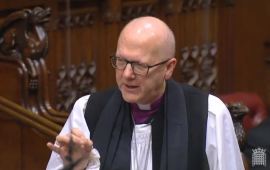
Bishop of Portsmouth – we must not let Brexit dilute our moral purpose

On 15th May 2019, the House of Lords debated a motion from Lord Horam, “That this House takes note of the Report from the European Union Committee Brexit: Common Security and Defence Policy missions and operations (16th Report, HL Paper 132).” The Bishop of Portsmouth, Rt Revd Christopher Foster, spoke in the debate: 

19.04.02 Portsmouthb

The Lord Bishop of Portsmouth:  My Lords, the noble Lord, Lord Dannatt, has just reminded us that none of us participating in this debate can forget that we will shortly mark the 75th anniversary of what must surely be the most defining day in Europe in living memory: D-day. That has special significance for the city of Portsmouth, and indeed the whole diocese I serve. As a result, we will have the pleasure—I think—of welcoming the President of the United States into our midst as part of the commemorations.

Continue reading “Bishop of Portsmouth – we must not let Brexit dilute our moral purpose”

Que sera sera

nickbaines's avatarNick Baines's Blog

This is the script of this morning’s Thought for the Day on BBC Radio 4’s Today programme:

I was checking my diary for this week when the news came in of the death of Doris Day. Whether it’s significant or not that this happened in Eurovision week, I have no idea. But, as we Brits will be exercising our foreign language skills again – nul points – in preparation for the big night, we might recall that it was Doris who introduced many of us to Spanish.

My late dad was a fan when we were kids and one of the first vinyl records he bought was one of her’s. And that’s where I heard Que sera sera – pronounced like a true Brit ever since. Que sera sera – what will be will be.

As a child I thought this was deep philosophy. You can’t change the future; what…

View original post 344 more words

Bishop of Portsmouth asks about bureaucracy in new apprenticeship system

On 13th May 2019 Lord Fox asked the Government “how many people are currently registered as undertaking (1) Intermediate, (2) Advanced, (3) Higher, and (4) Degree apprenticeships.” The Bishop of Portsmouth, Rt Revd Christopher Foster, asked a follow up question:

The Lord Bishop of Portsmouth: Is the Minister aware—and, if not, I and perhaps other noble Lords are ready to give examples—of the bureaucratic burdens and delays being experienced? For universities, the added obligation to report to and share data with the Education and Skills Funding Agency, as well as the three usual reports, is exacerbated by an identical reporting requirement for levels 2 and 7, NVQ and postgraduate. The burden seems disproportionate. For large levy-payers, there are unexplained delays in approving new apprenticeship standards. Will the Minister urgently address these to improve take-up? Continue reading “Bishop of Portsmouth asks about bureaucracy in new apprenticeship system”

Church Commissioner written answers: Sri Lanka aid, Christian persecution in Africa

On 13th May 2019 the Second Church Estates Commissioner, Dame Caroline Spelman MP, answered two written questions from Jim Shannon MP, on aid to Sri Lanka and on persecution of Christians in African countries:

Jim Shannon (Strangford): 252642 To ask the right hon. Member for Meriden, representing the Church Commissioners, what steps the Church of England is taking to tackle the persecution of Christians in African countries; and what steps the Church of England is taking with the Foreign and Commonwealth Office to highlight the persecution of Christians in those countries.

Continue reading “Church Commissioner written answers: Sri Lanka aid, Christian persecution in Africa”

Week in Westminster, 6th-10th May 2019

This week in the House of Lords bishops spoke about the toxic nature of much public debate, and welcomed new protective security funding for places of worship. They asked questions about modern slavery at car washes, the NHS and gambling related harm, diversity in public appointments, and biodegradable plastic bags. In the House of Commons the Second Church Estates Commissioner answered questions from MPs on the Bishop of Truro’s review into persecuted Christians overseas, the attacks on Christian worshipers in Sri Lanka, and fire safety in cathedrals. Continue reading “Week in Westminster, 6th-10th May 2019”

Bishop of Leeds calls for leadership by example to counter ‘toxic public debate’

On 9th May 2019 the House of Lords debated a motion from Lord Harris of Haringey, “to move that this House regrets the conduct, and toxicity, of debate in public life; of the divisions in society which result from that; and calls on Her Majesty’s Government to take steps to address such divisions.” The Bishop of Leeds spoke in the debate and a transcript is below. The Bishop of Rochester also spoke in the debate and his speech can be read here:

The Lord Bishop of Leeds: My Lords, I am grateful to the noble Lord, Lord Harris, for securing this debate and for the clarity of his and other speeches. I say to the noble Lord, Lord Patten, that if such a cast were assembled, some of the people who need to be there simply would not turn up. If they did, they would see it as their job to disrupt it, so I suspect it will be more complex.

We still admire Benjamin Disraeli for telling Parliament that half the Cabinet were asses and, on being ordered to withdraw the comment, responding, “Mr Speaker, I withdraw. Half the cabinet are not asses”. Political invective is not new and it must have a place in a free society, but words matter. I speak as a former professional linguist. Language is never neutral, and the ad hominem abuse we increasingly witness now simply encourages wider public expression of violent hatred. It is incrementally corrosive.

If the conduct of debate in public life has become toxic, it is only because it has been in the interests of some people to allow it to be so. I have already spoken in this House of the corruption of the public discourse and the consequences of normalising lying and misrepresentation. I add that reducing people to categories might reinforce tribal identity, but it demonises and dehumanises everyone else. As Viktor Klemperer recognised from 1930s Germany, a million repetitions of single words, idioms, and sentence structures or slanders become unconsciously assumed to be normal. Think of Rwanda and “cockroaches”.

Continue reading “Bishop of Leeds calls for leadership by example to counter ‘toxic public debate’”

Bishop of Rochester – national conversation with unifying narrative needed to overcome toxic public debate

On 9th May 2019 the House of Lords debated a motion from Lord Harris of Haringey, “to move that this House regrets the conduct, and toxicity, of debate in public life; of the divisions in society which result from that; and calls on Her Majesty’s Government to take steps to address such divisions.” The Bishop of Rochester spoke in the debate and a transcript is below. The Bishop of Leeds also spoke in the debate and his speech can be read here:

The Lord Bishop of Rochester: My Lords, I join other noble Lords in thanking the noble Lord, Lord Harris, for bringing forward this debate and for his characteristically robust, thoughtful, clear and evidenced introduction. I also thank other noble Lords for their contributions. I look forward to reading in the Official Report what the noble Lord, Lord Parekh, has just said, because there is a lot to reflect on.

Others have spoken from these Benches in recent months on this and related matters, referencing a number of scenarios which have given rise to language and expression that cause hurt and offence and do no credit to our public life. The right reverend Prelate the Bishop of Leeds will, I understand, speak later in this debate about the power and importance of language in our public discourse. My contribution, which I hope will be brief, is to raise a question about one part of the context in which such harmful, toxic, destructive and even violent expression may come to flourish.

The phrase attributed to Aristotle about nature abhorring a vacuum has many applications. I suggest that one of the reasons for this flourishing of destructive and harmful conduct and debate may be that these things are rushing in to fill a vacuum.

Church Commissioner Questions: Persecuted Christians Review, Sri Lanka attacks, Cathedral Fire Safety

On 9th May 2019 the Second Church Estates Commissioner, Rt Hon Dame Caroline Spelman MP, answered questions from MPs on the Bishop of Truro’s review into persecuted Christians overseas, the attacks on Christian worshipers in Sri Lanka, and fire safety in cathedrals. The exchanges follow:CCQs 9519 Continue reading “Church Commissioner Questions: Persecuted Christians Review, Sri Lanka attacks, Cathedral Fire Safety”

Bishop of Rochester suggests shared learning forum to improve diversity in public appointments

On 9th May 2019 Lord Holmes of Richmond asked the Government “what steps they are taking to increase diversity in public appointments”. The Bishop of Rochester, Rt Revd James Langstaff, asked a follow-up question:

The Lord Bishop of Rochester: My Lords, I am conscious that these Benches may not embody everyone’s image of diversity. None the less, I was pleased to lead the final stages of the process by which these Benches were opened to women as well as men, although none of them is here today. I have also been chairing for the last five years a process within the Church where we are tasked with increasing the proportion of BME people in senior roles in the life of the Church. We have made some modest progress, though there is lots still to do. Nevertheless, we have learned that while legislation and processes are important, as has been indicated, so are culture, attitudes and bias. I wonder whether the Government might welcome some kind of forum within which quasi-public bodies might engage with public bodies so that we can share our learning on these matters. Continue reading “Bishop of Rochester suggests shared learning forum to improve diversity in public appointments”

Bishop of St Albans asks Government about NHS plan and gambling related harm

On 9th May 2019 the Bishop of St Albans, Rt Revd Alan Smith, received a written answer to a question on the NHS and gambling related harm and rehabilitation:

The Lord Bishop of St Albans: HL15360 To ask Her Majesty’s Government, further to the Written Answer by Baroness Manzoor on 29 January (HL12939), when they expect the NHS to publish its “clear implementation framework” of the NHS Long Term Plan which would “set out how the commitments should be delivered by local systems and ensure transparency for patients and the public”. Continue reading “Bishop of St Albans asks Government about NHS plan and gambling related harm”