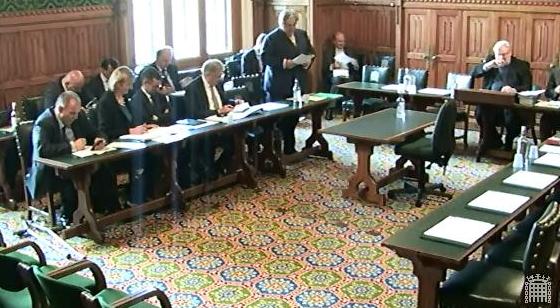
On Easter Day, 20th April 2014, the Church of England Dioceses of Bradford, Ripon & Leeds and Wakefield, will be merged to form a new Diocese of West Yorkshire and the Dales. Here – in three parts – is a (very) brief history of the bishops of those dioceses as parliamentarians. Part One (Ripon) can be viewed here.
Part Two: The Bishops of Wakefield
All but one of the 12 who held office as Bishop of Wakefield during the 126 year history of the diocese served in the House of Lords.
On Easter Day, 20th April 2014, the Church of England Dioceses of Bradford, Ripon & Leeds and Wakefield, will be merged to form a new Diocese of West Yorkshire and the Dales. Although the bishop of that new diocese will in due course join other bishops in the House of Lords, the dissolution of the three former dioceses marks an end to the era of the Bishops of Bradford, Ripon & Leeds and Wakefield as Lords Spiritual. Much has been written and recorded about the wider contributions of successive occupants of these Sees, but here – in three parts – is a (very) brief history of those bishops as parliamentarians.
Part One: The Bishops of Ripon
Since its formation in 1836 there have been 12 bishops of the diocese of Ripon (and latterly, Ripon & Leeds).
Longley and Bickersteth
Its first bishop was Rt Rev Charles Longley, who served until his translation to Durham in 1856, before becoming Archbishop of Canterbury in 1862.
Bishop Charles Longley
Longley had married the daughter of the Postmaster General in Prime Minister Lord Melbourne’s Government. However, as the Oxford Dictionary of National Biography records, “Melbourne agreed that Longley need not be constrained to vote with the government on matters of Irish church policy. Longley actually voted against the government on other issues besides the Irish church, to Melbourne’s pain and displeasure… Longley opposed the Oxford University Bill of 1854 which, among other things, reduced the proportion of clerical fellows in each college and reconstituted the central government of the university. In 1854 Longley was named as one of two churchmen who would join the executive commissioners empowered to revise the statutes of the university and colleges of Oxford.”Continue reading “Lords Spiritual No Longer, Part One: The Bishops of Ripon”
11th April 2014: The Diocese of Oxford has announced that Rt Rev John Pritchard will retire as Bishop of Oxford on 31st October this year. Bishop John, who chairs the Church of England’s Board of Education and leads for the Bishops in the House of Lords on education & church schools, will also cease to be a member of the Lords on that date. Continue reading “Bishop of Oxford announces retirement”
On 9th April 2014 the Bishop of Coventry received a written answer to a question on Egypt.
The Lord Bishop of Coventry: To ask Her Majesty’s Government what consideration they have given to making development aid to Egypt contingent on political and judicial reform.[HL6392]
Baroness Northover (LD): DfID does not have a country office or bilateral programme in Egypt but provides support through the Arab Partnership Fund and the British Embassy in Cairo. The Arab Partnership seeks to support political and economic reform in Egypt, focusing on accountability, improved governance, public voice and economic opportunity. Assistance is not provided through or to the Egyptian Government, but is channelled through civil society and international financial institutions in support of long-term reform.
On 9th April 2014 the Bishop of St Albans received an answer to a written question on apprenticeships:
Question Asked by The Lord Bishop of St Albans:
To ask Her Majesty’s Government what steps they have taken to link apprenticeships to professional registration in order to establish recognised industry standards for apprenticeship and traineeship schemes. [HL6576]
Lord Ahmad of Wimbledon (Con): We are reforming Apprenticeships by putting employers in the driving seat of designing new Apprenticeship standards. These will include skills and any specific requirements for professional registration, so that on completion a successful apprentice can achieve professional registration where appropriate.
Traineeships are a flexible programme aimed at providing young people with skills and experience they need to be able to compete for Apprenticeships and other sustainable jobs. At the core of Traineeships are work preparation training, English and maths and a work experience placement with an employer. Links to professional registration are not a requirement for Traineeships, but providers have the flexibility to add additional content which could include sector-specific training or qualifications where these are publicly funded.
On 9th April 2014 the Bishop of Portsmouth, Rt Rev Christopher Foster, gave his maiden speech in a House of Lords debate to take note of Higher Education in the UK.
“There is need for public investment in universities, otherwise what is currently a public good will again become a private good, affordable to a few.” – Bishop of Winchester, 9/4/14
On 9th April 2014 the House of Lords debated a Government motion to take note of Higher Education in the UK. The Bishop of Winchester, lead bishop for HE, spoke about the work of the Church of England in the field through its Cathedrals Group of universities, as well as the ethos and purpose of Higher Education.Continue reading “Higher Education: a public good for the common good – speech by Bishop of Winchester”
In the House of Lords on 8th April 2014 Baroness Benjamin asked Her Majesty’s Government ‘what steps they are taking to raise the academic attainment levels of black British students, and especially those of Caribbean descent?’ The Bishop of St Albans asked a supplementary question:
The Lord Bishop of St Albans: My Lords, what assessment have Her Majesty’s Government made of the impact on educational attainment of the absorption of the Ethnic Minority Achievement Awards into the dedicated schools grant, which was done some months ago?
Lord Nash: The impact was substantial. I will have to write to the right reverend Prelate to give him more details.
The Archbishop of Canterbury Justin Welby has welcomed the publication today of the report and draft Bill by the Parliamentary Joint Select Committee on Modern Slavery.
The Rt Revd Alastair Redfern, Bishop of Derby, was a member of the Joint Select Committee, and the report can be read in full here. In March 2014, the Archbishop also gave his backing to the Global Freedom Network, an ecumenical initiative to combat modern slavery and human trafficking. You can read more about the Global Freedom Network here.
Archbishop Justin said: “I strongly welcome the report and draft Bill published today by the Parliamentary Joint Select Committee on Modern Slavery, which has cross-party support. We owe a debt of gratitude to the Committee’s members for their efforts, and I would like to extend particular thanks to my colleague Alastair Redfern, the Bishop of Derby, for his participation in the Committee’s work.
“I hope that as these covenants are rolled out, we can think about how we can draw in the voluntary sector to offer real and significant support to those who put themselves on the line in the defence of our country.” – Bishop of St Albans, 7/4/14
On 7th April 2014 Lord Dannatt tabled a question for short debate, ‘to ask Her Majesty’s Government what is their assessment of whether they have sufficient manpower and the right balance of regular and reserve forces within the Armed Forces in order to meet the United Kingdom’s current national and international responsibilities and requirements’. The Bishop of St Albans, Rt Rev Alan Smith, spoke: Continue reading “Peacekeeping, Reservists, Chaplaincy and the Armed Forces Covenant: Bishop of St Albans”
You must be logged in to post a comment.