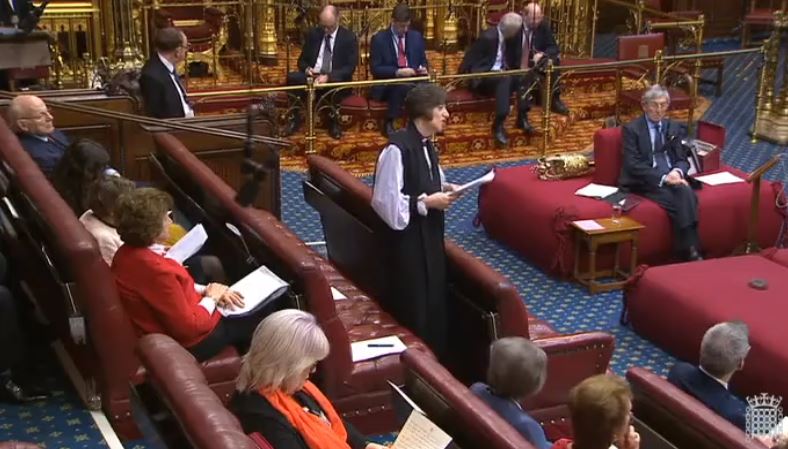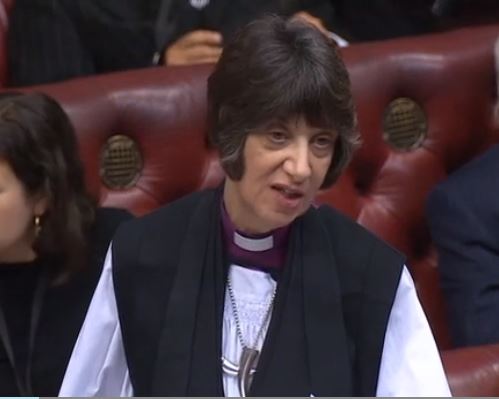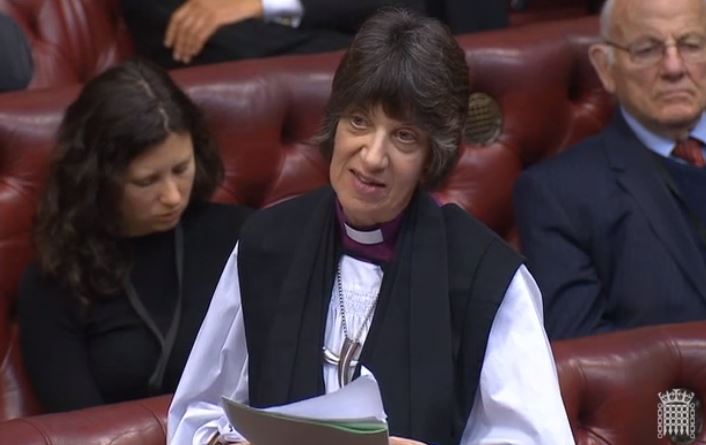
The Bishop of Leeds asked a question on the response potential conflict in Ukraine on 15ht April 2024, during a debate on the amassing of Russian forces on the Ukrainian border:
The Lord Bishop of Leeds [V]: My Lords, given the relative ineffectiveness of the western response to the invasion of eastern Ukraine in 2014, what assurance might Ukraine assume, should conflict or further invasion ensue? Also, could the Minister comment on any prognosis for the future of the Minsk accords and the prospects for Normandy?
The Bishop of Durham asked a question on the government’s plan for supporting those seeking asylum in the UK on 14th April 2021, in response to a government statement on immigration:
The Lord Bishop of Durham [V]: I begin by declaring my interest as a trustee of Reset and a member of the RAMP Project, as in the register. The Minister knows that I have deep respect for her work, and I am extremely grateful for the co-working we have done on a range of issues over the last few years. There is much that I welcome on the refugee side in the Statement and the policy statement. However, I have some very deep concerns around the asylum side of this. I would almost divide it into one half good, one half bad. The specific question I would like to ask today is this: under the Government’s proposals, the route by which people seeking asylum arrive in the UK will be indicative of the leave they are granted and the support they receive throughout their time. What basic support package, even if less generous, will be available to those granted temporary protection for two and a half years, to ensure that they do not face destitution? How will such temporary systems enable effective integration, which is one of the things that the Statement and the policy statement seek to achieve? I look forward to some robust discussions with the Minister in the future.
On 14th April 2021, the Bishop of St Albans asked a question concerning the recent eruption of a volcano on the island of St Vincent:
The Lord Bishop of St Albans [V]: My Lords, the diocese of the Windward Islands is linked with my diocese here in St Albans and I have been in touch with the bishop, Bishop Leopold Friday, overnight. The churches are already doing a huge amount of work and stand ready to help in any way they can, not least because here in my diocese, in Luton, we also have a large Vincentian population and this matter is affecting people’s families. If there are people who are forced to evacuate from the country, will the Government consider a temporary resettlement scheme for those with family links here in the UK?
The Bishop of Leeds asked a question on the possibility of revising UK citizenship education to include a greater breadth of historical knowledge and complexity on 14th April 2021:
The Lord Bishop of Leeds [V]: My Lords, I am grateful for these answers and glad that this document will be revised in due course. It is a concise, often masterful, précis of some quite complex areas of our history, but surely a confident country can cope with complexity and with where we have failed—it is not just our glorious past. History matters. For example, in relation to the role of the Soviet Union during the Second World War, much of what is regarded as glorious standing alone by the western allies would not have been possible without the role of the Soviet Union, which lost 20 million people. Will the rewriting be open to a wider scrutiny, in order that history is perhaps taken more seriously?
The Bishop of Leeds tabled a question on new restrictions on UK Citizens working in the EU and the effects of these restrictions on clergy on 13th April 2021:
The Lord Bishop of Leeds: To ask Her Majesty’s Government what assessment they have made of the impact of new (1) visa, and (2) residence, permit regimes for United Kingdom citizens working in the European Union on the numbers of Church of England clergy securing such permits.
The Bishop of St Albans received the following written answer on 12th April 2021:
The Lord Bishop of St Albans asked Her Majesty’s Government what steps they are taking to assist members of the Roma community to apply for settled status under the EU Settlement Scheme before 30 June; and what assessment they have made of the barriers (1) to obtaining the required documentation during the COVID-19 pandemic, and (2) to accessing, and completing, online applications, experienced by that community.
The Bishop of Coventry received the following written answers on 12th April 2021:
The Lord Bishop of Coventry asked Her Majesty’s Government:
what assessment they have made of the statement by the International Council on Monuments and Sites on 5 March that Tigray’s heritage is falling victim to fighting and “cultural cleansing”.
what representations they have made to the governments of (1) Ethiopia, and (2) Eritrea, about the need (a) to take immediate steps to prevent any further damage to the cultural sites of Tigray, (b) to safeguard and respect all cultural property in Tigray, and (c) to ensure that looted objects are restored to their communities.
The Bishop of London received the following written answer on 12th April 2021:
The Lord Bishop of London asked Her Majesty’s Government what plans they have (1) to reverse the real terms cuts to public health grants for local authorities, and (2) to maintain the amount allocated for public health grants as a percentage of the total budget of NHS England.
The Bishop of Durham received the following written answer on 12th April 2021:
The Lord Bishop of Durham asked Her Majesty’s Government how many members of staff working for asylum accommodation providers have received the training specified in the Asylum Accommodation and Support Statement of Requirements; and whether training for staff who have face-to-face contact with service users is stipulated in Home Office contracts with providers.
The Bishop of St Albans received the following written answer on 12th April 2024:
The Lord Bishop of St Albans asked Her Majesty’s Government:
what assessment they have made of reports that Armenian cultural heritage, including churches and monuments, in the Nagorno-Karabakh region has been destroyed by Azerbaijan during the dispute over that territory.
what representations they have made to the government of Azerbaijan about reports of the (1) destruction of an Armenian church, and (2) destruction of cultural heritage, in the Nagorno-Karabakh region.
You must be logged in to post a comment.