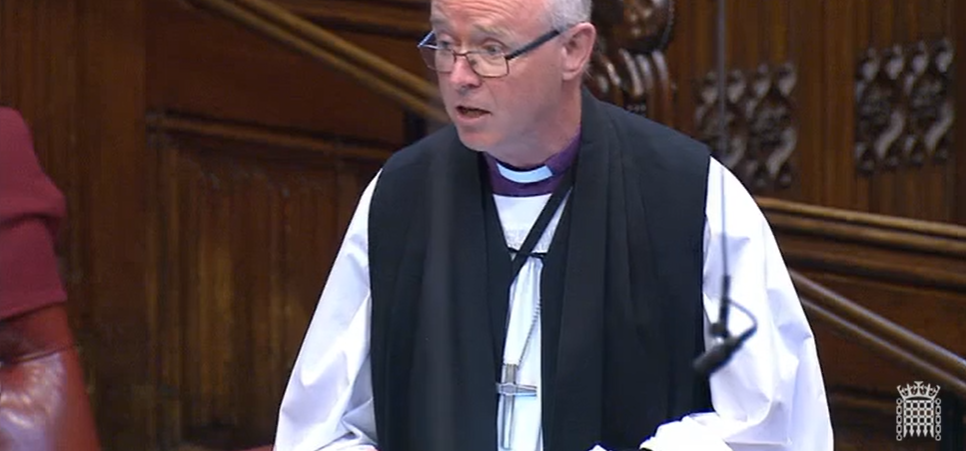
On 16th November the Bishop of St Albans received a written answer in response to a question on house prices, sales and diversification:
The Lord Bishop of St Albans: To ask Her Majesty’s Government, further to the Written Answers by Lord Greenhalgh on 1 October (HL8296), 6 October (HL8828), and 28 October (HL9442), what assessment they have made of the impact of (1) fears of negative equity on existing house purchases, and (2) house prices rising faster than wage increases, on the effectiveness of diversification. [HL9871] Continue reading “Bishop of St Albans asks about housing market”
The Lord Bishop of St Albans: To ask Her Majesty’s Government, further to the Written Answer by Lord Agnew of Oulton on 3 November (
The Lord Bishop of Durham [V]: I warmly welcome so much in the Statement and in the decisions made; I also associate myself with those who ask why it did not all happen a bit more quickly. None the less, this has exposed the underlying fundamental structural issues which mean that we are not tackling child poverty in the round and as a whole. What consideration have Her Majesty’s Government given to creating really long-term solutions by forming a child poverty commission, as proposed by faith leaders in their recent letter to the Prime Minister?
The Lord Bishop of Durham [V]: The Salvation Army has an innovative project for short-term housing solutions by using “meanwhile use” land to provide high-quality modular homes rooted in church communities and supported by wider community groups. This gives the residents the provision of a flat and the relational support of the community. What consideration have Her Majesty’s Government given to the Salvation Army’s innovative approach to homelessness and similar projects?
The Lord Bishop of St Albans [V]: My Lords, the Government have provided a way for citizens holding a BNO passport to take steps to come here. A high proportion of people will miss out on this scheme, particularly those born after 1997. What other immigration measures have the Government considered in the interests of safety for the people of Hong Kong?
The Lord Bishop of Durham [V]: Families in receipt of legacy benefits, such as employment and support allowance, did not benefit from the very welcome £20 a week uplift in benefits. These people are just as likely to be affected by the financial impact of the Covid-19 pandemic and include many disabled people. Will the Government extend the increase in benefits to include those in receipt of legacy benefits, as recommended by the Joseph Rowntree Foundation’s Keep the Lifeline campaign?
The Lord Bishop of St Albans: To ask Her Majesty’s Government, further to their decision to launch a one-year Spending Review, whether their multi-year capital allocation for priority infrastructure projects includes projects in rural areas, in particular (1) the Community Housing Fund, especially for rural affordable housing schemes, and (2) the Village Hall Improvement Grant Fund. [HL9791]
The Lord Bishop of Winchester [V]: My Lords, protecting freedom of religion or belief remains a pertinent issue in the developing world when more than 80% of the world’s population identify with a religion or belief system. My diocese has historic links with the Church of the Province of Myanmar, and during the pandemic many of its clergy have been providing volunteer support in understaffed hospitals. Can the Minister assure the House that, despite the almost £3 billion cut in the UK’s foreign aid budget, Her Majesty’s Government will continue to prioritise international freedom of religion and belief and recognise the contribution of religious groups in the development and support of their communities, particularly in times of crisis?
The Lord Bishop of Portsmouth [V]: My Lords, I welcome the Government’s desire to protect jobs and livelihoods, but can the Minister confirm that the extension of the furlough scheme until March—a full five months—is based on the assumption and expectation that those jobs, or at least the vast majority of them, will be ready to return to unchanged? That is a bold assumption. If it is not the case, what strategy do the Government have now for addressing the transitional challenges for those whose jobs will disappear? This Statement was made late, in haste. Tackling the jobs issue in March is tackling it too late.
You must be logged in to post a comment.