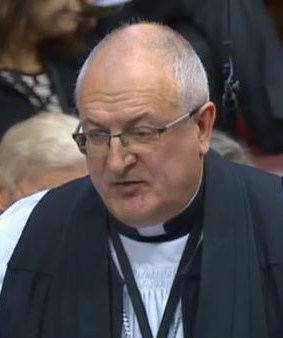
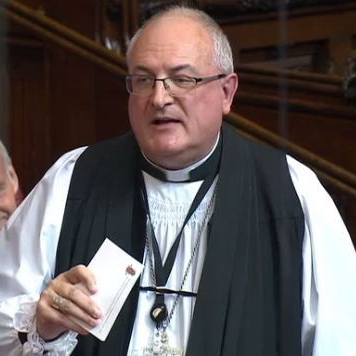
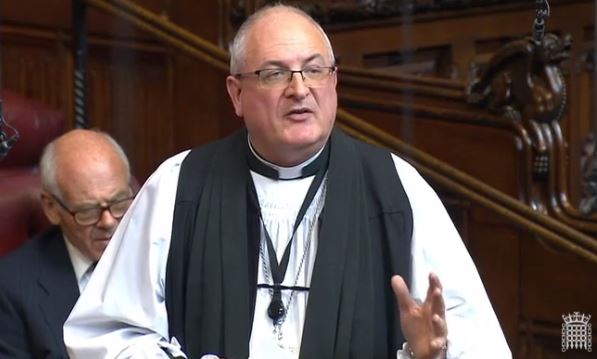
On 25th March 2024, the Bishop of Oxford asked a question on the ramifications of the government’s plan to relocate asylum seekers from hotels to larger sites, during a discussion on the number of asylum claims waiting to be determined:
The Lord Bishop of Oxford: My Lords, the National Audit Office published a report on 20 March expressing the view that government plans to relocate asylum seekers from hotels to larger sites are actually proving more expensive than the hotel accommodation. Is this affecting the Government’s long-term strategy for offering safe accommodation?
The Bishop of Chelmsford received the following written answer on 25th March 2024:
The Lord Bishop of Chelmsford asked His Majesty’s Government, in view of the expected growth in the supply of physician associates (PAs) to 10,000 by 2036–37 under the NHS Long Term Workforce Plan, how many PAs are expected to work in each setting.
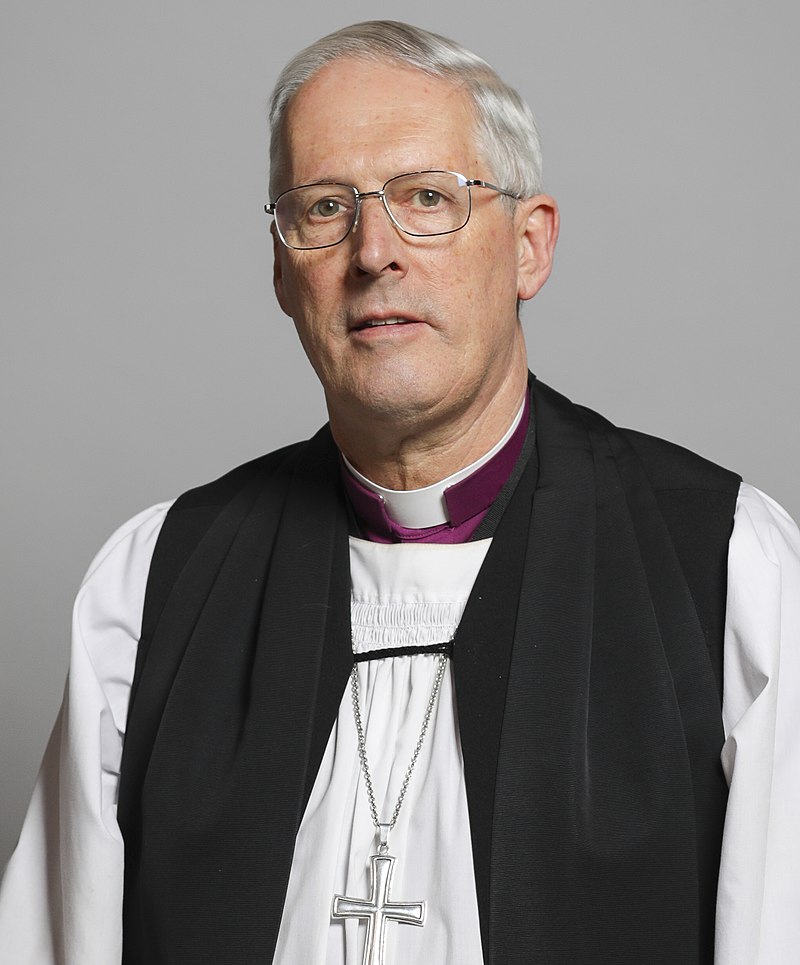
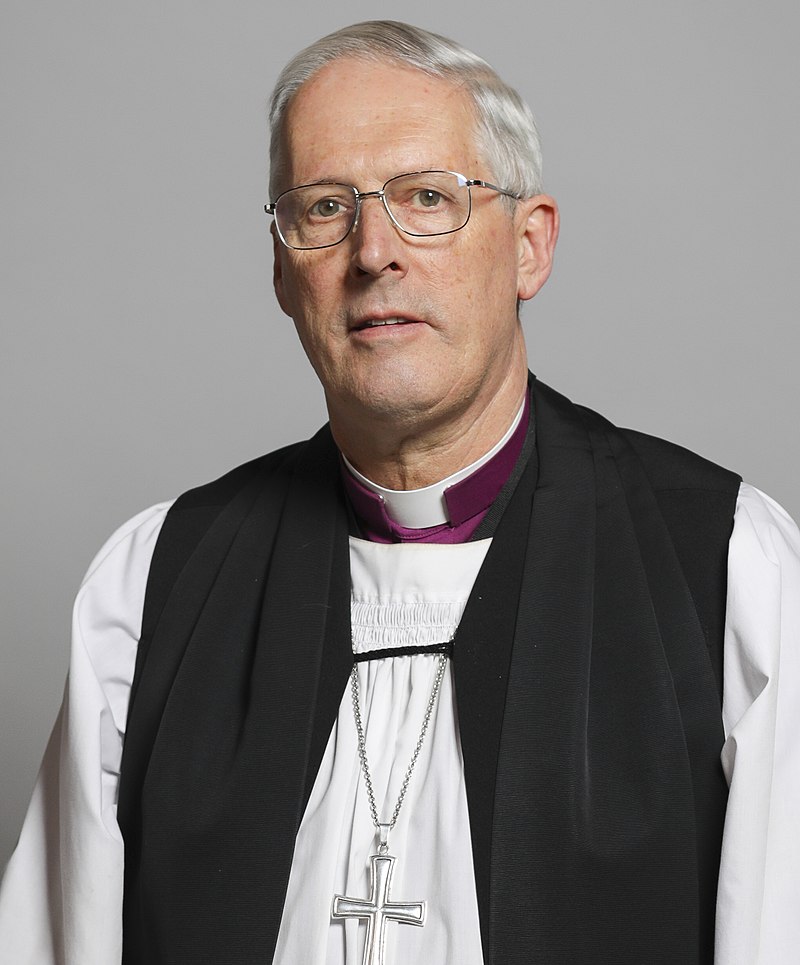
On 22nd March 2024, the Bishop of Worcester spoke in a debate on the Artificial Intelligence (Regulation) Bill (a private members bill tabled by Lord Holmes of Richmond), supporting the aims of the bill and calling for robust approach to AI regulation:
The Lord Bishop of Worcester: My Lords, I guarantee that this is not an AI-generated speech. Indeed, Members of the House might decide after five minutes that there is not much intelligence of any kind involved in its creation. Be that as it may, we on these Benches have engaged extensively with the impacts and implications of new technologies for years—from contributions to the Warnock committee in the 1980s through to the passage of the Online Safety Bill through this House last year. I am grateful to the noble Lord, Lord Holmes, for this timely and thoughtful Bill and for his brilliant introduction to it. Innovation must be enthusiastically encouraged, as the noble Baroness, Lady Moyo, has just reminded us. It is a pleasure to follow her.
That said, I will take us back to first principles for a moment: to Christian principles, which I hope all of good will would want to support. From these principles arise two imperatives for regulation and governance, whatever breakthroughs new technologies enable. The first is that a flourishing society depends on respecting human dignity and agency. The more any new tool threatens such innate dignity, the more carefully it should be evaluated and regulated. The second imperative is a duty of government, and all of us, to defend and promote the needs of the nation’s weak and marginalised —those who cannot always help themselves. I am not convinced that the current pro-innovation and “observe first, intervene later” approach to AI get this perennial balance quite right. For that reason, I support the ambitions outlined in the Bill.
The Bishop of St Albans received the following written answer on 22nd March 2024:
The Lord Bishop of St Albans asked His Majesty’s Government what assessment they have made of the impact on the peregrine falcon population in England of the theft of peregrine falcon eggs for sale of chicks to the Middle East.
Lord Benyon (Con, DEFRA): Defra has not made any assessment of the impact of peregrine falcon egg theft on the peregrine population.
The Government does, however, take all wildlife crime seriously, including the theft of wild bird eggs, which is an offence under the Wildlife and Countryside Act 1981.
The Bishop of Bristol received the following written answer on 22nd March 2024:
The Lord Bishop of Bristol asked His Majesty’s Government:
how much funding has been awarded in total from the Community Ownership Fund to communities seeking to turn places of worship into assets of community value.
which places of worship have received support from the Community Ownership Fund.
what steps they are taking to enable local communities to safeguard places of worship through the Community Ownership Fund.
The Bishop of Manchester spoke in debate on the state of local government finances and the impact on communities on 21st March 2024, highlighting the efforts of faith groups and partnership working to combat poverty and homelessness:
The Lord Bishop of Manchester: My Lords, I too am grateful to the noble Lord, Lord Shipley, for securing this important debate, but I am doubly grateful for its full title. This is not simply a debate about local government finances; it is a debate about the impact on local communities, and that is a vital distinction. Money is only ever a means to an end. It is an input—a crucial one—but what really matters are the outcomes and, in terms of local government, what really matters is how well local communities are served.
I still recall that back in the 1990s, when I started attending and speaking at national housing conferences, there were some where every positive mention of housing associations brought an audible hiss from some local authority members who were present. They saw us as rivals, and in some cases even the enemy, as we were taking money that had formerly gone to them to provide services that they had previously enjoyed delivering. I guess their attitude could be summed up as: if a job is worth doing, it is for the public sector to do it. I hope that we have long moved on from those attitudes. Local authorities have a vital and leading part to play in the service of their communities, but they are not the sole provider. Other agencies are not competitors; they are partners in the common task of supporting the local community.
The Bishop of Manchester tabled a question on the impact of the Household Support Fund on children’s bed poverty on 21st March 2024, calling for the government to consider a long term strategy for alleviating household poverty as the scheme comes to a close:
The Lord Bishop of Manchester: To ask His Majesty’s Government what assessment they have made of the impact of the Household Support Fund on children’s bed poverty.
Viscount Younger of Leckie (Con, DWP): My Lords, an evaluation of the current household support fund scheme is under way to better understand the impact of the funding. In the Spring Budget, the Chancellor announced an extension to the household support fund in England for a further six months, meaning that the Government will ensure that targeted support is available for those facing the most challenging financial circumstances as inflation falls. Subject to local decisions, this funding may be used to purchase beds and other household essentials for those in need.
The Bishop of St Albans received the following written answers on 21st March 2024:
The Lord Bishop of St Albans asked His Majesty’s Government what recent steps they have taken to secure guarantees from Sudan’s warring factions for the safe and unimpeded delivery of humanitarian assistance to conflict-affected populations.
The Bishop of St Albans received the following written answers on 21st March 2024:
The Lord Bishop of St Albans asked His Majesty’s Government how many prosecutions for poaching in England were successful under the Game Act 1831, the Hunting Act 2004 and the Night Poaching Act 1828 in (1) 2019, (2) 2020, (3) 2021, (4) 2022, and (5) 2023.
The Bishop of St Albans received the following written answer on 21st March 2024:
The Lord Bishop of St Albans asked His Majesty’s Government what consideration they have given to scrapping tax breaks for all second homes, and not just short-term lets, as a further step in dealing with the rural housing affordability crisis.
You must be logged in to post a comment.