Bishop of Norwich supports ban on pre-watershed payday loan advertising

“These loans are not being taken seriously by young people, serious though they are. We have allowed them to take over our televisions and radios, normalising them to the point where their use is seen as casual. Just this morning I was told the story of a young woman who took out a payday loan to pay for a Domino’s pizza. That could prove to be a very expensive pizza indeed.”- Bishop of Norwich, 3/11/14

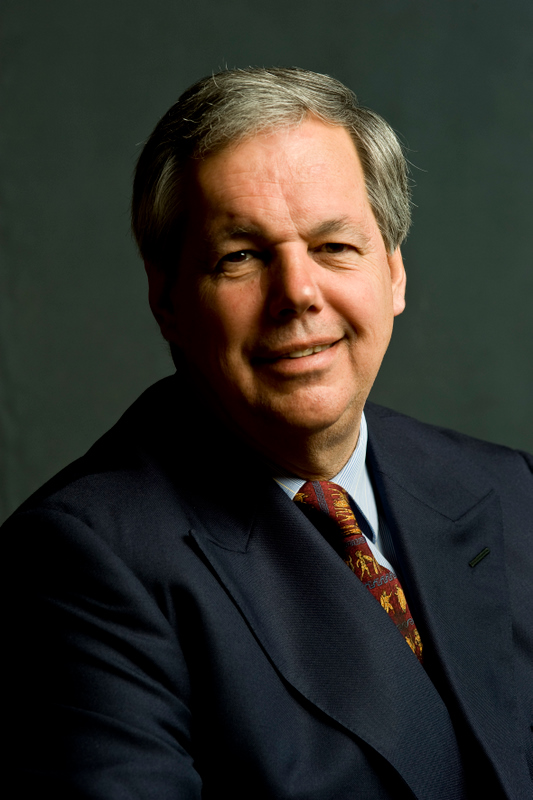
On 3rd November 2014, the Bishop of Norwich, the Rt Revd Graham James, took part in the Committee Stage of the Government’s Consumer Rights Bill, speaking in favour of an amendment to regulate the advertising of payday loans to children. The Bishop highlighted the pervasiveness of pre-wateshed advertising of payday loans, and the fact that young parents were far more likely to take out a loan than older parents. He also called for greater investment in financial education.

The amendment, which was co-sponsored by the Bishop of Truro, was withdrawn at the end of the debate, with its supporters calling for the Government to take further action before the Bill returned for its Report Stage.

14.06.12 Bishop of NorwichThe Lord Bishop of Norwich: My Lords, I rise to support the noble Lord, Lord Alton, and to speak to Amendment 105B, in the name of my colleague the right reverend Prelate the Bishop of Truro, on the advertising of payday loans. He cannot be here today but has been working very closely with the Children’s Society on this issue. Amendment 105B seeks to make provisions to restrict the times at which payday loan advertisements are shown, most specifically in relation to the watershed.

It surprised me to discover that, according to Ofcom, no less than 80% of all payday loan advertisements are shown before the watershed. It is therefore no surprise—to pick up on some of the statistics that the noble Lord, Lord Alton, mentioned—that the Children’s Society found in its survey that over half of all children aged 10 to 17 reckon that they see payday loan advertisements either “often” or “all the time”. It is the sheer quantity of these advertisements that normalises payday loans for children and young people. The research shows that one-third of all teenagers think that the payday loan adverts themselves are tempting and exciting—they are very well designed. Those teenagers are much more likely than their counterparts to say that they would consider taking out a payday loan in the future. Continue reading “Bishop of Norwich supports ban on pre-watershed payday loan advertising”

Bishop of Norwich calls for focus on family well-being in handling of Chilcot Inquiry

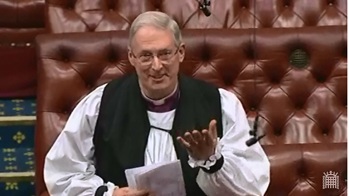
On 3rd November 2014, Lord Dykes asked Her Majesty’s Government what steps they are taking to expedite the publication of the report by the Chilcot Inquiry. The Bishop of Norwich, the Rt Revd Graham James, asked a supplementary question:

14.06.12 Bishop of NorwichThe Lord Bishop of Norwich: My Lords, does the Minister accept that repeated press reports of rows between the Cabinet Office and the inquiry over the declassification of documents are deeply hurtful to the families most affected by the Iraq conflict? Does he agree that until the inquiry is completed, many bereaved and grieving families will not be able to move on?

Lord Wallace of Saltaire: My Lords, I appreciate that many have been affected by the issues studied by this inquiry. I am not aware of any rows between the Cabinet Office and the inquiry. I am aware of a long series of complex discussions within the British Government, between the British Government and our allies and with the inquiry about the exact nature of what should be published. I am conscious that what will be published includes notes from more than 200 Cabinet meetings, for example, including some extracts from Cabinet minutes.

(via Parliament.uk)

Bishop of Coventry receives written answer on reform and reconciliation in Iraq

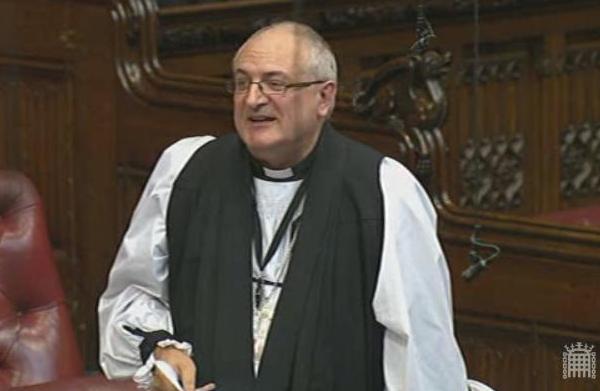
On 3rd November 2014, the Bishop of Coventry, the Rt Revd Christopher Cocksworth, received an answer to a written question on the subject of reform and reconciliation in Iraq.

13.10 Bishop of CoventryThe Lord Bishop of Coventry: To ask Her Majesty’s Government what practical assistance and support they are providing to the government of Iraq in taking forward a credible programme of political reform and reconciliation in that country.[HL2201]

The Minister of State, Foreign and Commonwealth Office (Baroness Anelay of St Johns): Political reconciliation and reform are crucial if there is to be a long-term solution to the current instability in Iraq. We therefore welcome the new Government of Iraq’s commitment to inclusive governance. We will support them in implementing their programme wherever we can and have called for others in the international community to do the same. We are already providing assistance with the development of parliamentary democracy, community policing and dialogue between religious leaders. We are in regular contact with the new Iraqi government over national reconciliation and, in particular, with Vice-President Allawi, whose responsibility it is. The Secretary of State for Foreign and Commonwealth Affairs, my right hon. Friend the Member for Runnymede and Weybridge (Mr Hammond), raised the importance of reform and reconciliation with Vice-President Allawi during his recent visit to London and our ambassador in Baghdad has also discussed it with him on a number of occasions.

(via Parliament.uk)

Bishop of St Albans receives written answer on financial advisory services

On 3rd November 2014, the Bishop of St Albans received an answer to a written question on the subject of financial advisory services.

Bishop of St AlbansThe Lord Bishop of St Albans: To ask Her Majesty’s Government how the provision of money management, budgeting and debt advice by local authorities and social sector landlords is being monitored.[HL2156]

The Parliamentary Under-Secretary of State, Department for Communities and Local Government (Lord Ahmad of Wimbledon): The Department for Work and Pensions are currently undertaking a review into how local welfare provision has been used in 2013/14 and its anticipated use in 2014/15 which will be published in due course. In addition, as part of its work on Universal Credit, the Department is commissioning budgeting support for claimants who need help and is establishing local delivery partnerships with local government to help provide this.

The Government-funded Money Advice Survey offers advice on managing personal debt, money management and budgeting. Face to face debt advice is provided by Citizens Advice, under contract with the Money Advice Service.

Department for Business Innovation and Skills also provide funding for the Citizens Advice Bureau, which provides people with advice on debt and other issues.

More generally, the Department for Communities and Local Government issued guidance to councils last year on good practice in the collection of council tax arrears. The actions of local authorities (in relation to service failures, maladministration or injustice) can be investigated by the Local Government Ombudsman, whilst the Housing Ombudsman Service looks at complaints about social landlords.

(via Parliament.uk)

Church of England Week in Westminster, 27th-31st October 2014

Welcome to the Church of England’s weekly round-up of activity in Parliament.

In the past week, the Second Church Estates Commissioner has answered questions in the House of Commons on the subjects of the ordination of women, extremism, episcopal vacancies and Church investments.

In the House of Lords bishops have supported amendments to the Government’s Criminal Justice and Courts Bill, Deregulation Bill and Serious Crime Bill and spoken about music education, devolution and the Scottish referendum, and slavery in supply chains. Bishops have also asked questions about the Green Climate Fund, the Troubled Families programme, blasphemy laws in Pakistan, Iraq, youth unemployment, Syria, Boko Haram and migrants and refugees.

Continue reading “Church of England Week in Westminster, 27th-31st October 2014”

Bishop of Derby takes part in debate on slavery and its use in supply chains

“We live in a culture that is rightly concerned about safeguarding. We are concerned rightly about the safeguarding of children at the moment. We have to get up to speed with the safeguarding of vulnerable adults, many of whom are in exploited forced labour.”

On 30th October 2014, Baroness Kennedy of Cradley led a short debate in the House of Lords to ask Her Majesty’s Government what steps they are taking to combat slavery in supply chains nationally and internationally. The Bishop of Derby, the Rt Revd Alastair Redfern, a former member of the Joint Select Committee on the Draft Modern Slavery Bill, spoke in the debate. He argued that there is a deep underlying tension between economic activity and treatment of the individual, which the modern slave trade has exploited. He also asked the Minister a number of questions regarding the strengthing of reporting and best practice in supply chains.

Bishop of DerbyThe Lord Bishop of Derby: My Lords, I, too, thank the noble Baroness, Lady Kennedy, for securing this debate and for her excellent introduction that laid out the ground clearly. I want to make some remarks from my experience of working with victims, the police and other agencies within our national context. We have just heard from the noble Baroness, Lady Cox, about the sheer horror of the way in which human beings are being treated in our own country.

I begin by welcoming Karen Bradley’s recent announcement that there will be amendments to secure proper reporting and disclosure. The key will be the level of reporting and the size of the company. I also welcome the strong support from many leaders in our industries. On the Select Committee, the people who represented Primark and Tesco, for instance, were supportive of a framework to require proper reporting and accountability, which would help their business case and standing in the community. Continue reading “Bishop of Derby takes part in debate on slavery and its use in supply chains”

Bishop of St Albans calls for pan-European strategy on immigration and asylum seekers

On 30th October 2014, the Parliamentary Under-Secretary of State for the Home Office, Lord Bates, repeated a Government statement concerning search and rescue for migrants and refugees. The Bishop of St Albans, the Rt Revd Alan Smith, asked a supplementary question:
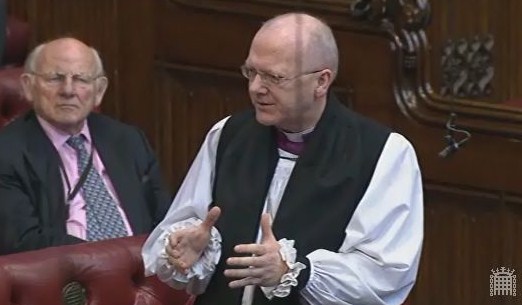
Bishop of St AlbansThe Lord Bishop of St Albans: My Lords, it is clear that we are all deeply worried about this terrible situation. Just last weekend, a family drowned off our own coasts and the horror was felt right across our country. There were serious discussions about whether we needed more people on duty to look after them. There is a deep sense of worry where people put themselves in such danger. I do not think that any of us believe that people are putting their families at risk—sometimes, they are huge, extended families; one was reported earlier this week on television—thinking, “Oh, well, it does not matter if we are likely to drown because we might be saved”. That would seem to me incredible. Surely we need a much more coherent, pan-European strategy underlying the whole question of immigrants and asylum seekers, and we should try to get some agreement on how we can address it. However, I would lament us withdrawing from anything that would help people in such dire circumstances.

Lord Bates: I understand the right reverend Prelate’s point. I should make the point again for the benefit of the House that we are not withdrawing from anything; this was something for which the Italian Government had responsibility, and they have decided to phase it out. The right reverend Prelate is absolutely right that more needs to be done to establish a co-ordinated approach, which was indeed the purpose of the Justice and Home Affairs Council meeting on this specific issue held on 9 and 10 October. One of the outcomes of that meeting was Operation Triton, which we have pledged resources to, in addition to all the other things that we are trying to do to help in the countries from which these people are fleeing for their lives.

(via Parliament.uk)

Bishop of Lichfield raises concerns about kidnappings by Boko Haram in Nigeria

On 30th October 2014, Baroness Cox asked Her Majesty’s Government what assessment they have made of recent developments in Nigeria, with particular reference to the terrorist activities of Boko Haram. The Bishop of Lichfield, the Rt Revd Jonathan Gledhill, asked a supplementary question:

14.03.27 Bishop of LichfieldThe Lord Bishop of Lichfield: My Lords, what does the Minister make of the claims recently made by journalists that the girls kidnapped by Boko Haram are being held as trophies for various tribal leaders, as is apparently common in these regions, and that they will be released as soon as some way is found to flatter these leaders?

Baroness Anelay of St Johns: My Lords, I have read those reports. Anyone who is kidnapped in any situation is a bargaining chip. The difficulty is knowing with whom one strikes the bargain and at what price for all.

(via Parliament.uk)

Second Church Estates Commissioner answers questions in the House of Commons

On 30th October 2014, the Second Church Estates Commissioner, the Rt Hon Sir Tony Baldry MP, answered questions in the House of Commons on the subjects of the ordination of women, extremism, episcopal vacancies and Church investments.

The full transcript of the question session is reproduced below:

Ordination of Women

14.01 CCQ BaldryDiana Johnson (Kingston upon Hull North): What assessment the Church of England has made of the potential effects of clause 2 of the Bishops and Priests (Consecration and Ordination of Women) Measure 2014 on women. [905729]

The Second Church Estates Commissioner (Sir Tony Baldry): The Church’s memorandum to the Ecclesiastical Committee gave a detailed assessment of that provision. I also refer the hon. Lady to the Lords Hansard report for 14 October, in which the Archbishop of Canterbury ably explained clause 2. I tried to explain it when I took the measure through the House but, given that she has tabled this question, clearly I lamentably failed.

Diana Johnson: I welcome the fact that we have recently had this long overdue Measure through Parliament, and the hon. Gentleman will know that I have put in an early bid for the Bishop of Hull to be a woman. However, I am concerned about clause 2. Does he share my concern that this country’s established Church will not be governed by the laws of this land? I think that it is a very odd situation for the established Church to be in.

Sir Tony Baldry: We are very much governed by the laws of this land, which is why the Measure had to go to the Ecclesiastical Committee, a statutory Committee of both Houses of Parliament, and then had to be approved by both the House of Lords and the House of Commons, and last week you, Mr Speaker, announced that it had been granted Royal Assent. Had the hon. Lady had serious concerned about clause 2, she could have raised them in the debate—[Interruption.] Yes, she did raise them, but if I had not managed to assuage those concerns for her and the House sufficiently, she could have divided the House on the matter. Parliament has now agreed to the Measure and—this is the substantive point—the only reason it is here is to help ensure that the arrangements work; it is not putting the Church of England outside gender and equality legislation. Were it to do so, I have absolutely no doubt that the Government would have opposed it.

Continue reading “Second Church Estates Commissioner answers questions in the House of Commons”

Bishop of Chester takes part in debate on devolution and the Scottish referendum

“To regard the English-Scottish relationship as simply the primary and maximal example of broader devolved relationships in the UK would be to invite a repetition of recent errors of judgment.”

On 29th October 2014, the Bishop of Chester, the Rt Revd Peter Forster, took part in a House of Lords debate on devolution following the Scottish referendum, led by Baroness Stowell of Beeston. The Bishop reflected on his own experiences of studying and living in Scotland, and the relationship between England and Scotland. He urged caution in how politicians and the public approach matters of devolution and nationhood, noting that the post-referendum landscape was a good opportunity to renew the Union, whilst respecting cultural differences and political realities.

14.03 Bishop of ChesterThe Lord Bishop of Chester: My Lords, bishops need to tread warily when discussing matters Scottish. Although I am thoroughly English by birth and background, I can, I think, claim rather closer connections with Scotland than some whom I observe wearing the kilt at the Chester Caledonian Association dinners which I regularly attend.

Let me explain. I have a Scottish wife—my one and only wife, I hasten to add—and two Scottish degrees, all three from Edinburgh. I trained for ordination in Scotland as somebody sponsored by the Scottish Episcopal Church, and I have owned a house in Scotland for 25 years and will happily retire there in a few years’ time. I am Anglican co-chair of the current Church of England-Church of Scotland ecumenical conversations. So tread I shall, if nevertheless warily. If I have learnt one thing in my discussions with the Church of Scotland, it is that were the Kirk ever to contemplate having bishops, which remains, I think, doubtful, they would need to be very different from English bishops to be acceptable. Continue reading “Bishop of Chester takes part in debate on devolution and the Scottish referendum”