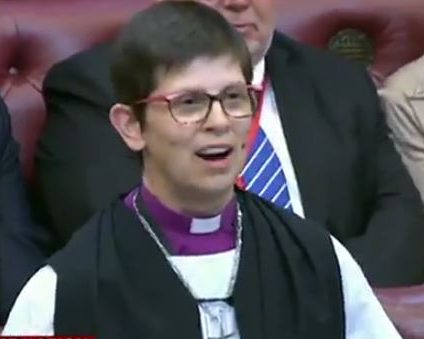
Bishop of Southwark asks about possibility of inquiry to address causes of recent social unrest

The Bishop of Southwark asked a question on the recent unrest and riots in the UK on 3rd September 2024, enquiring whether the government would set up an enquiry or similar mechanism to address the underlying economic and social issues in UK communities affected by the events:
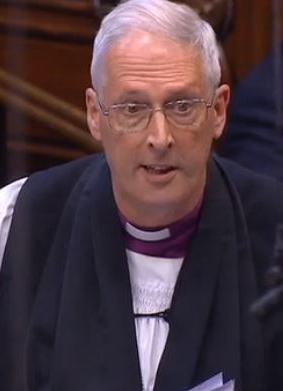
The Lord Bishop of Southwark: My Lords, I express appreciation to the Minister and his right honourable friend the Home Secretary for the Government’s Statement. I extend heartfelt sympathy to the families of the victims of recent violent disorder. I support the Government’s strong and determined response, including the swift apprehension of perpetrators and bringing them to justice. I also applaud the strong and positive signal that this sends: protest cannot extend to violence and abuse. I am grateful that Members of the House have spoken so powerfully on the evil of anti-Semitic, Islamophobic and racist incidents, which the Minister rightly addressed as criminality. In addition to the measures announced, are His Majesty’s Government seeking to address, perhaps through an inquiry, some of the underlying economic and social issues that can render people vulnerable to exploitation and incitement, to their own cost and to the detriment of the wider community?

Continue reading “Bishop of Southwark asks about possibility of inquiry to address causes of recent social unrest”
Votes: Victims and Prisoners Bill

On 16th April 2024, the House of Lords debated the Victims and Prisoners Bill. Votes were held on amendments to the bill, in which Bishops took part:

Continue reading “Votes: Victims and Prisoners Bill”

Church Commissioners Questions: Engagement with Young People, Cathedrals, Same Sex Relationships, Persecuted Christians, Antisocial Behaviour, and Parish Ministry

On 16th November 2023, Andrew Selous MP, representing the Church Commissioners, gave the following answers to questions from MPs in the House of Commons:

Engagement with Children and Young People

Bob Blackman MP (Con, Harrow East) asked: What recent progress the Church of England has made on increasing engagement with children and young people.

Continue reading “Church Commissioners Questions: Engagement with Young People, Cathedrals, Same Sex Relationships, Persecuted Christians, Antisocial Behaviour, and Parish Ministry”

Bishop of Derby asks about government’s anti-social behaviour plan

The Bishop of Derby asked a question on the issue of criminalisation of children during a debate on the government’s anti-social behaviour plan on 29th March 2023:

The Lord Bishop of Derby: My Lords, I declare my interest as vice-chair of the Children’s Society. I read the Anti-Social Behaviour Action Plan with real interest. Criminalising young people through tackling anti-social behaviour is counterproductive, not least given the pressures on the criminal justice system. I am therefore pleased to see a focus on preventive work with at-risk and vulnerable children with expanded funding for youth offending teams, for example. Can the Minister commit to look again at a definition of child criminal exploitation that recognises the abuse and manipulation of vulnerable children, which catches them up into what can become quite horrific spirals of crime? Such a definition would offer them greater protection.

Continue reading “Bishop of Derby asks about government’s anti-social behaviour plan”

Bishop of Chester seeks clarification on place of carol singers under busking guidelines

14.03 Bishop of ChesterIn the House of Lords on 30th June 2014, Liberal Democrat peer Lord Clement-Jones asked Her Majesty’s Government what assessment they have made of the link between busking and crime and disorder; and what plans they have to issue revised guidance on the use of the Metropolitan Police Act 1839 and the Police and Criminal Evidence Act 1984 in respect of busking. The Bishop of Chester, the Rt Revd Peter Forster, asked a supplementary question.
The Lord Bishop of Chester: My Lords, will the Government confirm that carol singing will not be reclassified as busking?
Baroness Williams of Trafford: My Lords, it depends on the carol singers. If they were being disruptive they might well be.

Bishop of Lichfield urges caution in redefining ‘anti-social behaviour’

“We [must] steer a course between tolerating bad behaviour on the one hand, and on the other hand taking an overly punitive and controlling approach to those whose behaviour can just be annoying. I am not here thinking of street preachers or those who sing hymns very loudly—though a balance has to be struck even in those instances—but chiefly of young people and the more vulnerable among adults.”

On 29th October 2013, the Bishop of Lichfield, the Rt Revd Jonathan Gledhill, spoke in the Second Reading debate of the Government’s Anti-social Behaviour, Crime and Policing Bill. He welcomed measures in the Bill on strengthening firearm regulations, tackling forced marriage and reforms to the College of Policing’s code of ethics. He raised concerns about the newly proposed definition for ‘anti-social behaviour’, suggesting that young people and vulnerable adults could be at risk from a broad definition.


14.03.27 Bishop of LichfieldThe Lord Bishop of Lichfield: My Lords, there is much to welcome in this Bill. The strengthening of the laws on firearms and on forced marriage, for example, are obvious steps forward. The measures for prevention of sexual harm, while raising important issues about the need for caution in restricting the freedoms of unconvicted people, will make possible swifter and more effective action to protect potential victims. The College of Policing has made an encouraging start. I am pleased to welcome the draft code of ethics. It sets a strong, ethical and I would say spiritual basis for law and its enforcement, which is a key concern for us all.

The emphasis on communities—people working together for the common good—has run through the long gestation period of these proposals. The principles of restorative justice and restorative practice, especially in local communities, are built into the efforts of churches in every part of this country to serve their local communities and especially those who are most vulnerable. In my part of the world, 80% of young people typically reoffend in the first two years after their sentence. However, with those who are taken on board by church monitoring and mentoring groups, even with the more difficult cases, the rate of reoffending is less than 20%. Continue reading “Bishop of Lichfield urges caution in redefining ‘anti-social behaviour’”