
On 10th November the House of Lords considered the Government’s Immigration and Social Security Co-ordination (EU Withdrawal) Bill. Lord Dubs pressed again an amendment on child refugees and family reunion, his earlier amendment to the Bill having been rejected in a vote in the House of Commons. The Bishop of Southwark spoke in support of the amendment. Lord Dubs did not press it to a vote, accepting some concessions from the Government in its place.
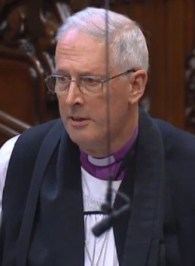 The Lord Bishop of Southwark: My Lords, I speak in favour of the amendment moved by the noble Lord, Lord Dubs. In doing so, I speak not only on my account but also in place of the right reverend Prelate the Bishop of Durham, who is locked down in the north-east and therefore, because of the procedures for consideration of Commons amendments, is unable to speak on this amendment, although that had been very much his intention.
Family life and kin relationships are vital in many parts of the world to ensure survival. Even in the UK, family means the difference between misery, destitution and poor mental health and a life where, even in the most difficult circumstances, there is practical care, support and love. Thus, I, too, welcome the Government’s steps towards ensuring safe and legal routes, including the commitment in case of a no-deal Brexit, to pursue bilateral negotiations on arrangements for family reunion, which I trust they will seek to ensure are equivalent to the Dublin regulations. I welcome the Minister’s commitments and await with interest her further comments following what the noble Lord, Lord Dubs, just said.
However, a step in the right direction is not the end of the journey. Continue reading “Immigration Bill: Bishop of Southwark supports Dubs amendment on child refugees and family reunion”
 The Lord Bishop of Oxford [V]: My Lords, I thank the Minister for her Answer and for what the Government have already done. Before the pandemic, 23% of children in socioeconomic groups D and E lacked home broadband and access to laptops, et cetera. Does the Minister agree that we now need to measure data poverty and its effects more carefully? Will the Government commit to legislating for household digital access to be treated as a utility on an equal footing with the right to access for water and heat—a change supported by the general public?
  The Lord Bishop of Gloucester: My L
 The Lord Bishop of Durham [V]: My Lords, in the light of the Minister’s last answer about continual review, in April 2019 59% of families affected by the two-child limit were working, with many struggling to afford essentials. When the new statistics on the policy are released tomorrow, will Her Majesty’s Government finally agree to review and assess the evidence that the two-child limit negatively impacts children in working families and that lifting it is the most effective way to reduce the number of children living in poverty?
 The Church of England in Parliament
You must be logged in to post a comment.