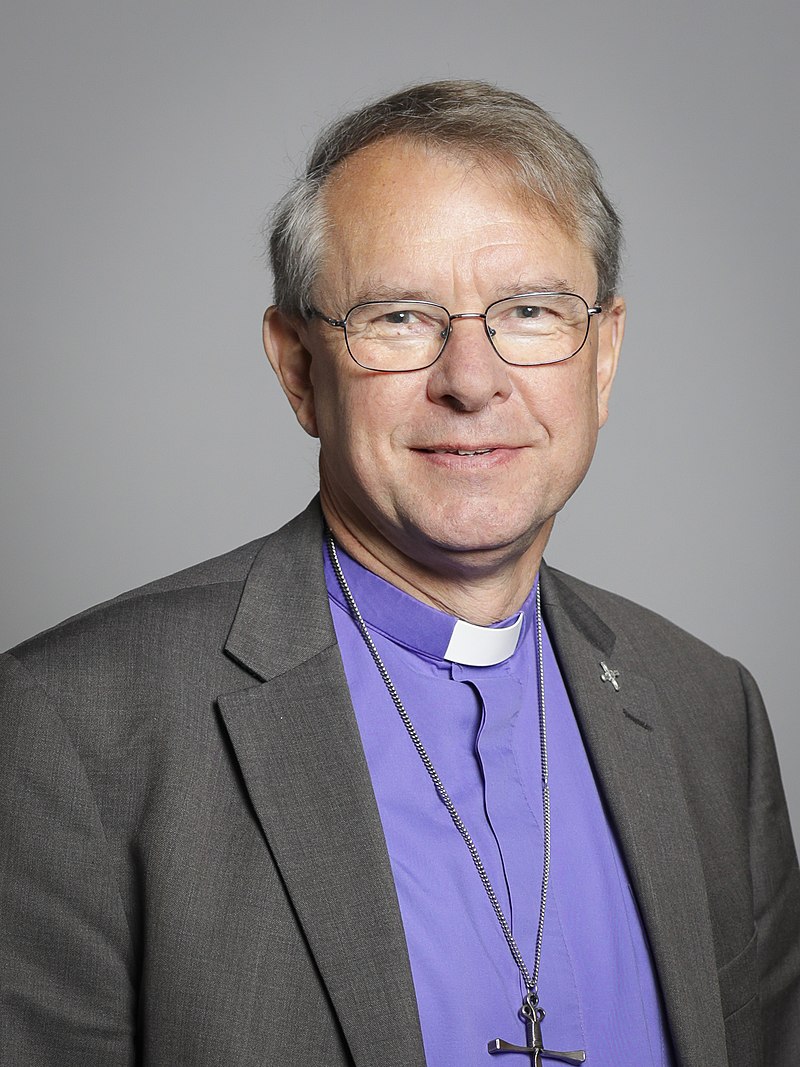
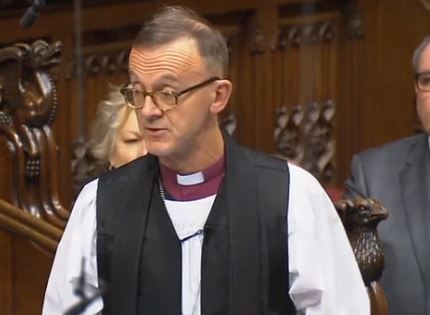
The Bishop of Durham received the following written answer on 8th December 2022:
The Lord Bishop of Durham asked His Majesty’s Government how many children subject to No Recourse to Public Funds (NRPF) conditions are in receipt of the 15 hours a week of free early education available to disadvantaged two-year old children.
The Bishop of Carlisle asked a question on whether the government would seek approval from relevant medical bodies for methods of age-assessment used on refugees on 6th December 2022, during a debate on the ethical considerations of such assessments:
The Lord Bishop of Carlisle: My Lords, further to that answer, in determining what constitutes an appropriate scientific method of age assessment, can the Minister assure us that any future methods will be formally approved by the relevant medical body before they come into use?
Lord Murray of Blidworth (Con): Plainly they will be formally approved by the advisory committee to the Home Secretary, and one suggests that the views of relevant professional bodies will be of great weight in making such a decision.
The Bishop of Southwell and Nottingham asked a question on the length of waiting times for Children’s Adolescent Mental Health Services (CAMHS) for children in care on 5th December 2022:
The Lord Bishop of Southwell and Nottingham: To ask His Majesty’s Government what assessment they have made of the length of the waiting times for children and young people in care who need to access the support of Children’s Adolescent Mental Health Services; and what steps they are taking to reduce those waiting times.
Lord Markham (Con): We do not have a national waiting time standard for these services, so this data is not available. However, increasing access to these services is a priority.
The Bishop of Durham asked a question about the future use of the Manston immigration facility, and whether children would be detained there, during a debate on the accommodation and safeguarding of migrants on 9th November 2022:
The Lord Bishop of Durham: How will His Majesty’s Government ensure that Manston will now remain a 24-hour facility only, in a way that can be scaled up if necessary, and that no children are detained there at all—or, at least, are not detained with adults who they do not know?
On 7th November 2022, the House of Lords debated a private notice question from Baroness Kidron concerning the passage of the Online Safety Bill, as to whether the bill would be brought forward and passed during this parliamentary session. The Bishop of Durham asked a follow up question:
The Lord Bishop of Durham:My Lords, this seems a classic example of the people we want to protect not getting a voice. Five years’ worth of children have been damaged because of the lack of this. Please can we and the business managers put the children first?
The Bishop of Durham tabled a motion for his Universal Credit (Removal of Two Child Limit) Bill to be discharged from the committee stage on 26th October 2022. No amendments had been tabled by other Members to the Bill, so it passed Committee Stage and proceeds to its final Lords stage, Third Reading:
The Lord Bishop of Durham: That the order of commitment be discharged.
My Lords, I understand that no amendments have been set down to this Bill and that no noble Lord has indicated a wish to move a manuscript amendment or to speak in Committee. Unless, therefore, any noble Lord objects, I beg to move that the order of commitment be discharged.
The Bishop of Worcester asked a question about the Children’s Society Report on children’s wellbeing on 12th October 2022, during a debate on children in care:
The Lord Bishop of Worcester: My Lords, the quality of life of children in care is clearly a matter of grave concern, but I wonder whether the Minister is aware of the Children’s Society latest The Good Childhood Report,which suggests deep concern about the continuing decline in the well-being of children generally. As expected, the current cost of living crisis is having a significant effect on families: 85% of parents and carers, the report suggests, are very concerned about the future. The Children’s Society report suggests ways forward. Is the Minister aware of them? Faster rollout of mental health support, a permanent boost to social security lifelines and extended help with school lunches are among them. Will the Minister comment on that?
The Bishop of St Albans asked the following question during a debate on the Gambling white paper on 20th July 2022:
The Lord Bishop of St Albans: My Lords, I declare my interest as a vice-president of Peers for Gambling Reform. We should be shocked at the statistics that the noble Lord, Lord Foster, gave—60,000 young people not just gambling but addicted to gambling.
How many children who should not be gambling at all are caught up in this? This is damaging lives and families every day of the year. Surely we need to take some firm action, such as addressing this ubiquitous advertising on sports occasions which is normalising gambling instead of encouraging people simply to participate and enjoy sport for its own sake. When will the Government take some action on this?
The Bishop of Gloucester received the following written answer on 20th July 2022:
The Lord Bishop of Gloucester asked Her Majesty’s Government what consideration they have given to the potential merits of introducing an automatic registration process for the Healthy Start scheme.
On 11th July 2022, the House of Lords debated the Child Vulnerability (Public Services Committee Report). The Bishop of Chichester spoke in the debate:
The Lord Bishop of Chichester: My Lords, I am glad to follow the noble Lord, Lord Davies, in this debate. I am immensely grateful to the noble Baroness, Lady Armstrong, and all those who have produced this outstanding report. One of the most impressive things about it is that one hears the voices of those who are so often not heard.
I think that the move from Sure Start to family hubs is a model for how we respond. The challenge of looking at the poorest and most vulnerable in our society today is such an important focus for us. The model of the family hub is absolutely invaluable, because in lengthening the time over which a person might need encouragement and help beyond the formative years of nought to five, we remind ourselves that being human is not a problem that can be solved with a quick fix of investment. It is actually a long-term story of investment and hope, of failure and recovery. That perspective, looking at nought to 19, is a really important one. I was also very encouraged by seeing the recognition of the needs of 18 to 25 year-olds, as people move into young adulthood, which is still a very important area.
You must be logged in to post a comment.