
On 25th November Baroness Miller of Chilthorne Domer asked the Government “further to the ratification by 50 countries of the United Nations Treaty on the Prohibition of Nuclear Weapons, what plans they have to review their policies towards nuclear weapons.” The Bishop of St Albans asked a further question:
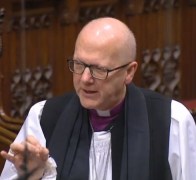 The Lord Bishop of St Albans: My Lords, recently I and a number of other Bishops issued a public letter welcoming the important ratification of the UN Treaty on the Prohibition of Nuclear Weapons. Can the Minister comment on the moral inconsistency, whereby we have rightly taken a stand on outlawing cluster bombs and landmines but not outlawing nuclear weapons, which, as we know, are far more destructive when they are used? Continue reading “Bishop of St Albans calls for nuclear weapon prohibition”
 The Lord Bishop of Portsmouth [V]: My Lords, I welcome this announcement, with its impact on jobs and industry, including in the diocese I serve. I note the welcome emphasis that the Government appear to give to defence and security. Will the Minister therefore recognise that previous defence reviews set out grand, strategic ambitions but were not backed by the necessary resources? Will she specifically confirm the Government’s commitment to providing those resources to match the ambitions of the review, and will she further recognise that as we wait for spending commitments on development aid and public sector pay, how much the Government propose in additional investment is an accurate barometer of what they consider to be most important?
  The Lord Archbishop of Canterbury: My Lords, as I am sure the noble Earl remembers, the Foreign Secretary, in his Guildhall speech, not only called for new capabilities and higher spending, but went on to set the point of these new capabilities when he said that,
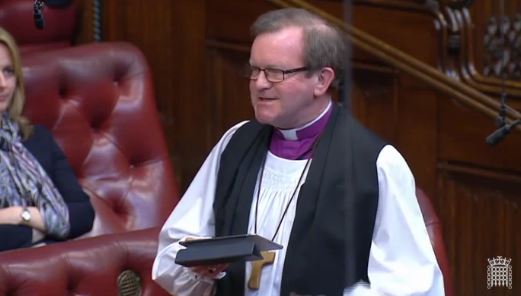 The Lord Bishop of Portsmouth: My Lords, it is as ever a pleasure to speak in your Lordships’ House, but today perhaps I feel the privilege especially. I cannot report that, 70 years ago, a Bishop contributed to this House’s debate on the founding of NATO. Without the personal, military, diplomatic or political experience to which the Minister alluded, I am grateful for the forbearance of your Lordships in listening to my contribution today.
 On 6th March 2019 Lord West of Spithead asked the Government a question about contracts to build five Type 31e frigates. The Bishop of Portsmouth, the Rt Revd Christopher Foster, asked a follow up question:
  The Archbishop of Canterbury: My Lords, I am grateful to the usual channels for permitting this debate; to the noble Lord, Lord Collins of Highbury, for responding on behalf of the Opposition; to the noble Lord, Lord Alderdice; and to the Minister, the noble Earl, Lord Howe, for their time and contributions today. My noble kinsman Lord Williams of Elvel said when I came into the House some years ago, “The wonderful thing about the House of Lords is that whatever you say, there will be a world expert listening to you”. Looking down the list of those who will contribute today, I am conscious of the expertise in the House, including a Nobel laureate, and I am greatly looking forward to hearing from noble Lords whose combined expertise and experience is sure to provide us with much to reflect on.
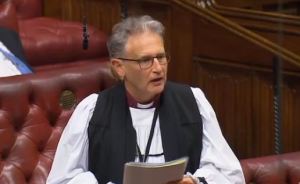 On 14th December 2018 the Archbishop of Canterbury, Most Revd Justin Welby,
 The Lord Bishop of Portsmouth: My Lords, I confide in you. Priests— even bishops, perhaps particularly so—are inclined to repeat themselves. I imagine noble Lords might have noticed. I have heard it said that we have only one sermon in us and just dress the message up differently each Sunday. I will be repeating my message today, and I am grateful to the noble Lord, Lord Sterling, for the opportunity to do so. I am just as grateful to the noble Earl, Lord Howe, for listening to my repetition with the grace, care and attention that we all appreciate.
 The Church of England in Parliament
You must be logged in to post a comment.