
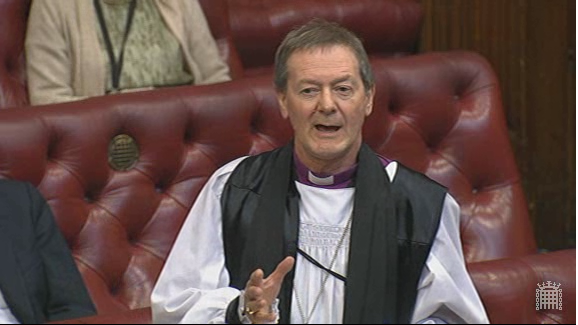
Bishop of Derby speaks on the Local Government Financial Settlement

On the 22nd January 2015 the Bishop of Derby spoke in a debate about the Local Government Financial Settlement. Bishop Alastair spoke about the need to stand back and look at what the future of local government should be. He went on to speak to the House about the work he undertakes in the Diocese to engage with local government on a variety of issues including regeneration, attracting new local business and the danger facing local government of local disengagement with politics.

DerbyThe Lord Bishop of Derby: My Lords, I thank the noble Lord, Lord Beecham, for securing this debate and for his introduction to it. I also thank the noble Broness, Lady Pinnock, and the right reverend Prelate the Bishop of Southwark, who both gave us very specific examples of some of the issues involved in this area. Continue reading “Bishop of Derby speaks on the Local Government Financial Settlement”

Bishop of Derby: focus on grassroot responses to maternal mortality

On 15th January 2015, the Bishop of Derby, the Rt Revd Alastair Redfern, took part in a question for short debate in the House of Lords, led by Baroness Hayman, on what progress has been made in reducing maternal and neonatal mortality in the developing world; and what plans they have to build on this work post-2015. The Bishop spoke of the situation in India, which has an ecumenical partnership with Derby Diocese, where one-third of global neonatal deaths occur. He noted that poverty, lack of education about basic hygine, attitudes towards women and girls and a lack of necessary infrastructure all contribute to high levels of maternal and neonatal mortality. He spoke of the grassroots responses to these conditions that he had observed in visits to India, and welcomed the partnership between DfID and development agencies such as Christian Aid, which work to channel funds to these effective local efforts.

DerbyThe Lord Bishop of Derby: My Lords, I too congratulate the noble Baroness, Lady Hayman, on securing this debate and on introducing it with such expertise and such a challenging sense of the statistics. Millennium development goals 4 and 5 are not being met and, as other speakers have said, the consequences are horrendous. My contribution will be from my own experience working with people at the grass roots, and I will then tease out what the implications of that experience should be.

I work in the diocese of Derby, in England, and we are twinned with the Church of North India, which extends from Calcutta to Mumbai—the whole of north India is twinned with our diocese in an ecumenical link. I work with people in a number of Indian communities where this issue is enormous. In 2012, one-third of global neonatal deaths happened in India. The highest rate of first-day mortality is in India. That is the context in which we are working with our partners, through whose eyes we discern some factors. Continue reading “Bishop of Derby: focus on grassroot responses to maternal mortality”

Bishop of Derby takes part in debate on chancel repair liability

Bishop of DerbyOn 15th January 2015, the Bishop of Derby, the Rt Revd Alastair Redfern, took part in a short debate in the House of Lords, led by Lord Avebury, on what steps the Government are taking to abolish the liability of private householders and others for chancel repairs. The Bishop put on record that the Church is, in principle, in favour of changing the law. However, he cautioned that the loss of title may cause the local parish financial hardships, and that compensation for the financial loss that would occur must be taken into account. The full transcript of the debate is reproduced below.

Chancel Repairs

Asked by Lord Avebury: To ask Her Majesty’s Government what steps they are taking to abolish the liability of private householders and others for chancel repairs.

Lord Avebury (LD): My Lords, a consensus that reform of the law on chancel repairs is long overdue has emerged from discussions with the church, the Law Commission, the Law Society, the Country Landowners’ Association and the National Secular Society. Since the Chancel Repairs Bill will not make further progress until after the general election, a preliminary debate on the issues is useful now. Continue reading “Bishop of Derby takes part in debate on chancel repair liability”

Bishop of Derby calls for strong National Referral Mechanism to support efforts to tackle modern slavery

On 10th December 2014, the Bishop of Derby, the Rt Revd Alastair Redfern, took part in the Committee Stage of the Government’s Modern Slavery Bill. The Bishop spoke in support of an amendment to put a new National Referral Mechanism on a statutory footing, and also raised questions about how the Government’s approach towards tackling slavery could be better integrated with safeguarding awareness. The Bishop had previously spoken in the Bill’s Committee Stage, and his remarks can be read here.

Bishop of DerbyThe Lord Bishop of Derby: My Lords, I will contribute briefly to the debate. I hope the Government will take the time to take seriously the NRM review. Jeremy Oppenheim has made some crucial insights, particularly about the 45 days being used as a period for deciding about judicial processes, not a period for nourishment and proper support. Therefore, we need to think very carefully about how we pitch the 45 days or whatever period it is, alongside a commitment to support victims on a longer timescale. He also made an important point about the concept of safeguarding, just referred to by the noble Lord, Lord Warner. I have spoken about this before in the House. It would be very helpful for everybody if we could connect what we are doing about slavery with the culture of safeguarding awareness. I very much support the suggestion from the noble Lord, Lord Warner, about what we call this mechanism. Continue reading “Bishop of Derby calls for strong National Referral Mechanism to support efforts to tackle modern slavery”

Bishop of Derby commends recommendations of Children’s Commission on Poverty

On 8th December 2014, Baroness Jones of Whitchurch asked Her Majesty’s Government what assessment they have made of the impact of child poverty on children’s early years educational development. The Bishop of Derby, the Rt Revd Alastair Redfern, asked a supplementary question:

Bishop of DerbyThe Lord Bishop of Derby: My Lords, has the Minister heard of the report At What Cost? produced by the Children’s Commission on Poverty, which is a group of young people supported by the Children’s Society? If the Minister has come across the report, what will the Government do about the recommendations in it?
Lord Nash: Again, I am afraid that I will have to write to the right reverend Prelate on that matter.


Bishop of Derby calls for hope in the face of conflict, during Archbishop’s debate

DerbyOn 5th December 2014, the Bishop of Derby, the Rt Revd Alastair Redfern, took part in the Archbishop of Canterbury’s debate on the role of soft power and non-military responses to conflict prevention. He noted that for soft power to be successfully exercised, it requires a great deal of trust – particularly trust in a bigger overview, the dignity of all people, a trust in the goodness of heart of people – and a willingness to learn new things. He also reflected on how the Anglican Church at its best is a model for these forms of trust.

The Lord Bishop of Derby: My Lords, I, too, congratulate my colleague the most reverend Primate—or perhaps I should say from these Benches my honourable friend—on his securing this debate. Continue reading “Bishop of Derby calls for hope in the face of conflict, during Archbishop’s debate”

Bishop of Derby speaks during Modern Slavery Bill debate

Bishop of DerbyOn 1st December 2014, the Bishop of Derby, the Rt Revd Alastair Redfern, took part in the first day of Committee Stage for the Modern Slavery Bill. A former member of the Joint Select Committee that  undertook the pre-legislative scrutiny of the bill, the Bishop spoke in favour of three amendments to the bill – one relating to ensuring that the legislation is ‘victim focused’, the second – recommended by the Joint Select Committee and co-sponsored by the Bishop – to create a specific offence for child exploitation, where a child has been exploited but not moved or trafficked, and the third to make criminalise all paying for sexual services. Following assurances from the Government of further discussions, the first two amendments were withdrawn. The third amendment was withdrawn following the recognition the the Bill was not an appropriate place for changes to be made to the law on prostitution.
Continue reading “Bishop of Derby speaks during Modern Slavery Bill debate”

Bishop of Derby – South Sudan (Written Answer)

On 1st December 2014, the Bishop of Derby, the Rt Revd Alastair Redfern, received an answer to a written question on South Sudan.
DerbyThe Lord Bishop of Derby: To ask Her Majesty’s Government what discussions they have had with other donor countries about the case for innovative funding arrangements to meet long-term humanitarian needs in South Sudan. [HL2868]

The Parliamentary Under-Secretary of State, Department for International Development (Baroness Northover): The UK has led conversations with other donors on improving linkages between humanitarian and development programmes, and ways to increase self-sufficiency and resilience among populations who are in need of humanitarian assistance. With our partners we are looking to fast track and implement innovative ways to stimulate markets to address food insecurity and build livelihoods, link development programmes in health and education with humanitarian provision of these services, and improve co-ordination in-country between humanitarian and development planning and provision. Continue reading “Bishop of Derby – South Sudan (Written Answer)”

Bishop of Derby – South Sudan (Written Answers)

On 27th November 2014, the Bishop of Derby, the Rt Revd Alastair Redfern, received answers from the Foreign and Commonwealth Office to four written questions about South Sudan.

Bishop of DerbyThe Lord Bishop of Derby: To ask Her Majesty’s Government what steps they are taking to encourage greater and co-ordinated regional political pressure being put on all parties to the conflict in South Sudan to cease fighting and to respect agreements signed to date.[HL2864]

The Minister of State, Foreign and Commonwealth Office (Baroness Anelay of St Johns): The UK is actively supporting regional efforts, led by the Intergovernmental Authority on Development (IGAD), to resolve the crisis in South Sudan. We raise the need for continued regional engagement through our Embassies in IGAD capitals, contacts between Ministers and through the UK Special Representative’s engagement in the peace talks. Continue reading “Bishop of Derby – South Sudan (Written Answers)”

Bishop of Derby takes part in debate on slavery and its use in supply chains

“We live in a culture that is rightly concerned about safeguarding. We are concerned rightly about the safeguarding of children at the moment. We have to get up to speed with the safeguarding of vulnerable adults, many of whom are in exploited forced labour.”

On 30th October 2014, Baroness Kennedy of Cradley led a short debate in the House of Lords to ask Her Majesty’s Government what steps they are taking to combat slavery in supply chains nationally and internationally. The Bishop of Derby, the Rt Revd Alastair Redfern, a former member of the Joint Select Committee on the Draft Modern Slavery Bill, spoke in the debate. He argued that there is a deep underlying tension between economic activity and treatment of the individual, which the modern slave trade has exploited. He also asked the Minister a number of questions regarding the strengthing of reporting and best practice in supply chains.

Bishop of DerbyThe Lord Bishop of Derby: My Lords, I, too, thank the noble Baroness, Lady Kennedy, for securing this debate and for her excellent introduction that laid out the ground clearly. I want to make some remarks from my experience of working with victims, the police and other agencies within our national context. We have just heard from the noble Baroness, Lady Cox, about the sheer horror of the way in which human beings are being treated in our own country.

I begin by welcoming Karen Bradley’s recent announcement that there will be amendments to secure proper reporting and disclosure. The key will be the level of reporting and the size of the company. I also welcome the strong support from many leaders in our industries. On the Select Committee, the people who represented Primark and Tesco, for instance, were supportive of a framework to require proper reporting and accountability, which would help their business case and standing in the community. Continue reading “Bishop of Derby takes part in debate on slavery and its use in supply chains”