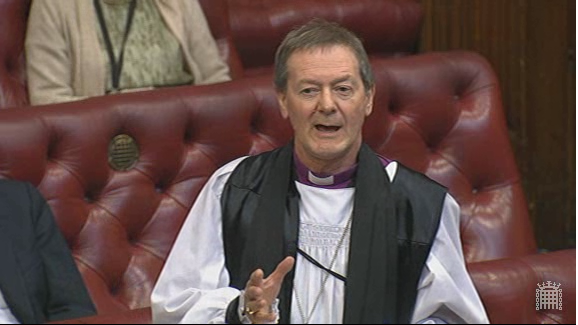
Bishop of Derby urges caution over ‘sapping of political energy’ in civil society

“We need transparency for professional lobbying and for political parties but we need transparency, and that is openness, in political debate. We should rejoice that so many charities, faith groups and voluntary groups want to be involved. They are subject to regulation in the political sphere through our tradition of charity Acts. Politics needs this political energy for the common good and all the signals—as we can tell from our e-mail inboxes—are that this source of political energy is being closed down and discouraged at the very time we are wringing our hands because the great public are not interested in political parties, elections or the democratic process.”

On 22nd October 2013, the Bishop of Derby, the Rt Revd Alastair Redfern, took part in the Second Reading debate of the Government’s Transparency of Lobbying, Non-Party Campaigning and Trade Union Administration Bill. In his speech, he asked the Minister to comment on three of the major tests for regulating transparency: the test of influencing electoral outcomes; the test of levels of financial expenditure and the test regarding the constituency as a measure. He expressed concern that as a result of politics becoming professionalised and pragmatic, ordinary people with political instincts were being excluded and the Bill as it stood would further sap political energy. The bishop hoped that there would be a pause and that the Minister would be willing to meet representatives of charities, faith and voluntary groups to look at proper controls and accountability.

Bishop of DerbyThe Lord Bishop of Derby: My Lords, I, too, want to comment on Part 2 from the perspective of charities and faith groups and the scoping out of a framework in this debate for further work. I declare an interest as a trustee of Christian Aid and as chair of the governors of the Churches’ Legislation Advisory Service, the secretariat service of which comprises Central Lobby consultants who will have to register under Part 1 of the Bill.

I recognise that the Government are trying hard to listen to concerns about Part 2. Like others, I have been in correspondence with the Leader of the Commons and his team. However, as the noble Baroness, Lady Hayter, and others have said, the Constitution Committee noted:

“The provisions of Part 2 directly affect the fundamental common law right to freedom of political expression”. Continue reading “Bishop of Derby urges caution over ‘sapping of political energy’ in civil society”

Bishop of Derby takes part in debate on demographic change in the UK

On 17th October 2013, Independent Peer Lord Filkin led a take-note debate in the House of Lord on the Report of the Public Service and Demographic Change Committee ‘Ready for Ageing?’ The Bishop of Derby, the Rt Revd Alastair Redfern, took part in the debate, focusing his remarks on the important role civil society play in supporting the elderly. He also raised concerns about the language used to talk about the elderly and highlighted the very significant contribution played by older people in society.

Bishop of DerbyThe Lord Bishop of Derby: My Lords, I, too, thank the noble Lord, Lord Filkin, and his colleagues on the Select Committee for introducing such a comprehensive and expert report. I shall pursue the theme mentioned of the contribution of civil society.

My first point is about the language that we use and the signals that we give out. The noble Baroness, Lady Tyler, talked about the importance of a public debate. It is easy to use language such as “retirement”, which indicates something negative, about stopping and ceasing to contribute. In the diocese where I work, we have 200 clergy who are retired; 80% of them make an enormous contribution, not just filling in but front-line, active contribution to the life of the church. Some cultures use the word senior rather than the word ageing. We must be very careful how we frame the debate. I invite the Minister to comment on the language that we use and the signals that we give out, so that it is not about a problem of decline and desperation but celebrating life at different stages and in different ways. Continue reading “Bishop of Derby takes part in debate on demographic change in the UK”

Bishop of Derby responds to Government Statement on Al-Madinah Free School

On 17th October 2013, a Government Statement was repeated in the House of Lords by the Parliamentary Under-Secretary State for Schools, Lord Nash, on the Al-Madinah Free School in Derby. The Bishop of Derby, the Rt Revd Alastair Redfern, responded to the statement during the subsequent question and answer session.

DerbyThe Lord Bishop of Derby: My Lords, I declare an interest as the Bishop of Derby and congratulate the Minister and his colleagues on the monitoring and firm action that is being taken. As I understand it, this is a very local initiative. What lessons can be learnt because if we do not have the local authority playing a key role, how are we providing the right kind of framework and guidance for local initiatives so that the right kind of standards, structures and expectations are put in place and met? What are we learning and how are we going to deal with that?

The Parliamentary Under-Secretary of State for Schools (Lord Nash): I am grateful to the right reverend Prelate for his question. This is a local initiative, it is quite a complicated situation and I do not have time to go into all the details now, but I can assure the House that we are all over this and will not allow this situation to continue.

(via Parliament.uk)

Written Answers – Civil Service, Freedom of Religion and the United Nations

Bishop of DerbyOn 17th October 2013 the Bishop of Derby, the Rt Revd Alastair Redfern, received answers to written question on the topics of civil service corporate credit cards, freedom of religion and the United Nations.

Civil Service: Corporate Credit Cards

The Lord Bishop of Derby: To ask Her Majesty’s Government what are the rules and criteria for the issuing of corporate credit cards to civil servants; and how the use of such cards is monitored and audited.

Lord Gardiner of Kimble: The Government Procurement Card (GPC) is a payment charge card used for making low value purchases. Its proper use contributes to making efficiencies.

All Departments have a clear policy for card allocation. The GPC Steering Group, established after the last General Election, has developed minimum policy standards for central Government departments and their Arm’s Length Bodies (ALBs). GPC Central Policy describes the roles and responsibilities for personnel that are required to govern and control local GPC programmes. These policies have been shared with the National Audit Office (NAO) and must be followed by all departments using GPCs. Before the last General Election there was no central oversight of Government GPC card use.

All Departments now operate compliance checking processes which include transaction logs that must be reconciled with bank statements and receipts each month; and the requirement for budget managers to reconcile GPC payment to ensure compliance with approved spend. The departmental controls, in accordance with GPC policy, include monthly compliance checking, including identifying off-contract spend and clear guidance for users on the correct route-to-buy.

All spend on GPCs over £500 is now published.

(via Parliament.uk) Continue reading “Written Answers – Civil Service, Freedom of Religion and the United Nations”

Bishops of Derby and Wakefield seek clarification on UK’s position on EU Justice and Home Affairs measures

On 14th October 2013, the Bishop of Derby, the Rt Revd Alastair Redfern, and the Bishop of Wakefield, the Rt Revd Stephen Platten, both received answers to written questions on the European Union’s Justice and Home Affairs Measures.

Bishop of DerbyThe Lord Bishop of Derby: To ask Her Majesty’s Government, further to the Written Answer by Lord McNally on 29 August (WA 318), what guarantees they sought from other member states, prior to their decision of 9 July to opt out of 130 European Union Justice and Home Affairs measures, that the United Kingdom would be able to opt back in to various police and justice measures.

The Minister of State, Ministry of Justice (Lord McNally): Protocol 36 does not provide for guarantees to be obtained from Member States and no Member State would have been able to have given such a guarantee. We therefore did not seek any such guarantees from Member States. However, the issue has been discussed in meetings with our EU counterparts at both Ministerial and official level.

However, Protocol 36 to the Treaties places an obligation on the UK and the Union institutions to, “…seek to re-establish the widest possible measure of participation of the United Kingdom in the acquis of the Union in the area of freedom, security and justice without seriously affecting practical operability of the various parts thereof, while respecting their coherence”. Given this, we are confident that we will be able to reach agreement on a sensible final package of measures that the UK will formally apply to rejoin.

Final agreement is subject to approval by the Council in the case of Schengen measures and the Commission for all others. Continue reading “Bishops of Derby and Wakefield seek clarification on UK’s position on EU Justice and Home Affairs measures”

Bishop of Derby asks Government about success of national civil service volunteering scheme

On 9th October 2013, the Bishop of Derby, the Rt Revd Alastair Redfern, received an answer to six written questions on the subject of the national civil service volunteering scheme.

DerbyThe Lord Bishop of Derby: To ask Her Majesty’s Government how many civil servants are participating in the national civil service volunteering scheme, broken down by region.

To ask Her Majesty’s Government which government ministries and departments are participating in the national civil service volunteering scheme.

To ask Her Majesty’s Government how they intend to measure the success or otherwise of the civil service volunteering scheme.

To ask Her Majesty’s Government what, if any, criteria they apply to placements offered as part of the civil service volunteering scheme.

To ask Her Majesty’s Government what proportion of the organisations participating in the civil service volunteering scheme are (1) voluntary groups, (2) community groups, and (3) social enterprise organisations.

To ask Her Majesty’s Government how many of the voluntary groups, community groups and social enterprise organisations participating in the civil service volunteering scheme have received government funding.

**

Lord Wallace of Saltaire: The Government encourages all staff to undertake volunteering which can be of benefit to the local community but also allows civil servants to gain valuable insight and career skills. However, there is no formal national civil service volunteering scheme.

Due to the number of civil servants, and the amount who volunteer in their own time, it is not possible to know how many organisations which have worked with civil servants are voluntary groups, community groups or social enterprise organisations which have received government funding.

(via Parliament.uk)

Bishop of Derby asks Government what funding has been provided to churches to help tackle violence against women (Written Answer)

On 30th July 2013, the Bishop of Derby, the Rt Revd Alastair Redfern, reveived an answer to a written question on the subject of violence against women.

Bishop of DerbyThe Lord Bishop of Derby: To ask Her Majesty’s Government, further to the Written Answer by Baroness Northover on 9 July (WA35), what funding has been provided to churches and faith-based organisations from the Violence against Women and Children Research and Innovation Fund.

Baroness Northover: The initial competitive tenders for Women and Children Research and Innovation programme were issued in May 2013, and we expect contracts to be in place by the end of the year.

The innovation grants will specifically target support to developing country organisations and will be open to partnerships between international and local organisations, including churches and faith-based organisations.


(via Parliament.uk)

Bishop of Derby receives answers to questions on food banks and sexual violence in conflict

On 25th July 2013, the Bishop of Derby received written answers to questions on the topics of food banks and sexual violence in overseas conflicts. The original questions and their answers are reproduced below.

Food Banks

Bishop of DerbyThe Lord Bishop of Derby: To ask Her Majesty’s Government what incentives are provided to supermarkets to donate waste food to food banks at the end of trading.

The Parliamentary Under-Secretary of State, Department for Environment, Food and Rural Affairs (Lord De Mauley): The Government does not currently offer incentives to supermarkets to redistribute surplus food. We do however recognise the good work of organisations that redistribute surplus food to provide access to nutritional meals for those who may otherwise struggle. In addition, most major retailers already have partnerships with redistribution charities. In 2012, Defra held a meeting with retailers and food distribution charities to explore the current barriers to redistribution. The Waste and Resources Action Programme is working with Fareshare and FoodCycle to deliver a trial to increase food redistribution from retail stores.

(via Parliament.uk)

**

Overseas Conflict: Sexual Violence

The Lord Bishop of Derby: To ask Her Majesty’s Government, further to the Written Answer by Baroness Northover on 9 July (WA35), what consideration has been given to inviting religious leaders from recipient countries to attend the high level event in the autumn designed to mobilise global leadership to prevent sexual violence in conflict.

Baroness Northover: The Call to Action event in the autumn will highlight the actions the international community needs to take for the protection of women and girls in emergencies. The UK’s commitment to addressing sexual violence in conflict and, more broadly, in tackling the many forms of violence against women and girls that manifest themselves in emergencies. Preparations for the event are underway and officials are considering what role religious leaders might play.


The Lord Bishop of Derby: To ask Her Majesty’s Government, further to the Written Answer by Baroness Northover on 9 July (WA35), whether the proposed technical training and guidance for field staff and advisers will include advice on how to engage with religious communities when providing humanitarian support to the victims of sexual violence in conflict.

Baroness Northover: The guidance and training for DfID advisers and staff is based on the United Nations Inter-Agency Standing Committee Guidelines for Gender-based Violence Interventions in Humanitarian Settings. These guidelines draw attention to the role that religious leaders and groups can play in the provision of psychological and social support, and in encouraging survivors of violence to seek appropriate care.

(via Parliament.uk)

Bishop of Derby – Written Answers

On 24th July 2013 the Bishop of Derby, the Rt Revd Alastair Redfern, received written answers to questions on Egypt and the Gulf States.

Bishop of DerbyThe Lord Bishop of Derby: To ask Her Majesty’s Government what assessment they have made of the prospects for political reconciliation in Egypt.

The Senior Minister of State, Department for Communities and Local Government & Foreign and Commonwealth Office (Baroness Warsi):We are in contact with all sides in Egypt, and have urged all to resolve their differences through dialogue, and avoid violence. The Secretary of State for Foreign and Commonwealth Affairs, my right hon. Friend the Member for Richmond (Yorks) (Mr Hague), was in regular contact with former Foreign Minister Amr, most recently on 8 July to discuss the situation in Egypt. We have requested contact with the new interim government and continue to be in contact with the army and Muslim Brotherhood. It is important that Egypt makes an early return to democratic processes, including free and fair elections, and that those processes are inclusive.

(via Parliament.uk)

Continue reading “Bishop of Derby – Written Answers”

Bishop of Derby – Religious Freedom (Written Answer)

On 22nd July 2013 the Bishop of Derby, the Rt Revd Alastair Redfern, received an answer to a written question on the subject of freedom of religion.

DerbyThe Lord Bishop of Derby: To ask Her Majesty’s Government what is their assessment of the European Union guidelines on promotion and protection of freedom of religion or belief, agreed by the Council of Ministers on 24 June.

The Senior Minister of State, Department for Communities and Local Government & Foreign and Commonwealth Office (Baroness Warsi): We worked closely with EU partners to develop guidelines for EU country offices to strengthen their work on the right to freedom of religion or belief across the world. We were gratified that these guidelines took as their original inspiration the UK’s own freedom of religion or belief toolkit. We believe the guidelines are a valuable tool for EU country offices and the embassies of individual EU member states to use, and look forward to strengthened joint working with our EU partners to ensure that the right to freedom of religion or belief is more widely guaranteed and that any violations are tackled in the most effective manner.

(via Parliament.uk)