
On 19th November the Bishop of Salisbury asked a question he had tabled to Government, on fuel intensive businesses moving to net zero carbon emission. The exchanges are below, along with the follow-up questions from other Members:
Fossil Fuels: Business
 The Lord Bishop of Salisbury: To ask Her Majesty’s Government, further to the report by the Transition Pathway Initiative Management Quality and Carbon Performance of Energy Companies: September 2020, published on 7 October, what steps they plan to take to encourage fossil fuel intensive businesses to accelerate their move to net zero carbon emissions.
The Parliamentary Under-Secretary of State, Department for Business, Energy and Industrial Strategy (Lord Callanan) (Con): My Lords, the Government have schemes worth nearly £2 billion operating or in development to support our vital energy-intensive industries to decarbonise. These schemes include the industrial energy transformation fund to help companies to reduce their fuel bills and transition to low-carbon technologies, and the industrial decarbonisation challenge to support industry with the development of low-carbon technologies in industrial clusters.
The Lord Bishop of Salisbury: I thank the Minister for his Answer. There have been some welcome and notable commitments, particularly by European oil and gas companies, but overall, the sector is not moving fast enough to align with the Paris agreement. How does the Minister see the Government supporting companies to move faster and have consistent standards for reporting all emissions from scopes 1, 2 and 3 so companies demonstrate alignment clearly in their reporting?
I commend to the Minister the work of the Institutional Investors Group on Climate Change working with TPI to establish a net-zero standard. It would be marvellous if the Government supported these endeavours in the context of their presidency of COP. Continue reading “Bishop of Salisbury asks Government to encourage fossil fuel intensive businesses to accelerate move to net zero carbon emissions”
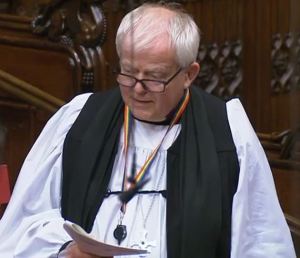 The Lord Bishop of Salisbury: My Lords, neither ship recycling nor Northern Ireland are my territory, though church is sometimes seen as an ark to gather people safely and hazardous materials are a concern for us all. It is important for Northern Ireland to thrive as best it can within the new political arrangements that are still unfolding. The purpose of this SI is clear and not controversial; it is to the benefit of one shipyard in Northern Ireland. The EU has developed a good scheme for overseeing this process and I am sure we will be glad to continue to use it.
  On 29th October the Bishop of Salisbury received written answers to two questions of Government, on (i) tree planting targets and (ii) working with business to address species and habitat destruction caused by UK supply chains:
 The Lord Bishop of Salisbury [V]: My Lords, this is not really my territory. I hesitate to come into this discussion but I will not delay noble Lords long. I note that the Delegated Legislation Committee in the other place dealt with this proposal in 13 minutes and, even then, the Minister commented on the widening of the discussion beyond the SI itself. That has already begun to happen in this discussion.
 On 20th October the Bishop of St Albans received a written answer to a question he had asked Government about the restoration of wood pasture:
 The Lord Bishop of St Albans [V]: My Lords, I plan to say a few words on Amendment 20, moved by the noble Lord, Lord Grantchester. I am also sympathetic to Amendments 23, 25 and 26.
 The Lord Bishop of Rochester: My Lords, while I understand that the focus of formal sponsorship is on businesses, is the Minister able to confirm that Her Majesty’s Government are also keen to engage in similarly deliberate ways with other bodies, including faith communities? These communities are highly motivated—indeed mandated—to care for God’s creation, locally and globally, and many, including the Church of England’s General Synod, have already committed to challenging targets for carbon reduction.
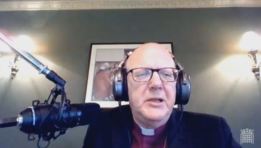 The Lord Bishop of St Albans [V]: My Lords, it is encouraging to hear about the progress being made, but we are fighting a losing battle if we continue to import saplings rife with diseases that then kill significant numbers of trees. Will the Minister update your Lordships’ House on the tree health resilience strategy and what other steps Her Majesty’s Government are taking to increase biosecurity?
  The Church of England in Parliament
You must be logged in to post a comment.