Bishop of Leeds asks Government about farming and rural policy post-Brexit

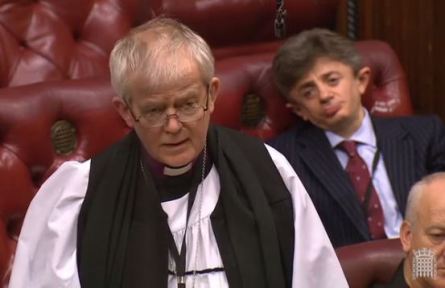
On Thursday 23rd March 2017 the House of Lords debated a motion from Lord Teverson “That this House takes note of the Report from the European Union Committee Brexit: environment and climate change (12th Report, HL Paper 109).” The Bishop of Leeds, Rt Revd Nick Baines, spoke in the debate:

The Lord Bishop of Leeds: My Lords, a number of questions have already been posed, and I pity the Minister for having to go through them in some detail. We heard earlier that we in this Chamber tend to be gloomy, and now we should be cheerful. I am neither; I am just puzzled—which is not a new experience.

From reading the report, which is a model of clarity, as are most of the Brexit reports that come from the various committees, it seems that, as we peel back the layers of the onion, we end up with more layers. I realise that that sounds paradoxical, but it seems to get more and more complex. The other night in the debate on Brexit and Gibraltar I tried to ask some questions about stress testing, to which I got no answer. So I shall try again, focusing very briefly on just one or two questions. Continue reading “Bishop of Leeds asks Government about farming and rural policy post-Brexit”

Bishop of St Albans asks Government to improve enforcement action against fly tipping

stalbans190117On 8th March, the Bishop of St Albans, Rt Revd Alan Smith asked Her Majesty’s Government ‘what further action they are taking to deal with the recent rises in fly-tipping.’ The exchange between the Bishop and the Minister is below, with the follow up questions from other Members.

The Lords Bishop of St Albans: My Lords, I beg leave to ask the Question standing in my name on the Order Paper. In so doing, I express my regret that I could not find a suitable topical for International Women’s Day.

Continue reading “Bishop of St Albans asks Government to improve enforcement action against fly tipping”

Neighbourhood Planning Bill: Archbishop of York supports amendment on planning regulations


york-170117-bOn 23rd February the House of Lords considered the Government’s Neighbourhood Planning Bill at Report Stage. The Archbishop of York, Most Revd & Rt Hon John Sentamu spoke in support of an amendment from Lord Stunell on planning authority regulations. 

The amendment was put to a vote and passed by 113 votes to 107.

Amendment 18

Moved by Lord Stunell

18: Clause 13, page 14, line 5, at end insert—

“(2A) No regulations shall be made under subsection (1) that would have the effect of preventing a local planning authority from requiring a condition that would otherwise be in conformity with the national planning policy framework.”

The Archbishop of York: My Lords, first, I apologise to the noble Baroness, Lady Cumberlege. I was whispering to her because the spirit was on me, and was saying, “Preach it, sister, preach it”, as she referred to a document as a bible.* Continue reading “Neighbourhood Planning Bill: Archbishop of York supports amendment on planning regulations”

Bishop of St Albans asks for reassurances on food standards post-Brexit

On Thursday 2nd February Baroness Miller of Chilthorne Domer asked Her Majesty’s Government “what measures they will put in place following Brexit to safeguard environmental standards and biodiversity.” The Bishop of St Albans, Rt Revd Alan Smith, asked a follow-up question:

stalbans190117-bThe Lord Bishop of St Albans: My Lords, we are all reassured that EU environmental legislation is going to be enshrined within UK law, but we will probably be coming out of the single market and entering into a series of trade negotiations with, for example, the United States. Trade negotiations are just that: we will have to make compromises. Will the Minister assure the House that we will not be producing our food to lower standards or consuming food that has been produced more cheaply by undercutting our industry—for example, chicken washed in chlorine and beef reared on growth hormones? Continue reading “Bishop of St Albans asks for reassurances on food standards post-Brexit”

Church Commissioner questions: Israel/Palestine, human trafficking, prisons, social media, low carbon economy, tourism, lead theft

On 19th January 2017 the Second Church Estates Commissioner, Rt Hon Dame Caroline Spelman MP, answered questions in the House of Commons from MPs on Israel/Palestine, human trafficking, prisons, social media, low carbon economy, tourism and lead theft. The transcript is below:

spelman-190117b Continue reading “Church Commissioner questions: Israel/Palestine, human trafficking, prisons, social media, low carbon economy, tourism, lead theft”

Church Commissioners’ Written Answer: Churchyard Biodiversity

Caroline SpelmanOn 10th January 2017 the Second Church Estates Commissioner, Rt Hon Dame Caroline Spelman MP, answered a written question from Mark Hendrick MP about churchyard biodiversity in the Diocese of Blackburn:

Mr Mark Hendrick (Preston) To ask the right hon. Member for Meriden, representing the Church Commissioners, (a) what steps the Diocese of Blackburn has taken to work with Caring for God’s Acre to map flora and fauna on its Estate, (b) which churches in the Diocese of Blackburn have recorded flora and fauna in churchyards, (c) what notable finds of flora and fauna have been recorded and (d) what plans the Diocese of Blackburn has to take part in the Cherishing Churchyards Week from 3 June to 11 June 2017. Continue reading “Church Commissioners’ Written Answer: Churchyard Biodiversity”

Bishop of St Albans suggests irresponsible developers should be liable for costs of flood damage

St Albans 2On 8th November 2016, Baroness Jones of Whitchurch asked Her Majesty’s Government “whether flood defences are in place to protect vital infrastructure this winter.” The Bishop of St Albans, Rt Revd Alan Smith, asked a follow up question:

The Lord Bishop of St Albans: The Minister has already referred to the EFRA Select Committee report, Future Flood Prevention. One of its recommendations is the imposition on developers of a statutory liability for the cost of floods where those developments have not complied with planning regulations or the local planning situation, thereby causing additional flooding. Does the Minister agree with this eminently sensible suggestion, and will Her Majesty’s Government adopt it? Continue reading “Bishop of St Albans suggests irresponsible developers should be liable for costs of flood damage”

Bishop of Portsmouth asks Government to look at impact on schools of increasing business rates on small solar panels

portsmouth241016On 27th October 2016 Baroness Featherstone asked Her Majesty’s Government “whether they will reverse their decision to end the business rate exemption for small solar panels from April 2017”. Baroness Featherstone said “I urge the Government to look at the impact on schools and parish councils, which will be devastating”. The Bishop of Portsmouth, Rt Revd Christopher Foster, asked a follow up question: 

The Lord Bishop of Portsmouth: My Lords, may I press the Minister a little further on the impact—perhaps, I am hoping, the unintended impact—of this decision on some small schools? Is it really intended that small schools should pay business rates, often after significant community fundraising to install solar panels to increase awareness among children and young people of climate-change issues? Continue reading “Bishop of Portsmouth asks Government to look at impact on schools of increasing business rates on small solar panels”

Bishop of Salisbury welcomes new Carbon Budget Orders

On 19th July 2016 the House of Lords debated the approval of the Government’s draft Carbon Budget Order 2016 and Climate Change Act 2008 (Credit Limit) Order 2016. The Bishop of Salisbury, Rt Revd Nicholas Holtham, spoke in the debate, welcoming the Orders, which were approved by Peers at the conclusion of the debate: 

Bp Salisbury 2The Lord Bishop of Salisbury: My Lords, I welcome both orders and welcome the Minister in her new role with its important responsibilities to further our progress in the care of our common home. I particularly welcome her as somebody who lives in the diocese of Salisbury, and I look forward to working with her in this new context.

The Committee on Climate Change’s Meeting Carbon Budgets—2016 Progress Report to Parliament says that it,

“comes at a critical point in the development of climate policy in the UK … against the backdrop of the Paris Agreement in December last year”.

The political circumstances could not be more significant. I was grateful to the noble Viscount, Lord Ridley, for his eloquent speech in favour of international agreements, which gave me a sense of urgency in relation to the implementation of the Paris agreement. I have taken on a preaching engagement in the autumn, about which I have been feeling some trepidation. It is to preach at the annual service for the Worshipful Company of Fuellers. I am now looking forward to that event and to trying to engage with that group of people on these issues. Continue reading “Bishop of Salisbury welcomes new Carbon Budget Orders”

Bishop of St Albans asks Government about action to prevent fly-tipping

On 12th May 2016 the Bishop of St Albans, Rt Revd Alan Smith, received written answers to questions of Government about fly-tipping:

St Albans 2The Lord Bishop of St Albans: To ask Her Majesty’s Government what assessment they have made of the levels of fly-tipping on private land across the UK in each of the last five years. [HL8278]

Lord Gardiner of Kimble: Fly-tipping is unacceptable whether it occurs on public or private land, it spoils our enjoyment of the countryside, can harm human health and wildlife, and damage farming and rural tourism. It also undermines legitimate waste businesses where unscrupulous operators undercut those that operate within the law and is a drain on both local authorities and landowners that clear it up. Tackling this scourge and other forms of illegal waste activity is a priority for the Government. Continue reading “Bishop of St Albans asks Government about action to prevent fly-tipping”