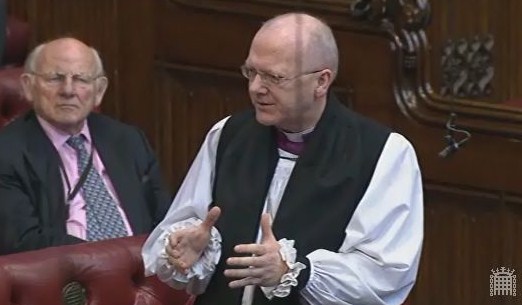
Bishop of Salisbury urges a rethink on Government renewable energy proposals

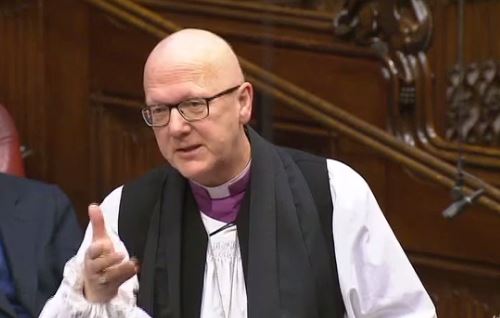
On the 16 March 2016 the Bishop of Salisbury, Rt Revd Nicholas Holtham, took part in a debate to approve the Government’s draft Renewables Obligation Closure Etc. (Amendment) Order 2016. Baroness Featherstone also tabled a Motion to Regret the change. The draft instrument closes the renewables obligation from 1 April 2016 (12 months early) to solar PV generating stations at 5 megawatts and below. It applies both to new generating stations and to existing stations that wish to add additional capacity up to the 5 megawatts threshold. The Bishop’s speech is below and the vote on the Regret Motion can be seen here.

Bp Salisbury 2The Lord Bishop of Salisbury: My Lords, it is curious to rehearse the same arguments so soon after the recent debate on feed-in tariffs. It is very disappointing in the wake of the success in Paris of COP 21, and the enthusiasm engendered from that about a new level of ambition in response to human-caused climate change. I feel as though the Minister is in a position of defending the indefensible. The noble Baroness, Lady Byford, made a very good point about the place of subsidies and pump-priming. Therefore, it is disappointing that the Government are not working more effectively with the renewable energy sector to build on the considerable success of that industry.

Continue reading “Bishop of Salisbury urges a rethink on Government renewable energy proposals”

Bishop of St Albans – technological goods should be designed to last longer

On 3rd March 2016 the House of Lords considered a questions for short debate tabled by Baroness Jones of Whitchurch, “To ask Her Majesty’s Government what steps they are taking to promote the principles of the circular economy, based on the re-use, repair, refurbishment and recycling of existing materials and products, to protect the environment, give new growth opportunities and avoid waste.” The Bishop of St Albans, Rt Revd Alan Smith, spoke in the debate:


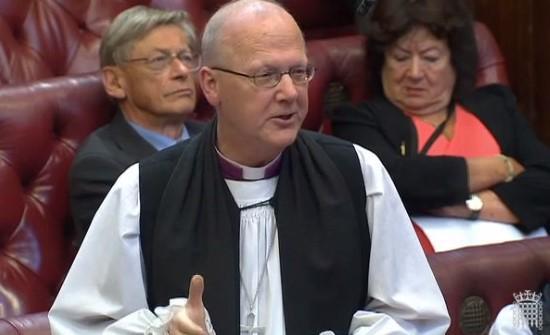
Bishop St Albans June 2015The Lord Bishop of St Albans: My Lords, my thanks also go to the noble Baroness, Lady Jones of Whitchurch, for this important debate on the circular economy.

I want to spend just a few moments highlighting the economic and environmental impact of planned obsolescence—this has already been referred to —particularly in technological goods, which we know is used by companies to drive growth and ensure a steady supply of return customers. It is a business model that relies on technological products needing to be upgraded and/or replaced at regular intervals, whether because they go out of fashion, have a limited lifespan, or are difficult or expensive to repair. Continue reading “Bishop of St Albans – technological goods should be designed to last longer”

Bishop of St Albans highlights sustainable alternatives to throwaway approach to smartphones

On 23rd February 2016 Baroness Jones of Whitchurch asked Her Majesty’s Government “what progress has been made in reducing levels of unwanted electronic goods ending up in landfill through encouraging manufacturers to produce more sustainable products.” The Bishop of St Albans, Rt Revd Alan Smith, asked a follow up question.

Bishop of St AlbansThe Lord Bishop of St Albans: My Lords, nothing exemplifies our society’s throwaway attitude more than modern smartphones, which are almost impossible to get repaired at a reasonable cost, with batteries that are fixed in them and processors which are designed not to work after a couple of years. In contrast, there are now some social enterprises such as Fairphone, a Dutch company, that are producing phones using ethically sourced materials and in which every part can be replaced or upgraded when necessary. Does the Minister agree that such an initiative needs to be held up to the technology industry as a good example of the way forward to find sustainable products? Continue reading “Bishop of St Albans highlights sustainable alternatives to throwaway approach to smartphones”

Bishop of Leeds leads debate on national response to flooding

On 14th January 2016 the Bishop of Leeds, Rt Revd Nick Baines, led a short debate in the House of Lords on flood management. His speech and the Government response is below. The full text of the debate, including a speech by the Bishop of St Albans, can be read here.

The Lord Bishop of Leeds: To ask Her Majesty’s Government how they intend to review their long term strategy for flood management, particularly in rural areas that do not qualify for large-scale flood defences.

LeedsThe Lord Bishop of Leeds: My Lords, I am grateful for the opportunity to put to the Government the Question before us. If there was a sound track to this debate it would probably include Phil Collins’s “In Too Deep”.

It is important to note the destructiveness of the recent flooding, given that the news agenda moves on very quickly and communities which found themselves at the heart of a sympathetic nation quickly feel themselves to be forgotten. For some of the communities in my diocese, the recent floods come in the wake—almost literally—of other occurrences in recent years. For them the need for longer-term and more joined-up measures is obvious.

I pay tribute to civic leaders, emergency services, public service workers, members of the Armed Forces, the Environment Agency and local volunteers, many of whom sacrificed holidays and family time over Christmas to support victims of this appallingly destructive flooding. Continue reading “Bishop of Leeds leads debate on national response to flooding”

Bishop of St Albans suggests new approaches to flood management

On 14th January 2016 the Bishop of Leeds, Rt Revd Nick Baines, led a short debate in the House of Lords on flood management. The Bishop of St Albans, Rt Revd Alan Smith, also spoke in the debate.

StAlbans171115The Lord Bishop of St Albans: My Lords, I thank my right reverend colleague for today’s debate. Due to the shortage of time, straightaway I shall focus a little more on whole-catchment flood management. A renewed focus on this approach has been one of the notable outcomes of the current flood crisis, helped of course by the exemplary work of the Pickering slow-the-flow scheme, which the noble Baroness, Lady McIntosh, described so eloquently.

The potential of whole-catchment approaches—for example, using meandering rivers, planting trees and building permeable dams to slow water in upland areas and reduce peak flow further downstream—is enormous. In the long term, it provides a cheaper, more environmentally friendly method of flood management, which works, as a number of people have already said, with natural processes rather than constantly trying to hold back the tide. Such approaches also have the benefit of being effective across a catchment, rather than simply focusing on one or two high-value areas, and so can help to lower the flood risk in rural hamlets and villages that might otherwise not qualify for flood protection. Continue reading “Bishop of St Albans suggests new approaches to flood management”

Bishop of Salisbury welcomes Paris agreement and calls for sights to be set higher on climate change

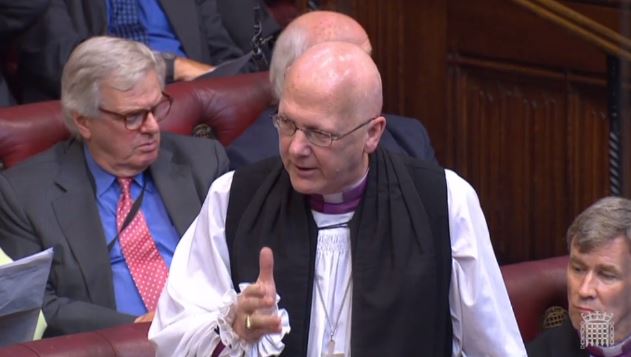
On 17th December 2015 the House of Lords debated a motion from Baroness Miller of Chilthorne Domer, “To ask Her Majesty’s Government what progress was made at the COP 21 climate change talks”. The Bishop of Salisbury, Rt Revd Nicholas Holtam, spoke in the debate, congratulating Government on the achievements on climate change at the Paris summit and calling for more emphasis on community energy and renewables. 


Bp Salisbury 2

The Lord Bishop of Salisbury: My Lords, I thank the noble Baroness, Lady Miller, for this debate and congratulate the noble Baroness, Lady Sheehan, on her maiden speech. What a great debate in which to make a maiden speech, when we are looking so much towards the future.

On Tuesday, we congratulated the Government, the Minister, the officials from DECC and some Members of this House on the contributions that they made in Paris. Many people will feel that this is an agreement for which they hoped and prayed. Someone said, “I can’t really comment. It was near miraculous”. I think that that might be true. It is particularly significant in the wake of the terrorism in Paris on 13 November. Terrorism seeks to divide us and creates fear. This agreement of nearly all the world acting together gives hope, which feels to be a very important statement. I have said before that I am particularly grateful for the creation of a predictable framework of $100 billion of climate finance for poor countries. That is particularly significant at a time when questions are being asked about overseas aid. This is an important contribution to that debate. Continue reading “Bishop of Salisbury welcomes Paris agreement and calls for sights to be set higher on climate change”

Church Commissioner Questions – Syrian refugees, fossil fuel investments, hedgehogs

On the 17th December 2015 the Second Church Estates Commissioner, Rt Hon Caroline Spelman MP, answered four oral questions in the House of Commons about Syrian refugees, fossil fuel investments and the protection of hedgehogs.

Continue reading “Church Commissioner Questions – Syrian refugees, fossil fuel investments, hedgehogs”

Bishop of Salisbury welcomes Paris climate change agreement

On 15th December 2015 a statement from the Secretary of State for Energy and Climate Change on the Paris Climate Change Summit was repeated in the House of Lords. The Bishop of Salisbury was amongst those who responded:


SalisburyThe Lord Bishop of Salisbury: My Lords, I, too, congratulate the Minister on the achievements in Paris and the part that the UK Government played. The faith communities organised, among those from the wider public sphere, to gather in Paris. Forty-four pilgrims walked from London; seven walked from the Danish-German border; and 22 cycled from Copenhagen. As they travelled on the journey to Paris, they gathered with them the support of the communities through which they travelled and in which meetings were held. This culminated last week with the presentation of a petition, with signatures from 1.83 million people, to Christiana Figueres and President Hollande by 20 of us in the faith communities. This is a deal that many people wanted. Ban Ki-moon, Secretary-General of the UN, said that it was the most complex and largest talks he had ever been part of. The sense of achievement is therefore very great in having pulled off the Paris agreement. The UK’s contribution through climate finance was particularly significant.

Continue reading “Bishop of Salisbury welcomes Paris climate change agreement”

Floods in Cumbria – Bishop of Leeds asks question

On 9th December 2015 Lord Grantchester asked Her Majesty’s Government “what emergency measures they are considering to support the emergency services and local communities affected by flooding in Cumbria.” The Bishop of Leeds, Rt Revd Nick Baines, asked a follow-up question: 


LeedsThe Lord Bishop of Leeds: My Lords, what cognisance is taken by the Government of the stochastic modelling performed by the insurance industry and how many one-in-100-years events it takes for something to cease to be a one-in-100-years event?


Baroness Williams of Trafford: My Lords, I am sure that the right reverend Prelate will appreciate that this is probably a matter for God because every time that we have tried to predict, an even worse event has occurred. I do not make that point lightly. We are constantly reviewing the flood defences and how we can respond.


(via Parliament.uk)

Bishop of Portsmouth speaks on floods

On 7th December 2015 a statement from the Secretary of State for Environment, Food and Rural Affairs on flooding in the north of England was repeated in the House of Lords. The Bishop of Portsmouth responded:

BishPortsspeechtaxcreditsThe Lord Bishop of Portsmouth: My Lords, I apologise to the House and in particular to the noble Baroness, Lady Parminter, and the Minister for my earlier ill-timed intervention. I add an expression of my compassion and sympathy, and the assurance of my prayers, to all those whose lives and livelihoods have been affected and particularly to the families of those who died.

The right reverend Prelate the Bishop of Carlisle lives in Keswick so has seen for himself the terrible problems caused by these storms. I know that the House will appreciate that he cannot be in his place today. In the past 10 years we have seen in Cumbria three so-called once-in-a-lifetime flooding events. Does the Minister believe that there may be a category problem here, and that some redefinition may be appropriate? Continue reading “Bishop of Portsmouth speaks on floods”