Queen’s Speech: Bishop of London speaks on health and levelling up

The Bishop of London spoke in a debate regarding the Queen’s Speech on 17th May 2022:

The Lord Bishop of London: My Lords, it is a pleasure to speak in the debate on the Motion for the humble Address. I declare my interests as outlined in the register. There is much in Her Majesty’s gracious Speech to commend it to your Lordships’ House. However, it is unfortunate that it did not include any detailed remarks on the relationship between health disparities and the levelling-up agenda. While there was a valid emphasis on restoring the strength of the economy, it was a shame to hear so little detail on the circumstances that will enable us to economically bounce back: namely, our health.

Thankfully, the actual levelling-up report highlighted health as one of its mission areas, stating:

“By 2030, the gap in Healthy Life Expectancy … between local areas where it is highest and lowest will have narrowed”,

and that, by 2035, healthy life expectancy will rise by five years. The measurement of these missions, along with an independent body to ensure that they are seen through, will be vital to their success and essential in the wider context of health inequalities which we are facing post pandemic. Without these metrics and this accountability, we may well miss the goal of levelling up entirely.

Continue reading “Queen’s Speech: Bishop of London speaks on health and levelling up”
Votes: Health and Care Bill

On 16th March 2022, the House of Lords debated the Health and Care Bill in its report stage. Votes were held on several amendments to the bill, in which Bishops took part.

Continue reading “Votes: Health and Care Bill”

Bishop of St Albans asks about rural health in the Integration White Paper

The Bishop of St Albans asked a question on references to rural health in the the Integration White Paper on 10th February 2022:

The Lord Bishop of St Albans: My Lords, I declare my interests as a vice-president of the Local Government Association and president of the Rural Coalition. I want to pick up very briefly on what the noble Baroness, Lady Brinton, said about rural issues. It is disappointing that there are no explicit references to rural health. One of the concerns of the APPG on Rural Health and Social Care parliamentary inquiry was the way in which inappropriate data, metrics and funding formulas can disadvantage rural areas. National programmes are one thing, but when they are delegated to local areas how are we going to ensure that they are properly rural-proofed and will integrate both health and care?

Continue reading “Bishop of St Albans asks about rural health in the Integration White Paper”

Bishop of Exeter asks about access to dental service in rural communities

The Bishop of Exeter asked a question on access to dental services for rural communities on 31st January 2022, during a debate on issues in NHS dental care:

The Lord Bishop of Exeter: My Lords, the report of Healthwatch England states that, of all the areas in the country with lack of access to NHS dentistry,

“the worst affected is Devon, as there are currently no practices showing as taking on adult or child patients.”

Can the Minister assure the House that, as part of the Government’s levelling-up policy, rural communities in Devon and elsewhere will not be further disadvantaged and will have access to NHS dental services?

Continue reading “Bishop of Exeter asks about access to dental service in rural communities”

Health & Care Bill: Bishop of St Albans tables amendments on health and social care in rural areas

During a debate on the Health & Care Bill on 13th January 2022, the Bishop of St Albans tabled two amendments on health inequalities in rural areas:

The Lord Bishop of St Albans: My Lords, Amendments 68 and 95 are in my name. I declare my role as president of the Rural Coalition. I support the broad drift of these amendments, which engage with the important issue of reducing inequalities.

Rural health and social care has often presented challenges in terms of proximity to services, the types of services available within a local area and the demographics of rural areas. It is complicated. Rural areas have a higher proportion of older residents, which is always a greater burden on healthcare services compared with areas with younger populations.

Continue reading “Health & Care Bill: Bishop of St Albans tables amendments on health and social care in rural areas”

Health & Care Bill: Bishop of Carlisle supports amendments on health inequality on behalf of the Bishop of London

On 13th January 2022 the House of Lords debated the Health & Care Bill in its second day of committee. On behalf of the Bishop of London, the Bishop of Carlisle spoke in support of amendments seeking to reduce health inequalities:

The Lord Bishop of Carlisle: My Lords, I will speak on behalf of my noble friend the right reverend Prelate the Bishop of London. She has added her name to Amendment 65, and we on these Benches support the other amendments in this group that seek to reduce health inequalities. As we have heard, these amendments would help to ensure that the Bill does not forget the underserved and disadvantaged in our society, many of whom have been mentioned already.

Continue reading “Health & Care Bill: Bishop of Carlisle supports amendments on health inequality on behalf of the Bishop of London”

Bishop of Leeds raises inconsistency of covid rules on singing in churches

On 15th June 2021 the House of Lords heard a repeat of a Government statement on covid-19 rules.

The Lord Bishop of Leeds: My Lords, regardless of matters of hindsight, does the Minister agree that prolonging the restrictions might be justified for certain reasons? I do not demur from that, but the prolonging of inconsistencies is a serious impediment to public adherence to the rules. You do not have to look very far to see where the discipline broke down a long time ago. For example—this is not special pleading; it is just at the forefront of my mind—you can sing in a pub but not in a church. This is what brings the rules into disrepute, and therefore people do not agree with them.

Secondly, can the Minister say something in response to Michael Gove’s reported comments about acceptable death rates? We have learned to live with acceptable death rates from flu and other seasonal diseases. Will the Government do some work on what might be an acceptable death rate from Covid in future and be up-front with the country as to what that might be? I think we can take it.

Continue reading “Bishop of Leeds raises inconsistency of covid rules on singing in churches”

Bishop of Carlisle asks about access to affordable cancer treatments in developing countries

On 30th November 2020 questions were put in the House of Lords on vaccine distribution. The Bishop of Carlisle asked a question:
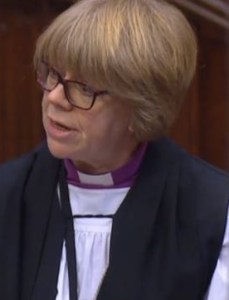
The Lord Bishop of Carlisle: My Lords, for obvious reasons we have focused largely on equal access to vaccines but, given the broader significance and implications of this Oral Question on affordable drugs and the fact that Global Cancer Week took place earlier this month, are any negotiations currently taking place on access to affordable cancer treatments, especially in developing countries? Continue reading “Bishop of Carlisle asks about access to affordable cancer treatments in developing countries”

Bishop of London – need to invest in local public health responses to coronavirus and offer right financial support for most restricted areas

On 20th October 2020 the House of Lords heard the repeat of a Government statement on Covid-19, and also considered the Government’s Health Protection (Coronavirus, Restrictions) (No. 2) (England) (Amendment) (No. 5) Regulations 2020. The Bishop of London spoke in response to both:

In response to the Motion to approve the Regulations, she said:

The Lord Bishop of London: My Lords, I am grateful to the Minister for the work that he and others are doing to make decisions at this very challenging time. The regulations we are debating relate to health protection restrictions and fines. However, I wonder whether our approach to public health protection and restrictions during the pandemic needs to pay more attention to a bottom-up approach of wisdom, rather than simply relying on top-down pragmatism and the push and pull of financial incentives. Last week, the right reverend Prelate the Bishop of Manchester highlighted how policies, such as fines, are out of touch with many. It has led to frustration and resentment nationwide. Continue reading “Bishop of London – need to invest in local public health responses to coronavirus and offer right financial support for most restricted areas”

Bishop of Durham says social and spiritual health needs to be part of Government’s covid lockdown decisions

On 14th October 2020 the House of Lords heard the repeat of a Covid-19 update that had been given to the House of Commons by the Prime Minister. The Bishop of Durham spoke in response:

The Lord Bishop of Durham [V]: In welcoming the fact that places of worship have been allowed to continue to open—that is partly a recognition of their important place in the life of the nation—I note that the Prime Minister spoke still in the binaries of economic health and medical health that we have heard throughout the course of the pandemic. However, the nation’s health is more than this binary. The Government must surely no longer overlook the need to protect the nation’s social and spiritual health too. The Christian faith is clear that well-being is far more than being medically healthy or simply alive; rather, it involves social engagement, emotional nourishment, spiritual rest and love from good community. Will the Government acknowledge the nation’s need for social and spiritual health by including experts on social well-being in all future conversations around lockdown measures?

Baroness Evans of Bowes Park (Con): I agree with the right reverend Prelate that that is the dilemma being faced. As he rightly says, harm to health is harm to the economy and harm to the economy is harm to health: these things are all interlinked, which is why this is a very difficult situation and why difficult decisions are having to be made about how to balance them. I can assure him that that is at the forefront of our thoughts. As part of the ongoing discussions around decisions being made about national and local levels, I know that Cabinet colleagues and the Prime Minister are talking to a huge range of people with different backgrounds to make sure that we get that right and get the country moving in the right direction.

Parliament.uk