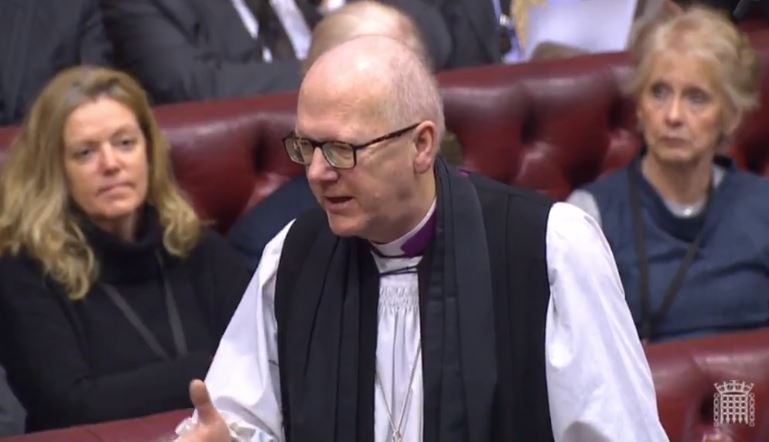
Illegal Migration Bill: Bishop of Gloucester backs amendments regarding detention of pregnant women

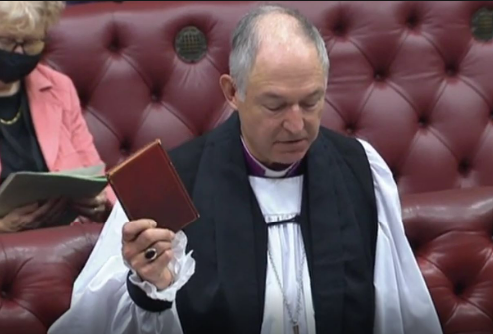
On 3rd July 2023, the House of Lords debated the Illegal Migration Bill in the second day of the report stage. The Bishop of Gloucester spoke in support of amendments to the bill tabled by Baroness Lister of Burtersett which would seek to prevent the current 72 hour limit on detention of pregnant women from being removed:

The Lord Bishop of Gloucester: My Lords, it is a great pleasure to follow the noble Baroness, Lady Lister, who expertly outlined why the amendment is needed.

Continue reading “Illegal Migration Bill: Bishop of Gloucester backs amendments regarding detention of pregnant women”

Bishop of St Albans asks about support for people with degenerative medical conditions

The Bishop of St Albans received the following written answers on 22nd June 2023:

The Lord Bishop of St Albans asked His Majesty’s Government what support is available for people with progressive supranuclear palsy.

Lord Markham (Con): Patients with a diagnosis of progressive supranuclear palsy would be supported through the usual range of commissioned health and social care services. Depending on the needs of an individual, support may be provided through a range of commissioned health and social care services including their general practitioner, general neurology services, specialised neurology services and social care. There is not a separately commissioned service for progressive supranuclear palsy.

Continue reading “Bishop of St Albans asks about support for people with degenerative medical conditions”

Bishop of London asks about reducing health inequalities

The Bishop of London received the following written answer on 21st June 2023:

The Lord Bishop of London asked His Majesty’s Government what recent progress they have made towards reducing health inequalities; and what further steps they intend to take in the future.

Lord Markham (Con): The Government is committed to improving healthy life expectancy by five years by 2035 and reducing the gap between areas where it is highest and lowest by 2030, as stated in the Levelling Up White Paper.

Continue reading “Bishop of London asks about reducing health inequalities”

Bishop of St Albans asks about diagnoses of corticobasal degeneration in the past five years

The Bishop of St Albans received the following written answer on 21st June 2023:

The Lord Bishop of St Albans asked His Majesty’s Government how many people were diagnosed with corticobasal degeneration in (1) 2018, (2) 2019, (3) 2020, (4) 2021, and (5) 2022.

Lord Markham (Con): The National Congenital Anomaly and Rare Diseases Registration Services (NCARDRS) does not hold comprehensive data on corticobasal degeneration. Therefore, this this information is not available in the format requested.

Hansard

Bishop of St Albans asks about research into neurological conditions

The Bishop of St Albans received the following written answers on 20th June 2023:

The Lord Bishop of St Albans asked His Majesty’s Government how much money they are directing annually to research the (1) causes, and (2) treatment, for corticobasal degeneration.

Continue reading “Bishop of St Albans asks about research into neurological conditions”

Bishop of London asks about community healthcare models to tackle health inequality

On 19th June 2023, the Bishop of London tabled a question on reducing inequality of access to primary care using the Community Health Worker Model:

The Lord Bishop of London: To ask His Majesty’s Government what assessment they have made of the community health worker model in relation to reducing inequality of access to primary care.

Lord Evans of Rainow (Con): My Lords, the Government have made no formal assessment of the community health worker model. However, they are supporting the development of models like the Brazilian one through the additional roles reimbursement scheme. We have delivered on our manifesto commitment to recruit 26,000 additional primary care professionals a year ahead of the March 2024 target. Our Delivery Plan for Recovering Access to Primary Care will also create a more equitable approach, regardless of patients’ routes to access.

Continue reading “Bishop of London asks about community healthcare models to tackle health inequality”

Strikes (Minimum Service Levels) Bill: Bishop of London speaks on inclusion of health services in bill

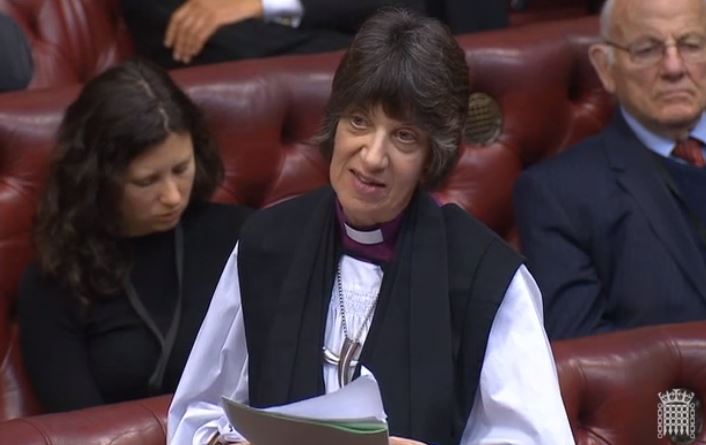
The Bishop of London spoke to a group of amendments related to health services during a debate on the Strikes (Minimum Service Levels) Bill on 9th March 2023, raising concerns of the effect of the bill on individual health service staff, pressure on staff levels, and low morale in the healthcare service:

The Lord Bishop of London: My Lords, I rise to speak to this group of amendments on the inclusion of health services in the Bill. I am sorry that I have not been able to speak before. I declare my interests as set out in the register.

I have been a union member. I joined as a nurse—and as an NHS manager and a civil servant in the Department of Health—because I wanted protection. The relationship with unions was critical; it was the way in which we improved patient care. One of my overall concerns about the Bill is that it has the potential to break down the relationship which is so vital for patient care, as the noble Baroness, Lady Noakes, said.

I am grateful to the Royal College of Nursing, which has helped me in considering the Bill. I am sure that it will not surprise noble Lords to know that it does not support the Bill, for what I see as some good reasons: not least because it curtails the freedom to participate in what otherwise is lawful action.

My right reverend friend the Bishop of Manchester regrets that he cannot be here, but he shares my concern that far too much power is given to the Secretary of State in what we have already heard is only a skeleton Bill, and that there is a complete lack of clarity about how it could be used. It is open to abuse. I am surprised that, as many others have said, the detailed policy that becomes legislation is not there. I am concerned that those who work in the health service probably cannot see whether they are in there or not.

Continue reading “Strikes (Minimum Service Levels) Bill: Bishop of London speaks on inclusion of health services in bill”

Bishop of London asks about support for health professionals in Myanmar and the Burmese diaspora

The Bishop of London asked a question on increasing FCDO funding for healthcare efforts in Myanmar on Tuesday 7th March 2023, during a debate on support for those caring for patients outside of government controlled areas in that country:

The Lord Bishop of London: My Lords, the Burmese diaspora are working closely with NHS colleagues in delivering clinical education and training. Their time and expertise are gifted free of charge and supported by modest FCDO funds, which allow organisations such as the Tropical Health and Education Trust to organise and structure this support in a professional way. Could the Minister comment on whether he sees any scope for increasing those funds for UK health communities in their response to Myanmar?

Continue reading “Bishop of London asks about support for health professionals in Myanmar and the Burmese diaspora”

Bishop of St Albans speaks in debate on healthcare in rural areas

The Bishop of St Albans took part in a debate on healthcare in rural areas on 23rd February 2023, highlighting issues of age, access and infrastructure:

The Lord Bishop of St Albans: My Lords, I thank the noble Baroness, Lady McIntosh, for obtaining this debate. She is a powerful champion for these issues; we are grateful that she continues to raise them. I also add my thanks to and appreciation of all those who work on the front line in our rural areas. They often have to drive huge distances, sometimes along quite difficult roads; it is not always easy and is certainly not always as wonderful as our memories of remote rural areas from our holidays. I declare my interest as president of the Rural Coalition.

Although many people in this country dream of retreating to the rural idyll that is deeply embedded in the English psyche, they do not always realise that, if their dream comes true, they may face many challenges in living in rural areas: poor access to banks and cash; patchy broadband; sporadic mobile signal; virtually non-existent public transport; and little childcare. Then, of course, there is the topic we are exploring today: the stresses on the healthcare system, which is primarily and unsurprisingly designed for an urban context. Rurality faces a unique challenge in the delivery of healthcare, demanding that the Government adopt a clear strategy for improvement. I welcome His Majesty’s Government’s promise to rural-proof our healthcare system; my hope is that that promise will be able to deliver what is needed.

Continue reading “Bishop of St Albans speaks in debate on healthcare in rural areas”

Bishop of London asks about development of healthcare strategies

The Bishop of London received the following written answer on 1st February 2023:

The Lord Bishop of London asked His Majesty’s Government what the consultation process will be in the development of their Major Conditions Strategy.

Lord Markham (Con): Through the Retained EU Law (Revocation and Reform) Bill, the Government is currently reviewing which retained European Union law should be repealed, reformed or preserved. The Government continues to work with a range of stakeholders to ensure that current standards in patient safety and public health are maintained.

Hansard