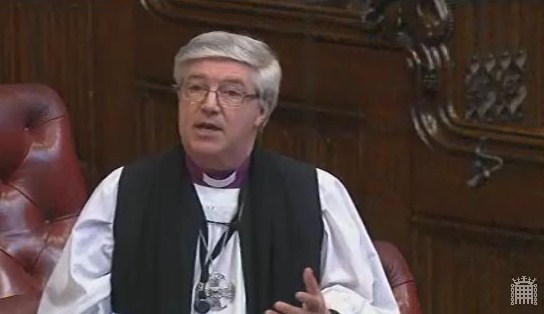
Bishop of Chester speaks during question time on dog licensing

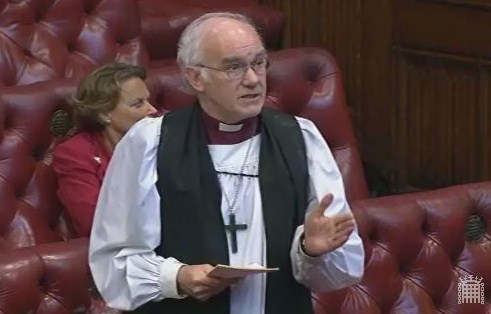
On 16th December 2014, Lord Hoyle asked Her Majesty’s Government whether they have any plans to reintroduce a dog licensing fee. The Bishop of Chester, the Rt Revd Peter Forster, asked a supplementary question:

14.03 Bishop of ChesterThe Lord Bishop of Chester: My Lords, I am one of those who wear a dog collar in this House—and for the privilege of doing so I have to be licensed. But as far as I am aware, no fees have been paid. Might I suggest that enough is enough?

Lord Mackenzie of Framwellgate (Non-Afl): My Lords, the right reverend Prelate has stolen my thunder, in a sense. I was going to ask: because of the increasing number of dangerous dog incidents, would it not be worth having a look at licensing the owners? Continue reading “Bishop of Chester speaks during question time on dog licensing”

Bishop of St Albans – Underage Marriage (Written Answer)

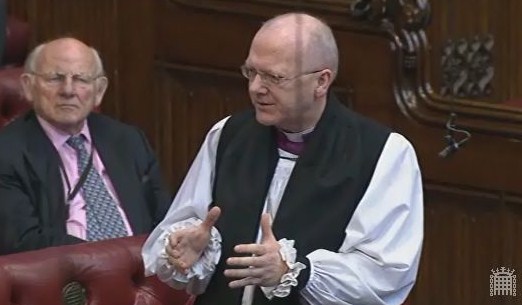
On 16th December 2014, the Bishop of St Albans, the Rt Revd Alan Smith, received an answer to a written question on under-age marriages.

Bishop of St AlbansThe Lord Bishop of St Albans: To ask Her Majesty’s Government what steps they are taking to protect girls who come to the United Kingdom already in under-age marriages. [HL3558]

The Parliamentary Under-Secretary of State for Schools (Lord Nash): Local authorities, with the help of other organisations as appropriate, have a duty to make enquiries under section 47 of the Children Act 1989 if they have reasonable cause to suspect that a child is suffering, or is likely to suffer, significant harm. A belief that a girl may have been involved in an under-age marriage should lead to such an assessment.

Where a local authority encounters concerns about a child’s welfare that constitute, or may constitute, an offence against a child, social workers should discuss the case with the police at the earliest opportunity. Offences may have been committed by the girl’s parents, or by her ‘husband’. Legislation that came into force earlier in 2014 means that forced marriage is now a criminal offence. Continue reading “Bishop of St Albans – Underage Marriage (Written Answer)”

Bishop of Worcester calls for simplification of visa rules for Commonwealth countries

On 19th November 2014, Lord Lea of Crondall asked Her Majesty’s Government whether they have made any proposal to other European Union member states, either severally or collectively, which would limit (1) the right of United Kingdom citizens to live and work in other European Union member states, or (2) the parallel right of citizens of other European Union member states to live and work in the United Kingdom. The Bishop of Worcester, the Rt Revd John Inge, asked a supplementary question:

WorcesterThe Lord Bishop of Worcester: My Lords, the Minister mentioned the reputation that this country has for hospitality. Is he aware of an associated issue: the difficulty that members of the Commonwealth face in obtaining a visa even to visit, let alone to work and live in this country, which seriously hampers a lot of very important overseas links with dioceses, including my own—so much so that my friends in Tanzania were unable to be present at my wife’s funeral earlier this year? Is that sort of impediment government policy and, if not, can he assure us that it will be addressed?

Lord Bates: We very much encourage people to come to this country, whether to study or to work. We want to encourage the best and the brightest to come to this country, as well as tourists; there are many people we want to encourage—but there is a difference between that and people who significantly abuse the system in coming here because of benefits.

(via Parliament.uk)

Bishop of Derby takes part in debate on Modern Slavery Bill

I wonder whether there is some way of privileging people once they have been recognised as having been exploited or enslaved, to give them a different way of accessing benefits and support because they have been enslaved and treated as commodities. That would make an enormous difference.

On 17th November 2014, the Bishop of Derby, the Rt Revd Alastair Redfern, took part in the Second Reading debate of the Government’s Modern Slavery Bill. The Bishop, who was a member of  the Joint Select Committee on the Draft Modern Slavery Bill, welcomed the progress that had been made in bringing the Bill to its current form. He noted that concerns about the commodification of humans through slavery required further thinking on supply chain accounting and other aspects of the legislation, and also raised questions about how best the vicitms of trafficking and slavery could be supported by the state.

DerbyThe Lord Bishop of Derby: My Lords, I was privileged to be on the Joint Select Committee and I congratulate the noble Lord, Lord Bates, on his very positive introduction. I also express my appreciation to the Government for listening and being willing to negotiate and explore options as this legislation unfolds.

I remind your Lordships that this is not just a huge and wicked crime. It is, as the noble and learned Baroness, Lady Butler-Sloss, says, increasing as we talk, massively. It treats human beings as commodities to be traded. The challenge of this legislation is to stop this practice. I am delighted that the Government are committed to producing a slavery strategy to complement the Bill and I hope that many of our concerns can be refined through that strategy. I would like to raise three of four things that might benefit from further scrutiny and wider debate in our process. Continue reading “Bishop of Derby takes part in debate on Modern Slavery Bill”

Bishop of Norwich asks question on Gangmasters Licensing Authority

On 17th November 2014, the Bishop of Norwich, the Rt Revd Graham James, received an answer to a written question from the Home Office on the subject of the Gangmasters Licensing Authority.

14.06.12 Bishop of NorwichThe Lord Bishop of Norwich: To ask Her Majesty’s Government whether they have any plans to extend the powers of the Gangmasters Licensing Authority under the Gangmasters (Licensing) Act 2004 in order to regulate gangmasters in sectors such as hand car washes. [HL2564]

The Parliamentary Under-Secretary of State, Home Office (Lord Bates): The Government has no plans to extend the licensing remit of the Gangmasters Licensing Authority to additional sectors such as hand car washes. Licensing can be an appropriate response to particular problems in particular sectors, but that does not mean it is appropriate in all cases. However the Government will keep the Gangmasters Licensing Authority’s remit under review.

(via Parliament.uk)

Bishop of Derby takes part in debate on slavery and its use in supply chains

“We live in a culture that is rightly concerned about safeguarding. We are concerned rightly about the safeguarding of children at the moment. We have to get up to speed with the safeguarding of vulnerable adults, many of whom are in exploited forced labour.”

On 30th October 2014, Baroness Kennedy of Cradley led a short debate in the House of Lords to ask Her Majesty’s Government what steps they are taking to combat slavery in supply chains nationally and internationally. The Bishop of Derby, the Rt Revd Alastair Redfern, a former member of the Joint Select Committee on the Draft Modern Slavery Bill, spoke in the debate. He argued that there is a deep underlying tension between economic activity and treatment of the individual, which the modern slave trade has exploited. He also asked the Minister a number of questions regarding the strengthing of reporting and best practice in supply chains.

Bishop of DerbyThe Lord Bishop of Derby: My Lords, I, too, thank the noble Baroness, Lady Kennedy, for securing this debate and for her excellent introduction that laid out the ground clearly. I want to make some remarks from my experience of working with victims, the police and other agencies within our national context. We have just heard from the noble Baroness, Lady Cox, about the sheer horror of the way in which human beings are being treated in our own country.

I begin by welcoming Karen Bradley’s recent announcement that there will be amendments to secure proper reporting and disclosure. The key will be the level of reporting and the size of the company. I also welcome the strong support from many leaders in our industries. On the Select Committee, the people who represented Primark and Tesco, for instance, were supportive of a framework to require proper reporting and accountability, which would help their business case and standing in the community. Continue reading “Bishop of Derby takes part in debate on slavery and its use in supply chains”

BISHOP OF ST ALBANS SPEAKS ON SUNDAY TRADING IN DEREGULATION BILL

Bishop of St AlbansThe Bishop of St Albans, the Rt Revd Alan Smith, spoke on amendment 11 to the Deregulation Bill, which concerned the extension of the liberalisation of Sunday trading laws to garden centres. The Lord Bishop of St Albans spoke out against this amendment, arguing about the importance for human health and wellbeing of protecting the seven day week cycle. He said that if Sunday trading laws were to be liberalised to this effect, it would be a thin-edge-of-the-wedge effect, and so such considerations should be made in a separate bill, rather than this amendment.

Read the full speech here: Continue reading “BISHOP OF ST ALBANS SPEAKS ON SUNDAY TRADING IN DEREGULATION BILL”

Bishop of Chester supports amendment to Criminal Justice and Courts Bill

On 21st July 2014, the Bishop of Chester, the Rt Revd Peter Forster, spoke during the Committee Stage of the Criminal Justice and Courts Bill. He spoke in support of an amendment to make assault on workers selling alcohol a specific criminal offence. Following the debate on the amendment, it was withdrawn without being put to a division of the House. 

14.03 Bishop of ChesterThe Lord Bishop of Chester: My Lords, I have considerable sympathy for the amendment, although I wonder how it will interact with the remainder of the law on assault if this is criminalised in a specific way. I declare an interest in that I used to be a publican. When I was employed in a university, one of the members of staff had to go down to the magistrates’ court and swear that they were a fit person to keep order. That is the only time when I have been into a court of law in my life, and the magistrates were not quite sure that this young clergyman would be able to do so. My main task was to prevent the students drinking the profits rather than sorting out any brawls. Continue reading “Bishop of Chester supports amendment to Criminal Justice and Courts Bill”

Bishop of Chelmsford calls for implementation of Low Commission findings on legal aid

On 7th July 2014, Lord Bach asked Her Majesty’s Government, 15 months after the coming into force of the Legal Aid, Sentencing and Punishment of Offenders Act 2012, what is their assessment of the effect of the Act on the legal advice system in relation to social welfare law in England and Wales. The Bishop of Chelmsford, the Rt Revd Stephen Cottrell, asked a supplementary question:
14.06.09 Chelmsford 3The Lord Bishop of Chelmsford: My Lords, I, too, should like to make reference to the Low commission. The church, faith communities and charities are all too keenly aware of the impacts of some of the cuts in legal aid on the poorest communities in our country. Sometimes a professional lawyer is needed. Would the Minister still regard the proposals of the Low commission for a nationally resourced strategy to provide support and legal advice as an important priority?
Lord Faulks: My Lords, as I said in response to the debate, it was a valuable contribution. The LASPO reforms were implemented only in April 2013; it is relatively early days. We are considering carefully the effects of these reforms. We have not ruled out the possibility of further changes but, at the moment, the various steps we are taking are helping to ensure that those who need representation are receiving it.

Bishop of Truro highlights church support for independent inquiry into abuse cases

On 7th July 2014, a Government statement on an inquiry into child abuse was repeated in the House of Lords. The Bishop of Truro, the Rt Revd Tim Thornton, asked a question about Church involvement in the matter.

Bishop of Truro 20.6.13The Lord Bishop of Truro: My Lords, I welcome the Statement. The church is keen to be involved in any such overarching inquiry. A question was asked in the other place about whether the church is involved in this matter. Is the Minister aware that my friend the most reverend Primate the Archbishop of Canterbury wrote to the Home Secretary some weeks ago asking for an inquiry such as this? The church is very willing to be involved. In a situation such as this—in which, inevitably and sadly, people involved in various authorities at a high level would be related to other authorities and institutions—it is crucial that such an inquiry is allowed to go wherever it needs to go. The church and other organisations and institutions should explicitly be involved in this matter. Perhaps I may add as chairman of the Children’s Society that we would be keen to stress that the voice of children and young people should be always in the centre of one’s thoughts on any matters such as this. If any matters come to light through this inquiry that need to be directed to the police, that will, one hopes, happen and they will be dealt with swiftly and decisively.

Lord Taylor of Holbeach: I pay tribute to the role of the church in the care of children. I am sure that the Home Secretary will note the offer of involvement in the review and these inquiries. I am delighted that the right reverend Prelate has raised this issue. The involvement of church activists in the national group to tackle sexual violence against children and vulnerable people is an important start.

(via Parliament.uk)