Bishop of Derby calls for strong National Referral Mechanism to support efforts to tackle modern slavery

On 10th December 2014, the Bishop of Derby, the Rt Revd Alastair Redfern, took part in the Committee Stage of the Government’s Modern Slavery Bill. The Bishop spoke in support of an amendment to put a new National Referral Mechanism on a statutory footing, and also raised questions about how the Government’s approach towards tackling slavery could be better integrated with safeguarding awareness. The Bishop had previously spoken in the Bill’s Committee Stage, and his remarks can be read here.

Bishop of DerbyThe Lord Bishop of Derby: My Lords, I will contribute briefly to the debate. I hope the Government will take the time to take seriously the NRM review. Jeremy Oppenheim has made some crucial insights, particularly about the 45 days being used as a period for deciding about judicial processes, not a period for nourishment and proper support. Therefore, we need to think very carefully about how we pitch the 45 days or whatever period it is, alongside a commitment to support victims on a longer timescale. He also made an important point about the concept of safeguarding, just referred to by the noble Lord, Lord Warner. I have spoken about this before in the House. It would be very helpful for everybody if we could connect what we are doing about slavery with the culture of safeguarding awareness. I very much support the suggestion from the noble Lord, Lord Warner, about what we call this mechanism. Continue reading “Bishop of Derby calls for strong National Referral Mechanism to support efforts to tackle modern slavery”
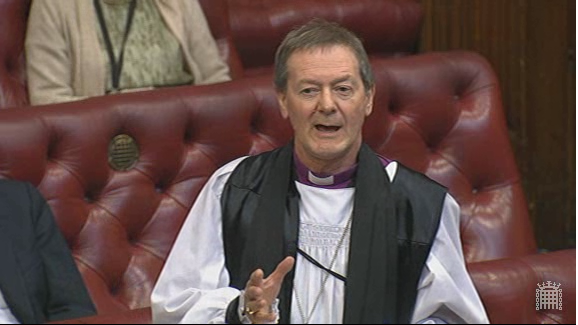
Bishop of Derby speaks during Modern Slavery Bill debate

Bishop of DerbyOn 1st December 2014, the Bishop of Derby, the Rt Revd Alastair Redfern, took part in the first day of Committee Stage for the Modern Slavery Bill. A former member of the Joint Select Committee that  undertook the pre-legislative scrutiny of the bill, the Bishop spoke in favour of three amendments to the bill – one relating to ensuring that the legislation is ‘victim focused’, the second – recommended by the Joint Select Committee and co-sponsored by the Bishop – to create a specific offence for child exploitation, where a child has been exploited but not moved or trafficked, and the third to make criminalise all paying for sexual services. Following assurances from the Government of further discussions, the first two amendments were withdrawn. The third amendment was withdrawn following the recognition the the Bill was not an appropriate place for changes to be made to the law on prostitution.
Continue reading “Bishop of Derby speaks during Modern Slavery Bill debate”

Bishop of Derby takes part in debate on Modern Slavery Bill

I wonder whether there is some way of privileging people once they have been recognised as having been exploited or enslaved, to give them a different way of accessing benefits and support because they have been enslaved and treated as commodities. That would make an enormous difference.

On 17th November 2014, the Bishop of Derby, the Rt Revd Alastair Redfern, took part in the Second Reading debate of the Government’s Modern Slavery Bill. The Bishop, who was a member of  the Joint Select Committee on the Draft Modern Slavery Bill, welcomed the progress that had been made in bringing the Bill to its current form. He noted that concerns about the commodification of humans through slavery required further thinking on supply chain accounting and other aspects of the legislation, and also raised questions about how best the vicitms of trafficking and slavery could be supported by the state.

DerbyThe Lord Bishop of Derby: My Lords, I was privileged to be on the Joint Select Committee and I congratulate the noble Lord, Lord Bates, on his very positive introduction. I also express my appreciation to the Government for listening and being willing to negotiate and explore options as this legislation unfolds.

I remind your Lordships that this is not just a huge and wicked crime. It is, as the noble and learned Baroness, Lady Butler-Sloss, says, increasing as we talk, massively. It treats human beings as commodities to be traded. The challenge of this legislation is to stop this practice. I am delighted that the Government are committed to producing a slavery strategy to complement the Bill and I hope that many of our concerns can be refined through that strategy. I would like to raise three of four things that might benefit from further scrutiny and wider debate in our process. Continue reading “Bishop of Derby takes part in debate on Modern Slavery Bill”

Bishop of Derby takes part in debate on slavery and its use in supply chains

“We live in a culture that is rightly concerned about safeguarding. We are concerned rightly about the safeguarding of children at the moment. We have to get up to speed with the safeguarding of vulnerable adults, many of whom are in exploited forced labour.”

On 30th October 2014, Baroness Kennedy of Cradley led a short debate in the House of Lords to ask Her Majesty’s Government what steps they are taking to combat slavery in supply chains nationally and internationally. The Bishop of Derby, the Rt Revd Alastair Redfern, a former member of the Joint Select Committee on the Draft Modern Slavery Bill, spoke in the debate. He argued that there is a deep underlying tension between economic activity and treatment of the individual, which the modern slave trade has exploited. He also asked the Minister a number of questions regarding the strengthing of reporting and best practice in supply chains.

Bishop of DerbyThe Lord Bishop of Derby: My Lords, I, too, thank the noble Baroness, Lady Kennedy, for securing this debate and for her excellent introduction that laid out the ground clearly. I want to make some remarks from my experience of working with victims, the police and other agencies within our national context. We have just heard from the noble Baroness, Lady Cox, about the sheer horror of the way in which human beings are being treated in our own country.

I begin by welcoming Karen Bradley’s recent announcement that there will be amendments to secure proper reporting and disclosure. The key will be the level of reporting and the size of the company. I also welcome the strong support from many leaders in our industries. On the Select Committee, the people who represented Primark and Tesco, for instance, were supportive of a framework to require proper reporting and accountability, which would help their business case and standing in the community. Continue reading “Bishop of Derby takes part in debate on slavery and its use in supply chains”

Human Trafficking – Question from Bishop of Derby

On 22nd September 2014 the Bishop of Derby, Rt Rev Alastair Redfern, received a written answer to a question on child victims of human trafficking.
Bishop of Derby
Home Office – Human Trafficking (HL1545)
Asked by the Lord Bishop of Derby on 28 July 2014:
To ask Her Majesty’s Government how many child victims of human trafficking were interviewed in 2013 by competent authority staff, as opposed to specialist interviewers.

Continue reading “Human Trafficking – Question from Bishop of Derby”

Bishop of Derby – Housing Benefit, Human Trafficking, Forced Labour (Written Answers)

On 18th August 2014, the Bishop of Derby, the Rt Revd Alastair Redfern, received answers to five written questions on the topics of housing benefit, human trafficking and forced labour.

Housing Benefit: Social Rented Housing

Bishop of DerbyThe Lord Bishop of Derby: To ask Her Majesty’s Government what plans they have to increase the availability of suitable housing for housing benefit claimants eligible for the under-occupancy charge who are willing but unable to move to smaller accommodation due to a lack of social housing available.

The Parliamentary Under-Secretary of State, Department for Communities and Local Government (Lord Ahmad of Wimbledon): The 2015-18 Affordable Housing Programme encourages housing providers to build social homes of sizes that match local household needs. Of the successful bids so far, 77% have been for 1 and 2 bedroom homes. This will make more housing available for households in social housing who wish to downsize.

The Government has also taken steps to support mobility among tenants in the social rented sector. Our social housing reforms have given councils and social landlords much more flexibility in the allocation of housing. Our statutory guidance on social housing allocations encourages local authorities to prioritise under-occupying tenants wishing to move, and to consider whether there are provisions in their allocation scheme that might make it difficult for under-occupiers to move. In February, we issued a guide to help landlords facilitate mutual exchanges; the guide highlights various steps landlords can take to make mutual exchange a more attractive and viable proposition for tenants. The introduction of the national HomeSwap Direct scheme has made it easier for tenants wanting to move to find a suitable property. Since its launch in October 2011, tenants have carried out over 18 million searches of the property data held on HomeSwap Direct. The Government has also made clear its intention to introduce a Right to Move for social tenants who need to move to take up a job or be closer to work – we intend to consult soon on proposals.

In addition, many social landlords (both housing associations and councils) are helping affected tenants to move to more suitable accommodation by holding “mutual exchange fairs” (where tenants who want to downsize can meet with tenants who want a larger property), running transfer incentive schemes, and repairing properties which are being swapped through mutual exchange.

(via Parliament.uk) Continue reading “Bishop of Derby – Housing Benefit, Human Trafficking, Forced Labour (Written Answers)”

Church of England gives evidence to Modern Slavery Bill Committee

On 21st July 2014, the Church of England’s Foreign Policy Adviser, Dr Charles Reed, gave evidence to the Public Bill Committee for the Government’s Modern Slavery Bill. The transcript of the evidence session, at which Dr Reed and Cecilia Taylor-Camara (Head of the Bishops Conference Office for Migration Policy, Catholic Bishops for England and Wales) gave evidence, is reproduced in full below.

Dr Charles Reed, Foreign Policy Adviser, Church of England

Q 24 The Chair:  For this session we have until 4.45 pm. Will the witnesses please introduce themselves for the record?

Cecilia Taylor-Camara: I am Cecilia Taylor-Camara, senior policy adviser to the Catholic Bishops Conference of England and Wales.

The Chair:  I ask the witnesses to speak up a little. This is rather a large room and the sound is not brilliant, so please shout if necessary.

Dr Reed: I am Charles Reed, international policy adviser for the Church of England.  Continue reading “Church of England gives evidence to Modern Slavery Bill Committee”

Church Commissioners – Oral and Written Questions

On 17th July 2014, the Second Church Estates Commissioner, the Rt Hon Sir Tony Baldry MP, answered a number of questions on the floor of the House of Commons, during the monthly Church Commissioner Questions slot. He answered questions on food banks, church and cathedral repairs, human trafficking and women bishops. He also answered a written question on Church Commissioners ICT. A full transcript of the session is reproduced below:

14.01 CCQ Baldry

Food Banks

Hugh Bayley (York Central) (Lab): What support the Church of England is giving to food banks.

The Second Church Estates Commissioner (Sir Tony Baldry): Four in five of the Church of England’s 13,000 parish churches are supporting local food banks. Continue reading “Church Commissioners – Oral and Written Questions”

Bishop of Derby welcomes Modern Slavery Bill during Queen’s Speech debate

“Our challenge will be: how does the state craft a strategy that delivers mercy?” – Bishop of Derby, 9/6/14

In the fourth response from the Bishops’ Benches to the Queen’s Speech, on 9th June 2014 the Bishop of Derby, Rt Rev Alastair Redfern, welcomed the Modern Slavery Bill and, as a former member of the committee that examined the draft bill, made some suggestions for how it could be improved even more.

Bishop of DerbyThe Lord Bishop of Derby: My Lords, I should like to offer some comments on the welcome proposal set out by the Government in the gracious Speech to introduce the modern slavery Bill. I had the privilege of serving on the Joint Select Committee with other Members of your Lordships’ House under the superb chairmanship of Frank Field MP, and we all came to an agreement on a number of important issues. I want to comment on and offer some suggestions as to how we might handle the debate on this important topic, not least because much of the world is looking to see the terms in which such a Bill might be couched and how it is introduced. Continue reading “Bishop of Derby welcomes Modern Slavery Bill during Queen’s Speech debate”

Bishop of Derby’s response to Modern Slavery Bill Announcement

Bishop of Derby’s response to Modern Slavery Bill Announcement

(From the website of the Diocese of Derby)

5th June 2014

The Bishop of Derby, The Rt Revd Dr Alastair Redfern has commented on the Modern Slavery Bill announced in the Queen’s speech at the opening of parliament. Continue reading “Bishop of Derby’s response to Modern Slavery Bill Announcement”