
Bishop of Derby promotes community-based strategy to tackle radicalisation

“I tell noble Lords from my own experience that if we are too heavy-handed we risk further radicalising families and communities at the grass roots, if some of their young are treated without any notion of a trial or evidence—all those British things that we try to stand for. We must handle this matter very carefully” – Bishop of Derby, 19/6/14

On 19th June 2014, Lord Dykes led a debate to ask Her Majesty’s Government what is their assessment of the threat from the spread of militant aggressive jihadism in the Middle East. The Bishop of Derby, the Rt Revd Alastair Redfern, took part in the debate, speaking of the challenges associated with tackling transnational groups, and the need for close international co-operation in dealing with them. He also spoke of the need for strong community-based work in the UK, to help tackle and reduce instances of British citizens fighting in the Middle East. He endorsed the strong heritage of European Islam and of the need to engage its voice in a sophisticated debate.
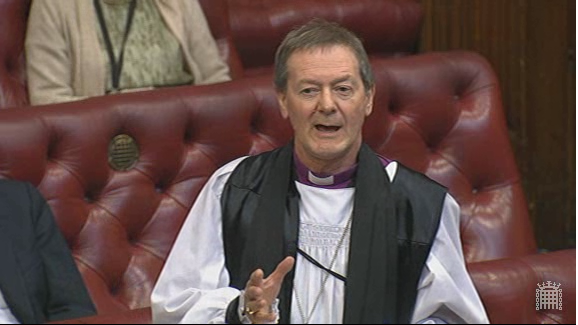
DerbyThe Lord Bishop of Derby: My Lords, I, too, congratulate the noble Lord, Lord Dykes, on securing this timely debate. I want to look at the Motion as it is set out. It concerns,

“the assessment of the threat from the spread of militant aggressive jihadism in the Middle East”.

Continue reading “Bishop of Derby promotes community-based strategy to tackle radicalisation”
Birmingham schools inspections – Bishop of Norwich on impact of religious education

In the House of Lords on 9th June 2014 the schools minister Lord Nash repeated the Statement made by the Secretary of State for Education on schools in Birmingham. After the Statement, the Bishop of Norwich, Rt Rev Graham James, asked a question of the minister:

The Lord Bishop of Norwich: My Lords, the Minister may not be aware that earlier this afternoon in his maiden speech, the right reverend Prelate the Bishop of Chelmsford said that good religious education is one of the best ways of countering religious extremism. I would be interested to know whether the Minister agrees. Given that none of the schools subject to these inspections in Birmingham were faith schools—although listening to our discussion, you would have thought otherwise—does it not seem that appropriate, well balanced and enriching religious education may have been an area of neglect? Continue reading “Birmingham schools inspections – Bishop of Norwich on impact of religious education”

Bishop of Wakefield raises concerns about Islamophobia in Georgia

The Lord Bishop of Wakefield asked Her Majesty’s Government: what representations they are making to the Government of Georgia regarding Islamophobia in that country; and what steps they are taking to ensure freedom of religion and the rights of minority groups there.

Baroness Warsi: My Lords, the UK raises human rights issues on a regular basis with the Georgian Government, both bilaterally and through multilateral institutions such as the EU, the OSCE and the Council of Europe. We have not made any recent representations regarding Islamophobia, but we continue to follow minority rights closely, including through our embassy’s work in Tbilisi and its regional travel. We fund a local NGO to maintain an inter-religion working group, which involves a variety of faith groups, including Muslims.

The Lord Bishop of Wakefield: My Lords, last year, I was fortunate to spend a couple of nights with a Muslim family in Batumi, and the next morning I met the president of the semi-autonomous region there, Mr Archil Khabadze. I pressed the question to him of why there was only one mosque for something like 110,000 out of the 150,000 people, that being the number of Muslims in the city. He said that at that time they would take immediate steps to find more land made available for Muslims in that city. I said that I would be coming back in the next three months to open the mosque with other religious groups. Would Her Majesty’s Government please press the authorities to make sure that the local administration there is asked to fulfil the promise that they made; otherwise, these very open Muslims will soon become radicalised.

Baroness Warsi: The right reverend Prelate raises a really important issue. His Question prompted me to go away and do some research, and I was quite intrigued to find out that just over 10% of Georgia’s population are indeed Muslim—a much larger percentage than in our own communities. The right reverend Prelate will be aware that one of the challenges in Georgia is that the Muslim community is not particularly well engaged politically and therefore does not really put its head above the parapet. I have become aware of low-level discrimination and tensions towards the Muslim community there, but as Georgia moves towards closer EU integration part of its requirement is to fulfil its obligation to bring in anti-discrimination laws.

(via parliament.uk)

Bishop of Birmingham highlights strong inter-faith relations in Birmingham during debate on Islam

On 19th November 2013, the Bishop of Birmingham, the Rt Revd David Urquhart, took part in Lord Pearson of Rannoch’s debate to ask Her Majesty’s Government what was the basis for the statement by the Prime Minister on 3 June that “There is nothing in Islam that justifies acts of terror” (HC Deb, 3 June, col 1234). The Bishop of Birmingham spoke about the experiences of Christian-Muslim relations in Birmingham, highlighting positive engagement between those of different beliefs to promote peaceful and practical relationships.

01.04.14 Bishop of BirminghamThe Lord Bishop of Birmingham: My Lords, I am grateful to the noble Lord for enabling us to talk about these very important matters, so in that sense I can agree with him. I also encourage him not to lose heart at sin and evil wherever they are found. There are remedies, and people of religion are often seeking to achieve them.

Of course, if I read my own scriptures, as I do every day, and select various pieces of them, I could easily form myself into some kind of sect which would be disapproved of, I hope, by most of civil society. None the less, our activities which are theological, seeking peace, are often turned into historical disappointments and much less than the ideal that we want to promote. That is true of all religions and, indeed, of all humanity. Continue reading “Bishop of Birmingham highlights strong inter-faith relations in Birmingham during debate on Islam”