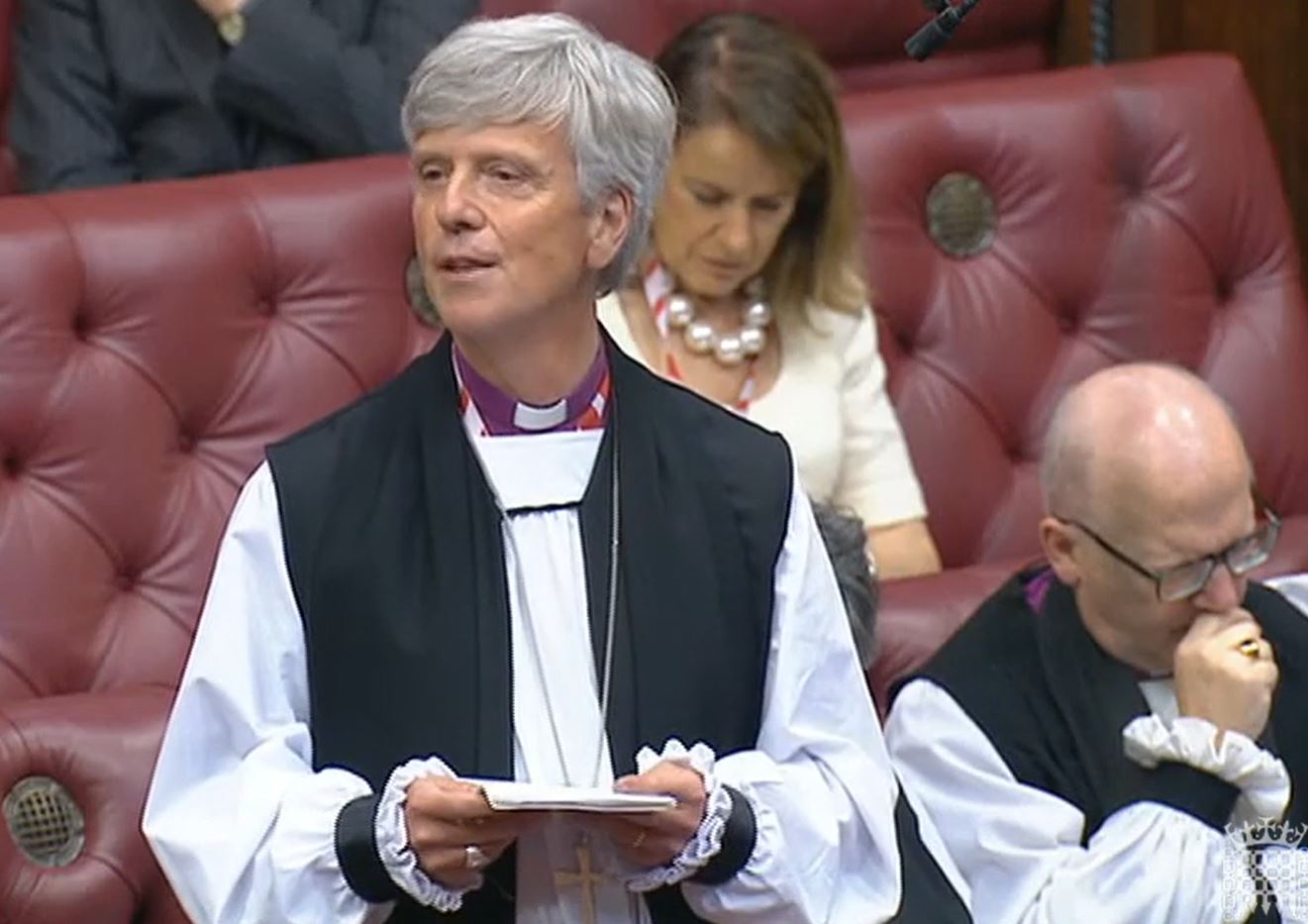
The Bishop of Southwell and Nottingham asked a question on the issues associated with commercial wedding celebrants during a discussion on the legalisation of humanist weddings on 16th March 2026:
The Lord Bishop of Southwell and Nottingham: My Lords, I welcome the Government’s intention to make it easier for couples to marry in legally binding ceremonies that reflect their religious, or non-religious, beliefs. However, I am concerned by the potential direction of travel of some aspects of these reforms, particularly the possible authorisation of this new category of commercial celebrants, which the Minister has referred to. I understand that, as has already been acknowledged, Humanists UK shares this concern. Can the Minister set out how the Government will ensure that safeguards are in place to protect against the commercialisation of weddings?
The Bishop of Guildford asked a question on the potential for humanist weddings to be introduced in England on 30th June 2025, raising the issue of commercial celebrants potentially devaluing the marriage ceremony:
The Lord Bishop of Guildford: My Lords, noble Lords will not be surprised to hear from these Benches that I am thoroughly in favour of marriage. I want to stress the many benefits of getting married in church, but I am also in favour of encouraging more people to marry wherever, provided that the ceremony reflects the seriousness of the commitment being entered into and the love that lies at its core. To that end, does the Minister agree that if adjustments were to be made to our current premises-based system to enable legal humanist marriages, the door should not be opened so wide that it brings in a free market in commercial celebrants that will cheapen and devalue what is such a vital and foundational institution?
The Bishop of Southwell and Nottingham spoke in a debate on reform of the law around prenuptial agreements on 27th February 2025, raising issues involved in these agreements and urging further reflection on the implications of changes to the law, as well as highlighting the value of the marriage covenant:
The Lord Bishop of Southwell and Nottingham: My Lords, I am grateful to the noble Baroness, Lady Deech, for bringing the debate on this Motion and for raising such fundamentally important issues, which she set out so clearly. I also acknowledge with respect the considerable wisdom and insight of the noble Baroness, Lady Shackleton, on these matters.
It has been my personal privilege to prepare many couples for marriage over the years. It is a hopeful time, where couples seek to express unconditional love and trust, and commit to share all aspects of their life, both at the time and looking to the future, whatever it may hold. I believe it would be detrimental for all parties if prenuptial agreements were to become a normal part of preparing for marriage, whether religious or not—although I entirely acknowledge the arguments in favour of these agreements, particularly the clarity they provide in financial matters, especially where there are pre-existing children, and their role in reducing litigation upon divorce.
On 19th December 2024, Marsha De Cordova MP, representing the Church Commissioners, gave the following written answers to questions from MPs:
Archbishops: Termination of Employment
Mr Richard Holden MP (Con, Basildon & Billericay): To ask the Member for Battersea, representing the Church Commissioners, whether the Church of England has a formal process for the removal of an Archbishop.
On 16th October 2024, the Bishop of Sheffield asked a question on the potential risks of changes to laws around marriage celebrants undermining the solemn nature of marriage:
The Lord Bishop of Sheffield: My Lords, on these Benches we would welcome humanist wedding ceremonies being given legal status, but the recommendations of the Law Commission go beyond that and would create a free market celebrant-based approach to the wedding industry. I gather that Humanists UK shares our concern that such a move could undermine the solemn nature of marriage, which is never a trivial transaction. Given this unlikely alliance between the Lords spiritual and Humanists UK, can the Minister confirm that the Government will not enact the recommendations of the Law Commission without considering carefully the impact of a further commercialisation of weddings?
On 8th December 2023 the Archbishop of Canterbury led a debate in the House of Lords on the following motion:
The Lord Archbishop of Canterbury to move that this House takes note of ‘Love Matters’, the report of the Archbishops’ Commission on Families and Households.
The opening speech made by the Archbishop is below. More information and a copy of the report on which the debate was based, can be read here.
On 15th June 2023 MPs put questions to Andrew Selous MP, Second Church Estates Commissioner, in the House of Commons:
Church Choirs: Engagement with Local Schools
Sir Desmond Swayne (New Forest West) (Con): What steps the Church of England is taking to encourage church choirs to engage with local schools. (905370)
The Second Church Estates Commissioner (Andrew Selous): The Church of England has enthusiastically supported the Government’s Sing Up programme, encouraging local music hubs to partner with churches, and enabling the use of skills and knowledge that schools would otherwise have to buy in. I am sure that my right hon. Friend, as a strong supporter of singing in church, will very much approve.
On 21st March 2023 Rt Hon Ben Bradshaw MP spoke to a Motion he had tabled in the House of Commons, for leave to bring in a Bill on same sex marriages in the Church of England. The Second Church Estates Commissioner, Andrew Selous MP, responded.
SAME SEX MARRIAGE (CHURCH OF ENGLAND): TEN MINUTE RULE MOTION
Mr Ben Bradshaw: That leave be given to bring in a Bill to enable clergy of the Church of England to conduct same sex marriages on Church of England premises in certain circumstances; and for connected purposes.
Ben Bradshaw introduces his Ten Minute Rule Bill and Andrew Selous responds
A transcript of the response from Andrew Selous is below:
Mr Andrew Selous MP (Second Church Estates Commissioner): Thank you very much Mr Deputy Mr Speaker. I do not intend to divide the House, but it is necessary to respond to the Bill in my capacity as Second Church Estates Commissioner, because it seeks to usurp the role of the democratically elected General Synod of the Church of England, as well as to remove the freedom of the Church of England to decide its own doctrine, a freedom which Members on all sides of this House champion for religions and beliefs all over the world, and one that we should therefore apply equally to the Church of England.
There are passionately held and differing views about same sex marriage on all sides of this House and I am also acutely aware of the personal pain and hurt that this issue causes for so many people. But it is for the democratically elected assembly of the Church of England, the General Synod, to decide matters of doctrine rather than Parliament. And this has been the settled convention for nearly fifty years, since the 1974 Worship and Doctrine Measure was approved by Parliament.
At the General Synod last month, it was agreed that the Prayers of Love and Faith proposed by the bishops would be finalised, that the pastoral guidance for clergy would be produced, and that a welcoming culture towards LGBTQI+ people would be embedded throughout the Church. It was also agreed not to change the doctrine of marriage. And that Motion was passed by a clear majority in all three Houses of the Synod. Amendments to require the bishops to bring forward proposals for same-sex marriage to the next meeting of Synod and to revisit the issue within the next two years, were rejected by the House of Bishops, the House of Clergy and the House of Laity.
The Right Honourable Gentleman’s Bill proposes that the decision of the Synod, arrived at prayerfully and democratically, should simply be set aside.
In this House, we do not all agree with each other, but we do respect everyone’s right to be here because we have all been given our mandate through the same black boxes on election night. I would ask that the Members of this democratically elected House show the same respect to the democratically elected members of the General Synod.
Directing the Church of England on doctrine is not the job of Parliament. It would infringe on settled principles of religious freedom, which we argue for our sisters and brothers overseas, and it would call into question the rights and protections of conscience for other denominations and faiths as well. Several Catholic members of this House came up to me after the Urgent Question on the 24th of January and told me how grateful they were that Parliament was not telling their church what to do!
The Bill is also unnecessary as should Synod decide to change the doctrine of marriage in the future, it could do so. It would produce a Measure, which would come before Parliament and amend the 2013 Marriage Act. There is no need therefore for Parliament to act independently to change the Act.
Although the Bill is intended to be permissive and not to compel any member of the clergy to solemnise same-sex marriage, it is just not possible to leave it to individual clergy to choose to do things that are clearly contrary to the doctrine of the church. Doctrine is not determined by local decision, varying by parish or diocese, but is decided centrally, not by a small group of bishops, but through the prayerful deliberation and decision of the democratically elected Synod. If the Church lost its ability to require compliance with its doctrine, this would be a breach of the Human Rights Convention as it would be contrary to article 9, read with article 11, for the State to interfere with a religious organisation’s ability to require compliance with its own doctrine.
The Bill’s attempt to give individual freedom and choice would be unworkable and would breach the longstanding convention that Parliament does not legislate for the internal affairs of the Church of England without its consent.
I honoured my commitment to tell the General Synod the views of Parliament as expressed in the Urgent Question on the 24th of January, and I know that the General Synod will continue to listen carefully and respectfully to the views of this House, just as I would ask Parliament to be respectful to the views of the Synod.
Note: The Motion was not opposed in a vote and the Bill was presented, though it will be unlikely to progress any further due to lack of time in the parliamentary session.
On 9th March 2023 MPs put questions to the Second Church Estates Commissioner, Andrew Selous MP, during his monthly question time in the House of Commons.
The Bishop of St Albans received the following written answer on 20th February 2023:
The Lord Bishop of St Albans asked His Majesty’s Government what estimate they have made of the total amount of backdated marriage allowance payments that have been paid in (1) 2022, (2) 2021, (3) 2020, and (4) 2019; and what estimate they have made of how much has not yet been claimed.
Baroness Penn (Con): The information requested is not readily available to HMRC and could only be obtained at a disproportionate cost.




 The Church of England in Parliament
You must be logged in to post a comment.