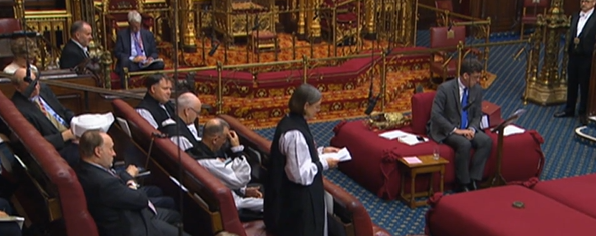
Media Bill: Bishop of Leeds emphasises importance of broadcasting in introducing new and challenging ideas to the public

The Bishop of Leeds spoke in a debate on amendments to the Media Bill on 20th May 2024, during a discussion on sports broadcasting, raising the importance of audiences encountering content that challenges preconceptions and introduces new ideas:

The Lord Bishop of Leeds: My Lords, surely at a time when we want children to get away from the telly and actually do sports, it is right that they be confronted by sports that they may know nothing about. Was it not curling, whatever that is, which became very popular and captured the imagination? Most of us could not believe that there was a sport where you push something along in that way.

Continue reading “Media Bill: Bishop of Leeds emphasises importance of broadcasting in introducing new and challenging ideas to the public”

Media Bill: Bishop of Newcastle supports amendments on regional diversity in broadcasting production

On 20th May 2024, the House of Lords debated amendments to the Media Bill. The Bishop of Newcastle spoke in support of two amendments to the bill tabled by Baroness Fraser of Craigmaddie aimed at ensuring regional diversity in broadcasting, emphasising the importance of intentionality in supporting the arts and creative industries:

The Lord Bishop of Newcastle: My Lords, I rise to speak to Amendments 16 and 17, tabled by the noble Baroness, Lady Fraser of Craigmaddie, to which I am pleased to have added my name in support.

Our country is one of diversity. The four nations that make up the UK include many regions, each with its own culture, sense of humour, accent, concerns and interests. As public service broadcasters are owned by the whole of the UK public, it is important that they truly reflect the public they serve in all their regional diversity.

Continue reading “Media Bill: Bishop of Newcastle supports amendments on regional diversity in broadcasting production”

Media Bill: Bishop of Leeds supports amendments on standards and terms of reference for public service broadcasters

On 8th May 2024, the House of Lords debated the Media Bill in committee. The Bishop of Leeds spoke in support of a group of amendments on standards requirements for public service broadcasters, stressing the need for detailed terms of reference in public service broadcasting:

The Lord Bishop of Leeds: My Lords, I support the first four amendments in this group—Amendments 1 to 3 and 7—and will not repeat what has been said so far in the excellent two speeches. However, I support them for a different reason: I think that they lay the ground for later amendments, particularly Amendments 9, 13 and 32. I will make a serious point about those amendments now, partly because I may have to be on a train when the Committee gets to them.

If we take seriously the Reithian principles to inform, educate and entertain, it means doing what the inscription from George Orwell outside the BBC spells out: that people are enabled to be confronted by, or to hear and see things, that

“they do not want to hear”.

Continue reading “Media Bill: Bishop of Leeds supports amendments on standards and terms of reference for public service broadcasters”

Media Bill: Bishop of Newcastle calls for additional focus on language provision

The Bishop of Newcastle spoke in a debate on the second reading of the Media Bill on 28th February 2024, commending the bill and requesting that additional attention for language provision be included in the legislation:

The Lord Bishop of Newcastle: My Lords, I am glad to be able to speak in this debate, and thank the previous speaker, the noble Lord, Lord Russell, for his comments. It is an honour to follow him.

In conversations I have had in recent weeks, it is clear that there is a strong desire across this House to ensure the Media Bill progresses positively through its legislative processes, in part because this is, as noble Lords have said, a Bill that acknowledges the vastly changed broadcasting landscape over the past 20 years. Given the rapidly developing technological nature of the communications landscape, it is understandable that the Bill aims to give flexibility and adaptability where needed. The point I wish to make is about the absence of clear statutory provision for languages in this Bill, in particular for Gaelic. Other noble Lords have already referred to this in the debate.

Continue reading “Media Bill: Bishop of Newcastle calls for additional focus on language provision”

Media Bill: Bishop of Leeds welcomes legislation and highlights areas of concern around data use and metrics

On 28th February 2024, the House of Lords debated the Media Bill in its second reading. The Bishop of Leeds spoke in the debate, welcoming the bill whilst raising concerns on issues of metrics, language, prominence and genres:

The Lord Bishop of Leeds: My Lords, it is a pleasure but somewhat daunting to follow the noble Lord, Lord Birt. I agree with every word he said. I strongly welcome the Bill. It is timely and necessary. The regulatory framework that governs public service media, not just broadcasting, is in urgent need of updating, given the accelerating changes in technology, media consumption and the wider media ecosystem in the 20 years since the Communications Act 2003. I commend the excellent Library briefing for this debate. It was very helpful.

A number of things that are on my mind have already been mentioned, so I will move swiftly on. As the noble Baroness, Lady Featherstone, and, I think, the noble Lord, Lord Lipsey, have already noted, I understand that the intention to drop Section 40 of the Crime and Courts Act will almost certainly proceed. It was a manifesto commitment by the Government. However, I will not be the only person to want to put on record that arguments by press agencies about freedom of speech can ring somewhat hollow. Leveson worked on this for good reasons. Freedom of speech and press freedom must not be confused with press protectionism. Victims of press misrepresentation and abuse must be forgiven for suspecting that government can easily be captured by business.

Continue reading “Media Bill: Bishop of Leeds welcomes legislation and highlights areas of concern around data use and metrics”