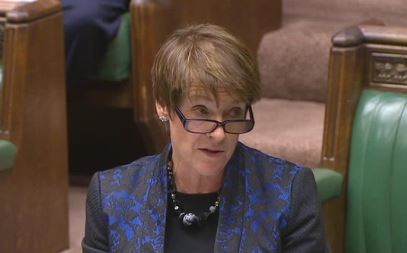
Bishop of Worcester asks Government about ‘real, substantial hope’ for Gaza

On 15th May 2018, Lord Ahmad repeated the answer to an urgent question asked in the House of Commons on violence at the Gaza border and its impact on the Middle East peace process. The Bishop of Worcester, the Rt Revd John Inge, responded:

The Lord Bishop of Worcester: My Lords, I am grateful to Her Majesty’s Government for the careful yet very specific response they have given to the appalling loss of life at the border between Gaza and the state of Israel yesterday. The thoughts and prayers of this Bench are with all those affected. It is good to know that the Minister supports an independent review of what happened. At the same time, will the Minister agree that, while the United Kingdom recognises the integrity of the border—and, indeed, of all Israel’s pre-1967 borders—and the security of Israel’s prosperous and pluriform society, the defence of its interests must offer tangible hope to those with whom it hopes to engage in dialogue? The phrase, “a glimmer of hope” was mentioned a moment ago. I was in Gaza about four years ago. The situation then was desperate ​and deteriorating. It is infinitely worse now. What real, substantial hope can be given to those who live in what is effectively a vast open prison? Continue reading “Bishop of Worcester asks Government about ‘real, substantial hope’ for Gaza”

Bishop of Southwark asks Government about Israel: Church of the Holy Sepulchre and Church Lands Bill

On 15th March 2018 the Bishop of Southwark, Rt Revd Christopher Chessun, received answers to six questions on Jerusalem, the  Church of the Holy Sepulchre and the Church Lands Bill:

The Lord Bishop of Southwark:  To ask Her Majesty’s Government, further to the Written Answer by Lord Ahmad of Wimbledon on 6 November 2017 (HL2966), what is their assessment of (1) the Status Quo as it refers to the relations between the Christian Communities of the Holy Land with the governments of that region, and (2) Her Majesty’s Government’s historic and current responsibilities in maintaining and defending that agreement. Continue reading “Bishop of Southwark asks Government about Israel: Church of the Holy Sepulchre and Church Lands Bill”

Archbishop of Canterbury asks about the importance of coexistence of the faiths in the Old City of Jerusalem

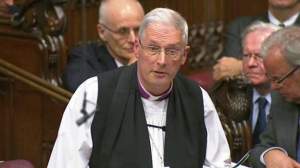
On 6th March 2018 Lord Polak asked Her Majesty’s Government “what action they are taking to promote coexistence between Israelis and Palestinians”. The Archbishop of Canterbury, Most Revd Justin Welby, asked a follow up question:
 

Continue reading “Archbishop of Canterbury asks about the importance of coexistence of the faiths in the Old City of Jerusalem”

Bishop of Southwark asks Government about humanitarian situation in Gaza

southwark-20feb17On 11th July 2017 the Bishop of Southwark, Rt Revd Christopher Chessun, received a written answer to a question on the supply of electricity in Palestine:
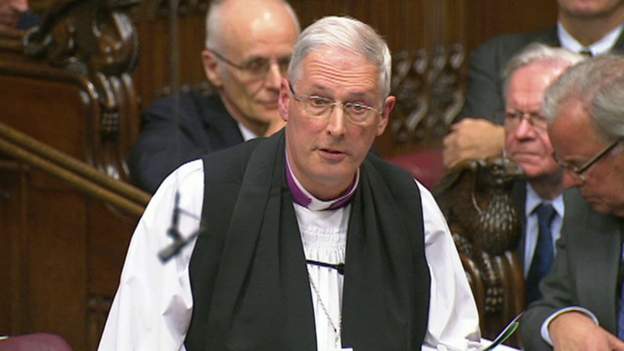
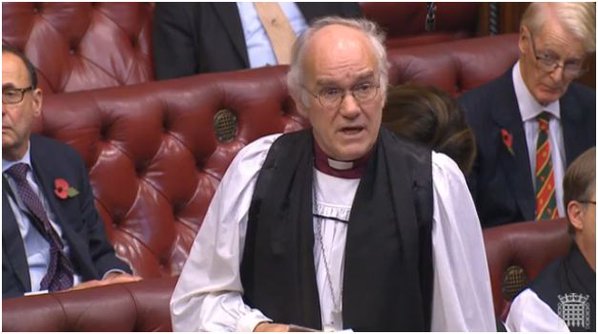
The Lord Bishop of Southwark: To ask Her Majesty’s Government, what steps they are taking to respond to the deteriorating humanitarian situation in Gaza, following the decision by the government of Israel to implement a request from the Palestinian Authority to reduce the flow of electricity supplies from Israel to Gaza. Continue reading “Bishop of Southwark asks Government about humanitarian situation in Gaza”

Bishop of Southwark asks Government about political reconciliation between Hamas and Fatah

On 11th July 2017 the Bishop of Southwark, Rt Revd Christopher Chessun, received a written answer to a question on political reconciliation in Palestine:

The Lord Bishop of Southwark: To ask Her Majesty’s Government what steps they are taking to encourage political reconciliation between Hamas and Fatah. Continue reading “Bishop of Southwark asks Government about political reconciliation between Hamas and Fatah”

Bishop of Chester on the Balfour Declaration

On 5th July 2017 the House of Lords held a short debate on a question from Lord Turnberg, “To ask Her Majesty’s Government what plans they have to mark the centenary of the Balfour Declaration in November.” The Bishop of Chester, Rt Revd Peter Forster, spoke in the debate.

The Lord Bishop of Chester: My Lords, I want to make two points in my two-penn’orth of time.

First, the Balfour Declaration did not arise in a vacuum and in part reflected the very considerable contribution made by Jewish people, mainly recent immigrants of course, to Britain and the then war effort. To take an obvious example, it was a Jewish chemist at the University of Manchester who devised a clever new way to manufacture acetone from sugar and carbohydrate. It was a vital chemical in short supply for the manufacture of cordite. That chemist, Chaim Weizmann, went on to become the first President of the State of Israel. Continue reading “Bishop of Chester on the Balfour Declaration”

Bishop of Worcester raises concerns about viability of two-state solution for Israel/Palestine

WorcesterOn the 3rd April 2017, Baroness Tonge asked the Government “what plans they have to commemorate the centenary of the Balfour Declaration.” The Bishop of Worcester, the Rt Revd John Inge, asked a follow-up question.

The Lord Bishop of Worcester: My Lords, will the Minister accept that there is grave concern about facts on the ground tending to suggest the impossibility of a two-state solution? Continue reading “Bishop of Worcester raises concerns about viability of two-state solution for Israel/Palestine”

Bishop of Winchester asks Government about access to healthcare for residents of the Occupied Territories

winchester171116

On the 28th March 2017 Baroness Sheehan asked a question about access to healthcare in East Jerusalem for residents from the Occupied Territories. The Bishop of Winchester, Rt Revd Tim Dakin, asked a supplementary question:

The Bishop of Winchester: My Lords, we have heard how the people of the Occupied Territories continue to face challenges accessing emergency care. The diocese of Jerusalem provides hospitals and health centres across this area, but many of the vital facilities and services are not fully operational because the equipment cannot be calibrated and staff lack accreditation. What conversations have Her Majesty’s Government had with the Israeli Government to facilitate the necessary inspections to ensure that these and similar facilities become operational and therefore reduce the reliance of Palestinian people on reaching hospitals in East Jerusalem?

Continue reading “Bishop of Winchester asks Government about access to healthcare for residents of the Occupied Territories”

Bishop of Leeds asks about direct aid to hospitals in Gaza strip

leeds-20117-bOn 21st March 2017, Lord Hylton asked Her Majesty’s Government what assessment they have made of the present state of public health in the Occupied Territories of Palestine; and the prospects for agreed international action, in particular action by Israel, to keep the Gaza Strip habitable. The Bishop of Leeds, the Rt Revd Nick Baines asked a supplementary question about direct aid from the UK to particular hospitals.

The Lord Bishop of Leeds My Lords, does the Minister agree that the health sector in the Gaza Strip is really on life support and that while the blockade remains and while there is a lack of public water, this will continue? Does he see any way of encouraging direct aid from the United Kingdom towards particular hospitals? There are two Anglican hospitals, for example, serving the whole community, often free of charge: the Al Ahli Arab Hospital; and the Al-Wafa Medical Rehabilitation Hospital, which has had to be relocated because of damage to St Luke’s Hospital in Nablus. These are beacons of hope in a fairly desperate place. Is there a way of enabling direct funding there as we continue to urge an end to the blockade? Continue reading “Bishop of Leeds asks about direct aid to hospitals in Gaza strip”

Church Commissioner questions: Israel/Palestine, human trafficking, prisons, social media, low carbon economy, tourism, lead theft

On 19th January 2017 the Second Church Estates Commissioner, Rt Hon Dame Caroline Spelman MP, answered questions in the House of Commons from MPs on Israel/Palestine, human trafficking, prisons, social media, low carbon economy, tourism and lead theft. The transcript is below:

spelman-190117b Continue reading “Church Commissioner questions: Israel/Palestine, human trafficking, prisons, social media, low carbon economy, tourism, lead theft”