
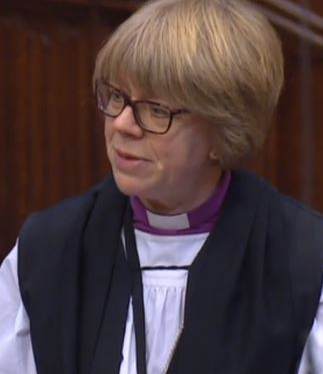
Bishop of London asks about prioritizing frontline patient care during NHS England transition

The Bishop of London asked a question on prioritising front line patient care during times of transition on 19th March 2025, following a government statement on NHS England:

The Lord Bishop of London: My Lords, I declare my interest as indicated by the noble Baroness, in that I am a former government Chief Nursing Officer. Following on from the noble Lord’s point, this is a very significant change not just to the NHS but to its workforce. We know from looking back that when there is a reorganisation of the NHS, attention and funds are distracted away from the front line and patient care. The announcement came on the same day as the publication of the NHS staff survey results, which highlighted that only 31% felt that there were enough staff to enable them to do their job, and that 45% felt unwell due to work-related stress. What action will the Government take to make sure that there is not a management distraction, through this reorganisation, away from the front line and patient care in particular? How will staff be supported during this transition, not least those who, I suspect, fear that their jobs are now under threat?

Continue reading “Bishop of London asks about prioritizing frontline patient care during NHS England transition”

Health & Care Bill: Bishop of London supports greater advocacy for patients

On 11th January 2022, the House of Lords debated the Health & Care Bill in committee. The Bishop of London spoke in the debate, supporting stronger voices for patients in the NHS, particularly in governing boards:

The Lord Bishop of London: My Lords, I declare my background as a former government Chief Nursing Officer and non-executive director of a number of healthcare trusts. I was not going to speak, but I have listened to noble Lords’ comments today and I come down with the noble Baroness, Lady Harding, in saying that we should not stipulate what skills are required of a board too tightly. What is in front of organisations changes over time, so the chair needs to be empowered to change. However, one caveat is that it would be wise to consider having somebody on the board with a background in patients. I speak from experience as a clinical professional: we can too easily forget the patient and to see things through their eyes. Far too often, we see things through the eyes of the clinician, which is not always in the best interest of patients.

Hansard


Bishop of London speaks during second reading of Health Service Safety Investigations Bill

London3On 29th October 2019 the House debated the second reading of the Health Service Safety Investigations Bill. The Bishop of London, Rt Revd Sarah Mullally, contributed:

The Lord Bishop of London: My Lords, I am grateful for the opportunity to speak at this Second Reading. I declare my interests as set out in the register. I too am grateful for briefings from the Library, the Royal College of Nursing, the Royal College of Surgeons and the Parliamentary and Health Service Ombudsman.

Like most noble Lords, I welcome the Bill’s proposal to create an independent body which will investigate serious patient safety incidents. The NHS is to be congratulated on the way in which it has sought over the years to develop as a learning organisation. Florence Nightingale said:

Continue reading “Bishop of London speaks during second reading of Health Service Safety Investigations Bill”