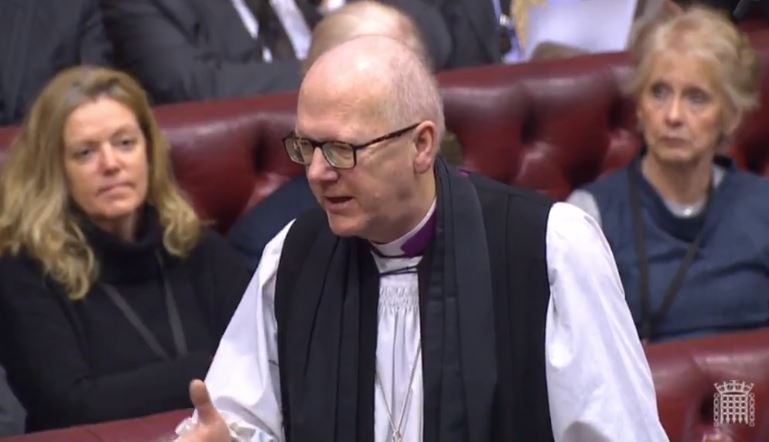
Bishop of Exeter asks about impact of litter on wildlife, costs of animal feed, and the effect of global warming on diseases contracted by trees

The Bishop of Exeter received the following written answers on 21st March 2023:

The Lord Bishop of Exeter asked His Majesty’s Government what assessment they have made of the impact of litter on wildlife.

Lord Benyon (Con): There is a systematic, proactive screening of potential new and emerging plant health risks. This includes consideration of changes which have the potential to affect the risk posed by non-native plant pests and pathogens to UK plants, both cultivated and in the wider environment. Pests and pathogens which are considered to pose a risk are prioritised for action in the UK Plant Health Risk Register. Risks are reviewed monthly by an expert group and Ministers, and prioritised for actions such as contingency plans in the event of an outbreak, pest risk analyses which can look in detail at potential risks associated with climatic factors, surveillance, enhanced inspection, regulation, national measures, import controls, research and awareness raising.  Actions and decisions are kept under review and would be reconsidered in light of new information concerning the pest or other factor which would change the risk to GB.

Continue reading “Bishop of Exeter asks about impact of litter on wildlife, costs of animal feed, and the effect of global warming on diseases contracted by trees”

Bishop of Exeter asks about private rented housing in rural areas

The Bishop of Exeter asked a question on the issue of privately rented accommodation in the south-west being bought up as Airbnbs, during a debate on conditions in the rented housing sector on 16th March 2023:

The Lord Bishop of Exeter: My Lords, there is an important rural dimension to this issue. In north Devon, the vast majority of privately rented property has been turned into Airbnb, creating a crisis in rural housing. Does the Minister think that the ability of local authorities to levy council tax is sufficiently robust to tackle this problem? If not, what plans do His Majesty’s Government have to legislate to address this problem, which is escalating every day?

Continue reading “Bishop of Exeter asks about private rented housing in rural areas”

Bishop of Exeter speaks on healthcare in rural areas

The Bishop of Exeter spoke in a debate on healthcare in rural areas on 23rd February 2023, emphasising the need to address challenges in staff retention in the NHS and the care service:

The Lord Bishop of Exeter: My Lords, I begin by thanking the noble Baroness, Lady McIntosh, for securing this important debate. We all acknowledge that the NHS is operating under enormous pressure at the present time. Perhaps inevitably, publicity focuses on our inner cities but, as we have been hearing this afternoon, rural communities are also pinch points. My own county of Devon has the second-oldest population in the country. We should not underestimate the challenge, both logistical and financial, of delivering healthcare to an ageing population, particularly in coastal communities and remote rural areas.

In his 2021 report on coastal communities and their patchy provision of medical services, the Chief Medical Officer for England observed that some

“of the most beautiful … and historically important places”,

including in the south-west region,

“have some of the worst health outcomes in England, with low life expectancy and high rates of many major diseases”.

Continue reading “Bishop of Exeter speaks on healthcare in rural areas”

Bishop of St Albans speaks in debate on healthcare in rural areas

The Bishop of St Albans took part in a debate on healthcare in rural areas on 23rd February 2023, highlighting issues of age, access and infrastructure:

The Lord Bishop of St Albans: My Lords, I thank the noble Baroness, Lady McIntosh, for obtaining this debate. She is a powerful champion for these issues; we are grateful that she continues to raise them. I also add my thanks to and appreciation of all those who work on the front line in our rural areas. They often have to drive huge distances, sometimes along quite difficult roads; it is not always easy and is certainly not always as wonderful as our memories of remote rural areas from our holidays. I declare my interest as president of the Rural Coalition.

Although many people in this country dream of retreating to the rural idyll that is deeply embedded in the English psyche, they do not always realise that, if their dream comes true, they may face many challenges in living in rural areas: poor access to banks and cash; patchy broadband; sporadic mobile signal; virtually non-existent public transport; and little childcare. Then, of course, there is the topic we are exploring today: the stresses on the healthcare system, which is primarily and unsurprisingly designed for an urban context. Rurality faces a unique challenge in the delivery of healthcare, demanding that the Government adopt a clear strategy for improvement. I welcome His Majesty’s Government’s promise to rural-proof our healthcare system; my hope is that that promise will be able to deliver what is needed.

Continue reading “Bishop of St Albans speaks in debate on healthcare in rural areas”

Bishop of St Albans asks about provision of services to rural areas

The Bishop of St Albans received the following written answers on 31st January 2023:

The Lord Bishop of St Albans asked His Majesty’s Government what steps they are taking to prevent the closure of rural bus routes.

Baroness Vere of Norbiton (Con): The Government has provided nearly £2 billion of support since March 2020 through emergency and recovery grants to mitigate the impacts of the pandemic on the bus sector. This includes a six-month extension to the Bus Recovery Grant to provide up to £130 million to continue supporting bus services in England outside London until the end of March of this year.

Continue reading “Bishop of St Albans asks about provision of services to rural areas”

Bishop of Exeter asks about crime prevention in rural areas

The Bishop of Exeter received the following written answers on 29th November 2022:

The Lord Bishop of Exeter asked His Majesty’s Government:

  • what assessment they have made of the rising levels of crime and low conviction rates in rural areas.
  • what consideration they have given to setting up rural crime units.
  • what steps they are taking to increase the conviction rate for rural crime.
  •  what guidance they plan to issue to farmers to protect themselves from violent crime.

Lord Benyon (Con): The Statistical Digest of Rural England, published in August 2022 by DEFRA, states “average crime rates (police recorded crime) are lower in rural areas than urban areas”. However, we recognise that some crimes are unique and specific to rural areas.

Continue reading “Bishop of Exeter asks about crime prevention in rural areas”

Church Commissioner Questions: Parish Ministry, Coronation, Rural Clergy, and Support over the Winter

On 17th November 2022, MPs put questions in the House of Commons to the Second Church Estates Commissioner, Andrew Selous MP:

Parish Ministry

Jerome Mayhew MP (Broadlands, Con):

2. What recent discussions he has had with the Church on strengthening its parish ministry.

Continue reading “Church Commissioner Questions: Parish Ministry, Coronation, Rural Clergy, and Support over the Winter”

Bishop of St Albans asks about the UK Infrastructure Bank

The Bishop of St Albans received the following written answer on 5th July 2022:

The Lord Bishop of St Albans asked Her Majesty’s Government whether the UK Infrastructure Bank, as a private company wholly owned by HM Treasury, will be subject to the same rural proofing guidance as government departments.

Baroness Penn (Con): The UK Infrastructure Bank has a dual mandate of supporting local and regional economic growth and tackling climate change, and it will support projects across the country. Its priority sectors include digital and clean energy infrastructure which may benefit rural areas in particular UKIB’s recently published Strategic Plan also notes that there are complex rural-urban disparities, and that infrastructure investment can help to address these.

Continue reading “Bishop of St Albans asks about the UK Infrastructure Bank”

Bishop of St Albans speaks in a debate on the UK Infrastructure Bank Bill

On 14th June 2022, the House of Lords debated the UK Infrastructure Bank Bill in committee. The Bishop of St Albans spoke in the debate:

The Lord Bishop of St Albans: My Lords, I declare my interest as a vice-president of the Local Government Association and president of the Rural Coalition. I shall speak to Amendment 9, which stands in my name, but I also want to give my broad support to Amendments 6 and 7, which also deal with regional inequalities, and to echo the importance of getting biodiversity and nature into the Bill.

It is telling that London, as the most productive region of the UK, receives a larger per capita amount of public spending compared to other regions of the UK. Productivity relies as much on public investment as it does on private investment but, at the same time, it makes sense economically, from a private perspective, to invest in those areas that receive significant public backing, particularly in areas such as transport. The reality is that government transport spending by region remains heavily skewed towards London, at nearly double the UK average. Hence, it certainly holds that public expenditure is a significant contributory factor to productivity, even if other factors, such as economies of scale and private investment, also play their part.

Continue reading “Bishop of St Albans speaks in a debate on the UK Infrastructure Bank Bill”

The Bishop of St Albans asks about food security

The Lord Bishop of St Albans

On 13th June 2022, the Bishop of St Albans tabled a question regarding food security and carbon emissions – the Bishop of Southwark spoke on his behalf:

The Lord Bishop of St Albans asked Her Majesty’s Government what assessment they have made of the effects on food security of allowing corporations to purchase arable land to offset their carbon emissions; and what plans they have to limit the amount of arable land that can be used for this purpose.

The Lord Bishop of Southwark

The Lord Bishop of Southwark: My Lords, I beg leave to ask the Question in the name of the right reverend Prelate the Bishop of St Albans, who has been unavoidably detained in his diocese and sends his apologies.

Lord Benyan (Con, Under-secretary of State – Department for Food, Environment and Rural Affairs): My Lords, I declare my farming interests as set out in the register. This Government are committed to safeguarding food security, as highlighted by the food strategy published today. I am very conscious of the issue raised, and we already have several protections in place, such as requirements for public consultations on any large new woodland as part of environmental impact assessments. I am also working closely with Her Majesty’s Treasury and BEIS to develop robust standards for green finance investments, and will set out the next steps in the forthcoming months.

Continue reading “The Bishop of St Albans asks about food security”