
Trade Bill: Bishop of Blackburn supports amendments on sustainable development goals, environmental, health and food standards

On 8th October 2020 the House of Lords considered the Government’s Trade Bill in committee. The Bishop of Blackburn spoke in support of amendments that would:

  • require parliamentary approval of both negotiating objectives and of free trade agreements before the UK becomes a signatory to any agreements, to safeguard food, environmental, animal welfare and health standards.
  • ensure trade agreements cannot be implemented, signed or ratified unless they are consistent with the provisions of the Sustainable Development Goals.

The Bishops’ speeches are below and the full text of the amendments beneath.

The Lord Bishop of Blackburn: My Lords, having made my maiden speech a week or so ago at Second Reading of the Bill, I am very grateful to the noble Lord, Lord Purvis, for proposing Amendment 35, to which I wish to speak, without, I have to say, the expertise of other contributors, but I shall speak in favour of the amendment on two counts, only simply, as I do not wish to repeat what has already has been said. Continue reading “Trade Bill: Bishop of Blackburn supports amendments on sustainable development goals, environmental, health and food standards”
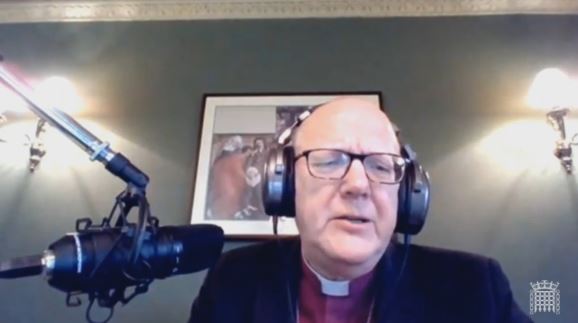
Trade Bill: Bishop of St Albans supports amendments to ensure trade deals meet standards on climate, environment, food and animal welfare

On 1st October 2020 the House of Lords considered the Government’s Trade Bill in Committee. The Bishop of St Albans, Rt Revd Alan Smith, spoke in support of amendments to the Bill to ensure that future trade agreements are fully compliant with international environmental obligations, and meet standards on animal welfare and food safety.

The Lord Bishop of St Albans [V]: I plan to speak mainly on Amendment 12, but I also support Amendment 40 and, particularly, Amendment 69 in this group [texts below]. Leaving the European Union should not mean leaving our international obligations. Recognition of those conventions mentioned under Amendment 12 is, one would imagine, already accounted for in the existing trade agreements due to be transposed into UK law as a result of this Bill. However, without this amendment, these remain an expectation not an assurance.

Continue reading “Trade Bill: Bishop of St Albans supports amendments to ensure trade deals meet standards on climate, environment, food and animal welfare”

Bishop of Birmingham asks Government about supply chains for all UK imports

On 14th July Lord Haskel asked Her Majesty’s Government “whether clauses (1) protecting human rights, and (2) maintaining environmental standards, will be inserted in the trade agreements being negotiated as a result of the United Kingdom’s departure from the European Union.” The Rt Revd David Urquhart, Bishop of Birmingham, asked a follow up question focusing on good working conditions.

The Lord Bishop of Birmingham: My Lords, just this week we have heard reports of poor working conditions and pay in factories in Leicester, but the UK is also heavily reliant on international supply chains. Will the Minister specify what steps the Government are taking to ensure that trade agreements insist that all UK imports are produced by workers with good conditions and dignified pay?

Continue reading “Bishop of Birmingham asks Government about supply chains for all UK imports”

Bishop of Carlisle asks Government about use of antibiotics in beef farming

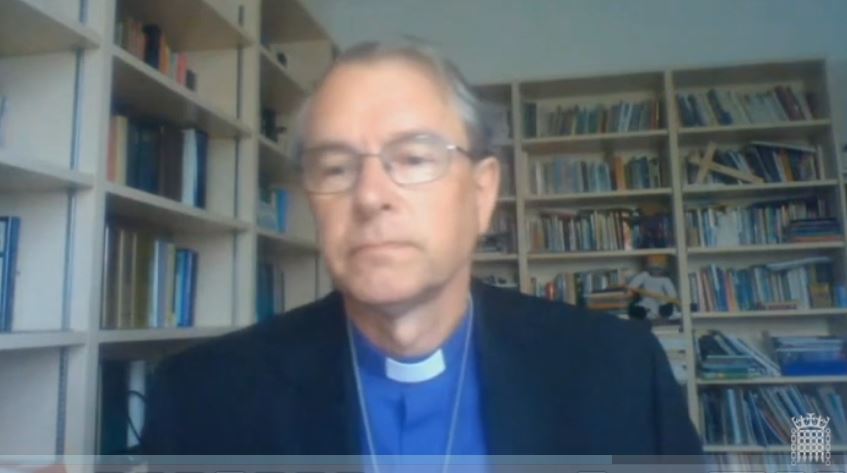
On 7th July Lord Lilley asked Her Majesty’s Government “what advice they give to British travellers to the United States of America on the risks of eating (1) chicken which has been subject to a pathogen reduction treatment, and (2) hormone-fed beef.” The Rt Revd James Newcome, Bishop of Carlisle, asked a follow up question focusing on the use of antibiotics amongst beef farmers in the United States.

The Lord Bishop of Carlisle: My Lords, I am grateful for what the Minister just said. Can he tell us whether Her Majesty’s Government have conducted any assessment of antibiotic use among beef farmers in the United States? If so, what might be the potential implications for public health of beef imports following any future trade deal?
Continue reading “Bishop of Carlisle asks Government about use of antibiotics in beef farming”

Bishops of Durham and St Albans debate international response to Covid-19

On 18th May 2020 a virtual sitting of the House of Lords debated a motion from Baroness Sugg, “That the Virtual Proceedings do consider the international response to COVID-19.” The Bishop of Durham, Rt Revd Paul Butler, and the Bishop of St Albans, Rt Revd Alan Smith, spoke in the debate:

20.04.30 Durham 2The Lord Bishop of Durham: My Lords, thankfully, the virus appears to be spreading slowly in most African countries, with Lesotho declaring its first case only last week. However, the World Bank forecasts that Covid-19 could push 49 million people into extreme poverty. The economic impact on some poorer nations could be more detrimental than the health threat. The aid Her Majesty’s Government committed at the international pledging event will be vital for the poorest nations, but our international response must be sustainable, which requires trade, not simply aid. What actions have Her Majesty’s Government taken to ensure that good free trade agreements are made with poorer nations?
Continue reading “Bishops of Durham and St Albans debate international response to Covid-19”

Bishop of Leeds asks Government about impact of US sanctions on Iran and migration

On 17th, 20th & 21st December 2018 the Bishop of Leeds, Rt Revd Nick Baines, received written answers to three questions about US sanctions on Iran and migration from Iran. 

The Lord Bishop of Leeds: To ask Her Majesty’s Government how many Iranian citizens made asylum applications in (1) 2015, (2) 2016, (3) 2017, and (4) 2018; and how many applications have been granted.

Continue reading “Bishop of Leeds asks Government about impact of US sanctions on Iran and migration”

Bishop of Leeds highlights importance of creative economy to post-Brexit trade

leeds-20117-bOn the 18th December 2017 Lord Whitty led a debate on the report of the European Union Committee – Brexit: trade in non-financial services (18th Report, Session 2016-17, HL Paper 135). The Bishop of Leeds, the Rt Revd Nick Baines spoke in the debate:

The Lord Bishop of Leeds: My Lords, I am no expert on the technical elements of trade in non-financial services, so have listened to speeches with both interest and admiration. Most of the points I wanted to make have already been made, so, given the time constraints, I will make a single point that lies behind the detail of the report—the reason why the frictionless movement of talent matters. I invite the Minister to note what I say, but not necessarily respond to it tonight.

Continue reading “Bishop of Leeds highlights importance of creative economy to post-Brexit trade”