
On 3rd November 2021, the Bishop of Newcastle gave her valedictory speech in the House of Lords, raising issues of economic planning and the impact of the government’s budget on poorer communities, and paying tribute to the North-East of England:
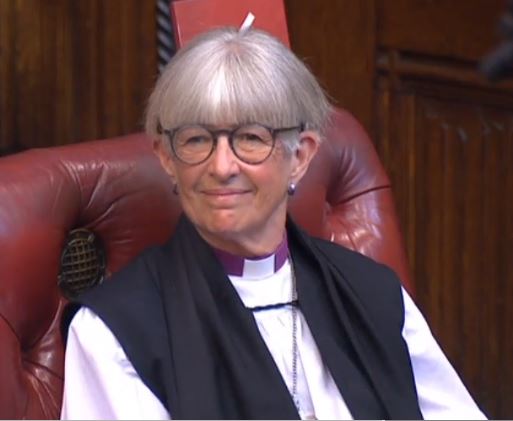
The Lord Bishop of Newcastle: My Lords, these past six years during which I have served as Bishop of Newcastle and as a Member of your Lordships’ House have, in a good way, been the most extraordinary years of my life. After a lifetime of living in the south, these six years in the north-east have helped me to see things from a different and much richer perspective.
The usual way to assess a Budget, the one we see in the newspapers, is to identify the winners and losers. I want strongly to resist this approach. When, aeons ago, I studied for my degree in economics, I learned that the way we spend our money shows what we value, what really matters to us. The question that matters is not what will I or we get out of this, but what kind of values does this Budget embrace—what is the moral framework undergirding it?
In Newcastle diocese I am well known—indeed, probably notorious—for citing the words of Archbishop William Temple, and references to him have not been unknown in speeches I have made in your Lordships’ House. I was therefore delighted to hear that Edward Heath shared my enthusiasm. He wrote that the impact of William Temple on his generation was immense and that the reason was not far to seek: William Temple was foremost among the leaders of the nation, temporal or spiritual, in posing challenging, radical questions about the nature of our society and its economic basis. Archbishop Temple did not often offer solutions, believing that the bishops lacked the technical expertise to do that, but he insisted that the answers to his questions had to be founded on a moral code. Archbishop Temple’s key priorities, were, first, that every child should find itself a member of a family housed with decency and dignity; secondly, that every child should have an opportunity of an education until years of maturity, which should make possible the full development of their aptitudes; and thirdly, that every citizen should be secure in possession of such income as would enable them to maintain a home and bring up children.
What would Temple make of the Budget we are debating today and what questions would he ask? Much of the Chancellor’s scope for making spending commitments depends on the forecast for economic growth, which is now expected to be 6.5% this year. Thinking of Temple’s priorities, and as chair of the North of Tyne Combined Authority Inclusive Economy Board, I believe the key question here is who will benefit from this growth. Experience suggests that the poorest are often left behind.
In terms of Temple’s priorities, there is much to welcome in this Budget, in particular the rise in the national living wage to £9.50 an hour, and it was so good to see Iain Duncan Smith’s satisfaction that the 8% cut in the universal credit taper rate at last gives us the universal credit system he designed. I also welcome the £1.7 billion levelling-up fund to be invested across the United Kingdom, which will begin to create greater interregional equity. I note that the levelling-up funding has so far focused on hard infrastructure, when we know that social infrastructure is needed as well if our communities are to flourish. I urge the Government to move further along the path of devolving funding to the regions and to trust regional and local government to make the best decisions for the areas and people they serve and know best.
One of my concerns about the Budget is that the poorest people in the world will continue to be impacted by the cut in foreign aid spending, which it seems will not be restored until at least 2024, and I remain deeply anxious for people who are on universal credit but not in work. This is a real concern in the north-east, with our relatively high level of unemployment. I understand, but nevertheless deeply regret, the Chancellor’s decision to remove the £20 a week uplift. This is a decision which hurts the most vulnerable, including many families with children.
This brings me to the question that concerns me most: are we doing the very best we can for our children and young people and the future flourishing of our country? The IFS analysis suggests that since 2010, health spending has increased by 40% while education spending will have increased by only 3%. As health spending disproportionately benefits people of my generation and older, this leads to an extraordinary and unacceptable situation of intergenerational injustice, which has been exacerbated by the pandemic. As a country we spend 5% of our GDP on education but 10% and rising on health. We should ask ourselves whether this is right. Increasing education spending will mean taking money away from something else, so there are no easy answers, but in the Temple tradition, I will not let that stop me asking to what extent we are prepared to invest in the future for our nation and our children, and what we are prepared to give up in order to achieve that.
In my maiden speech in your Lordships’ House, I said:
“The north-east is not a problem to be solved by the rest of the country but an asset to be valued.”—[Official Report, 25/5/16; col. 419.]
I have fallen deeply in love with the north-east, and most especially her people, who are warm, hospitable, proud and resilient. Human flourishing in all its forms, including economic flourishing, depends above all on our most precious resource—our people. The challenge to us as a nation is to invest in our people, particularly our young people, to equip them to thrive in the world they will live in.
I began my maiden speech by speaking of the wonderful kindness and warmth of welcome I received from your Lordships, the staff and all who work in this place. I conclude by saying that this early experience has been borne out in every way during my time here. I thank you all from the bottom of my heart and will hold your work deeply in my prayers.
Extracts from the speeches that followed:
Lord Lamont of Lerwick (Con): My Lords, it is an extreme pleasure to follow the right reverend Prelate. I have always believed that the Bishops make a very valuable contribution to this House, which was exemplified in the wonderful speech we heard a few moments ago. She said that she would have a different perspective since she came here from the north-east; I hope she will carry back the message that there are many people here working hard for the ideals she articulated and expressed so well. I am sure she will be missed by not just her colleagues but all of us.
Lord Londesborough (CB): My Lords, I should like briefly to focus on four key areas of the economy, all of which are connected: wage inflation, labour shortages, productivity and, finally, education. By way of quick introduction, since I am relatively new to this place, I should say that I am drawing chiefly on my own experience in the private sector—30 years as an entrepreneur and employer and the last seven years as an adviser and investor in start-ups. It is a particular pleasure to follow the former Chancellor of the Exchequer, the noble Lord, Lord Lamont of Lerwick, and, in her heartfelt valedictory speech, the right reverend Prelate the Bishop of Newcastle, whose comments I found myself endorsing.
(…)
Why we are lagging behind is a complicated question. I shall focus on the key area of education, to follow up the comments of the right reverend Prelate the Bishop of Newcastle. Yes, innovation and productive investment are crucial too, but there is no escaping the fact that if you do not educate and train your workforce sufficiently then productivity will suffer. It is here that, to me, the Budget Statement makes particularly disturbing reading. The Chancellor states, as the noble Lord, Lord Davies, mentioned, that per-pupil funding will return to 2010 levels in real terms by 2024-25. This follows more than a decade of austerity during which schools have suffered an 8% fall in real spending per pupil, so we are talking about 15 years to return to where we were in 2009. Yes, the Chancellor announced £1.8 billion extra for education recovery post pandemic, in addition to the £1.4 billion announced in June, but the total education recovery spend falls well short of the £15 billion that Boris Johnson’s own catch-up tsar, Kevan Collins, said was necessary before resigning from his post.
Perhaps the most striking contrast lies in the different paths for health and education spending. Since 2010, health spending has increased by more than 40%, while education overall will have seen a feeble rise of just 2%. I appreciate the huge health demands brought by an ageing population, the pandemic and the historic underfunding of the NHS, but this is not a balanced approach.
Education is not a short-term fix for productivity, but the longer we fail to invest in and develop the education and training of our workforce for the future, the longer it will take to achieve these badly needed productivity gains that ultimately underpin a higher wage economy. Without real economic growth, we run the risk of fuelling inflation and interest rates, inflicting further damage on living standards.
Lord Turnbull (CB): Before I sit down, I congratulate the right reverend Prelate the Bishop of Newcastle on her service in church and state. I was present for her maiden speech in March 2016. It was a breath of fresh air—vigorous and positive—and it led me to conclude that the bishops’ policy of retirement and refreshment may be one that other parts of the House ought to look at.
Lord Horam (Con): One area where I would be critical is that I do not think that we should have scrapped the £20 uplift in universal credit. I appreciate that the Chancellor has put in a taper, but only 38% of people who receive universal credit are in work. The remainder are out of work and they will lose substantially. The Treasury has said that it would cost a lot to keep the £20 uplift, but the fact is that the poor in this country are very poor and they face a bleak winter. I refer to the excellent speech by the right reverend Prelate the Bishop of Newcastle, in which she referred to the moral code. Archbishop Temple, while not putting in place any particular solutions because of his reluctance to get involved in the technicalities of how we deal with these things, referred to a moral code and, because of that, I think that he would have looked askance at the Government’s failure to keep the £20 extra for universal credit. It is a pity that they have done that; as a rich nation, we could and should have afforded it.
With that blemish, though, I none the less think that the Government’s overall strategy of meeting the extra spending that is necessary, and which will inevitably be followed by extra taxation, has been broadly right.
Baroness McIntosh of Pickering (Con): My Lords, I follow my noble friend in adding my congratulations to the right reverend Prelate the Bishop of Newcastle on not just her speech but, as others have commented, her years of service to the Church and her public service generally. I wish her every success. As a money spider has just walked over our papers, I strongly recommend that she buys a lottery ticket before the end of the week.
I will focus on two aspects. I note the right reverend Prelate’s remarks on Temple and add my request for everyone to have the right to a warm home. I am the honorary president of National Energy Action, which is based in Newcastle, in the north-east.
Lord Shipley (LD): My Lords, I pay tribute to the valedictory speech by my fellow Novocastrian the right reverend Prelate the Bishop of Newcastle. I express my thanks to her for her hard work both in this House and in her diocese, and for her work in addressing issues of inequality and disadvantage so effectively.
To be a success, the Budget depends on our economy expanding and interest rates remaining low. This strategy is very risky because businesses face rising costs, particularly in energy, and shortages in the supply chain and staff in some sectors, with inflation heading over 4%. The Government’s policy of spending now to reduce taxes later may prove hard to achieve. Indeed, the OBR forecast in March that if interest rates were 1% higher than forecast, additional debt interest of £20 billion a year would be needed, which would be twice that raised by the planned health and social care levy from next April.
“Employment is up, investment is growing, public services are improving, the public finances are stabilising and wages are rising”.—[Official Report, Commons, 27/10/21; col. 273-4.]
He failed to add that prices are rising, taxation is rising, and that low-income families are particularly exposed to that higher inflation and those rising taxes.
Baroness Kramer (LD): My Lords, I start with a sad farewell to the right reverend Prelate the Bishop of Newcastle. I hope that her words today on the importance of investing in our children will be heard by all parties and all sides—not only by those sitting in this debate but by their colleagues. The work that she has done in this area has been important in driving the thinking within this House—again, on all Benches. So I say farewell and thank you from all of us.
Lord Tunnicliffe (Lab): My Lords, I, too, thank the right reverend Prelate the Bishop of Newcastle for her speech and her contribution to our Chamber over the years. I particularly liked her focus on education as a key issue for our society to regard. I wish her well for the future. We are probably forgetting what our Chamber was like when we had only male bishops. Everything from the reading of the psalm to the breadth of speeches has improved as a result of our women bishops.
Lord Agnew of Oulton (Con, Treasury): The noble Lords, Lord Fox, Lord Desai, Lord Turnbull, Lord Rooker and Lord Tunnicliffe, and the right reverend Prelate the Bishop of Newcastle are all concerned about universal credit and I very much hear their concerns. However, the Government have always been clear that the £20 uplift was a temporary measure to support households whose incomes and earnings were affected by the economic shock of Covid. The taper means that 1.9 million working households will be able to keep substantially more of what they earn. That effectively represents a tax cut worth around £2.2 billion a year in 2022-23 for the lowest-paid in society.
(…)
The noble Lords, Lord Davies of Oldham and Lord Londesborough, and the right reverend Prelate the Bishop of Newcastle asked about educational recovery. The SR21 reaffirms and expands the Government’s commitment to helping the most disadvantaged pupils recover learning lost due to the pandemic, bringing total investment to specifically support educational recovery to £4.9 billion since the academic year 2020-21. It provides more than £3.2 billion over the SR period. This includes a £1 billion recovery premium for the next two academic years for schools. Primary schools will continue to benefit from an additional £145 per eligible pupil, while the amount for eligible pupils in secondary schools will nearly double. In broad terms, this will mean an average secondary school could attract around an additional £70,000 a year.
 The Church of England in Parliament
You must be logged in to post a comment.